

Mushroom glossary · Mushroom anatomy
What is a universal veil?
Also called: outer veil, velum universale
A universal veil is a temporary membrane that completely encloses the young fruiting body of some gilled mushrooms, making it look like an egg. As the mushroom grows the veil tears, leaving a cup-like volva at the stem base and patches or warts on the cap. It occurs in Amanita and Volvariella and is a useful clue in identification.
How does a universal veil form and break?
Some mushrooms look like a small white ball as they push out of the soil. At this stage the cap, gills and stem all sit inside one membrane, which protects them while they develop. As the mushroom expands and matures, the veil cannot hold and it ruptures.
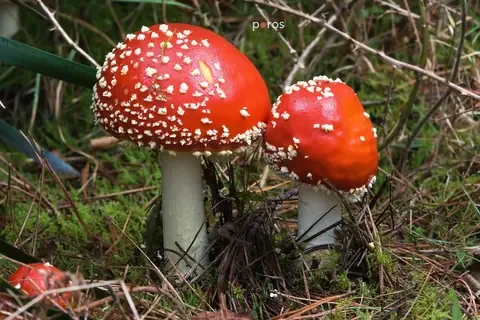
The lower part stays at the foot of the stem and is called the volva. The upper part may be carried up on the cap as patches or warts. The white spots on the red cap of the fly agaric are remnants of this veil, and rain can wash them off.
Universal veil or partial veil: what is the difference?
A universal veil wraps the whole mushroom from the outside. A partial veil runs only from the cap edge to the stem and covers the gills, and it may leave a ring on the stem when it tears. Some mushrooms have both, some have just one, and many have neither.
The skin around the young fruiting bodies of puffball-like fungi resembles a universal veil but has its own name, the peridium.
Why does the universal veil matter?
Its remnants are easy to see and carry real weight in classification. They matter most because of Amanita, a genus that holds a disproportionately high share of potentially lethal species. The death cap and the edible Caesar's mushroom both start life looking like a white egg.
The volva is often buried, so it is missed when a mushroom is cut off at ground level. Warts may have fallen and the volva may have broken away. For that reason neither the presence nor the absence of veil remains is enough on its own.
Pages related to Universal veil



Related terms
- VolvaThe sac at the base of some mushroom stems, left behind by the universal veil.
- Partial veilTissue covering the gills of a young mushroom from cap edge to stem, often leaving a ring.
- AnnulusThe ring of tissue on some mushroom stems, left behind by the partial veil.
- CapThe top part of a mushroom, which carries the spore-bearing surface on its underside.
- PrimordiumThe earliest visible beginning of a mushroom, a tiny knot of hyphae on the mycelium.
Frequently asked questions
Which mushrooms have a universal veil?
The best-known examples are in the genera Amanita and Volvariella. The death cap, fly agaric, Caesar's mushroom and paddy straw mushroom all develop inside one. Many other genera of mushrooms have neither a universal nor a partial veil.
Why are the spots on the cap sometimes missing?
The spots are pieces of veil left sitting on the cap, and rain can wash them away. A cap without spots does not show that the species lacks a universal veil. The cup at the stem base, the ring, the gills and other features have to be judged together.
Can a mushroom be identified at the egg stage?
While it is still closed, the cap colour, gills and ring cannot be seen, so identification is very difficult. Deadly Amanita species and edible ones look alike at this stage. The safest course is not to collect wild mushrooms in the egg stage at all.
Sources
- Wikipedia (EN) – Universal veil en.wikipedia.org
- Wikipedia (EN) – Partial veil en.wikipedia.org
- Wikipedia (EN) – Volva (mycology) en.wikipedia.org