Mushroom foraging in Turkey: is it allowed, and where?
The rules on picking mushrooms in Turkey's state forests and protected areas, routes to try, what to bring and who to show your finds to before eating.
In the wild 8 min read
We found no general rule in Turkey that regulates mushroom picking by name, but the Forest Law prohibits taking forest ground cover and medicinal or industrial plants from state forests without permission, and the National Parks Law forbids harvesting that disturbs the natural balance in protected areas. So before you go, ask the local forest management office, don't forage in protected areas, and get the owner's permission on private land. Never eat a mushroom you haven't identified.
Is mushroom picking allowed in Turkey?
We found no general provision that explicitly allows or bans mushroom picking; the rules depend on the legal status of the land. For state forests the key text is Forest Law No. 6831. Article 14(C) lists among prohibited acts in state forests the gathering and removal of acorn cups, linden flowers, all kinds of forest ground cover, oak galls, medicinal and industrial plants and forest seeds.
Mushrooms are not named in that clause. Whether they count as “forest ground cover” or “medicinal and industrial plants”, how picking a small amount for personal use is treated, and what permit commercial picking needs are decided in practice by the regional forest administration. So our advice is simple: before you go, ask the local forest management directorate or office. Picking to sell is a separate matter and should not be done without permission.
- State forest: Forest Law No. 6831 applies; ask the local forest management office.
- Protected area (national park, nature park, natural monument, nature reserve): National Parks Law No. 2873 applies; don't forage.
- Private land: get the owner's permission.
- Commercial picking: not without a permit; apply to the forest administration.
Can you pick mushrooms in national parks and nature parks?
Don't pick mushrooms in protected areas such as national parks and nature parks. Article 14 of National Parks Law No. 2873 states that the natural and ecological balance must not be disturbed in the areas it covers and that no forest products may be harvested in a way that disturbs the natural balance. The law covers national parks, nature parks, natural monuments and nature reserves.
Parts of a forest can be protected while other parts are ordinary state forest; signs or the site management will tell you which status a trail passes through. In a protected area, leaving the mushroom where it is and photographing it keeps you within the rules and gives you a good record for identification.
Where can you go mushroom foraging in Turkey?
Mushrooms appear mostly in autumn, on damp forest floors after rain, and which species grows where depends on the trees, the soil and the altitude. The saffron milk cap grows with pine, the death cap mostly with oak, and the Bolu kanlıca with fir. So the answer to “where?” is a forest type more than a place name.
We've collected routes from different regions of Turkey on our foraging routes page. Near Istanbul, see Belgrad Forest and, in Thrace, the Istranca (Yıldız) Mountains; for the western Black Sea, Bolu Yedigöller; for the Aegean, the Kaz Mountains; for the eastern Black Sea, the Kaçkar Mountains. We don't yet have a route page for Ankara and central Anatolia; see observation records by province on our Turkey mushroom map.
Timing matters as much as place. Our mushroom calendar shows which species appear in which month. The same forest can be empty in a dry autumn and full after a wet week.
If you are visiting an area for the first time, going with someone who knows it is the best guide to both paths and species. The species locals have picked for years may not be the ones you know, and a local name for an edible mushroom in one region can mean a different mushroom in another.
What should you take mushroom foraging?
Take a flat-bottomed basket, a small knife, waxed paper or paper bags to keep specimens apart, and a notebook or phone for notes. That is also the Missouri Department of Conservation's list; the same source notes that plastic shopping bags give little protection and speed up decay.
- Basket: flat-bottomed and airy, so mushrooms don't crush or sweat.
- Knife: a small pocketknife is enough for digging out the base and cleaning.
- Waxed paper or paper bags: to wrap each kind separately.
- Notes and photos: where it grew, the tree, single or clustered, colour, texture and smell.
- Suitable clothing and water: closed shoes for wet, slippery forest floors.
Don't use plastic bags: mushrooms sweat, crush and spoil quickly inside them.
How do you pick mushrooms: pull or cut?
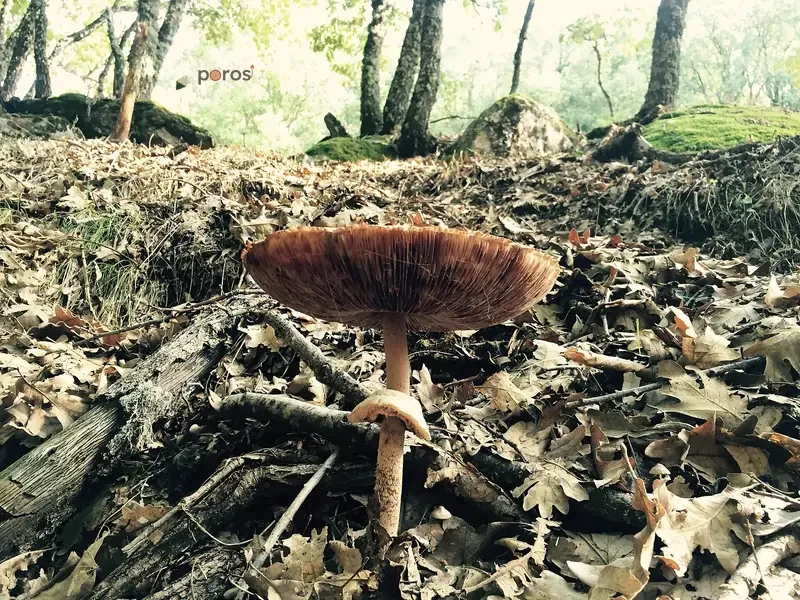
Pick an unfamiliar mushroom whole, base included, because the key to identification is often the part below ground. The Missouri Department of Conservation advises collecting the entire mushroom, including the base, by gently digging a little way from the stem. A cup-shaped base (volva), a root-like extension or attachment to buried wood can be decisive, and the bag-like volva of the deadly death cap is often hidden in the soil.
The same source's second rule is to keep each kind separate: wrap each mushroom in its own piece of waxed paper and keep known edibles apart from unknowns. If pieces of a single deadly mushroom mix with the rest of the basket, the whole basket becomes unsafe.
- Photograph the mushroom where it grows, together with the nearby tree.
- Loosen the soil with your knife a little way from the stem and lift the mushroom out with its base.
- Brush off soil and needles on the spot.
- Wrap the mushroom in its own paper and add a note of the place and tree.
- Close the hole you made and move on without trampling the area.
How do you forage without harming nature or yourself?
Foraging without harming nature means taking no more than you need, not trampling the forest floor and leaving unfamiliar mushrooms where they are. A mushroom picked for a photo and then thrown away gives the forest nothing; if you want to study an unknown species, take one and leave the rest.
The rules for not harming yourself are short too. Don't pick mushrooms by roadsides, at the sprayed edges of fields or on polluted ground; some species accumulate heavy metals. Don't taste-test your finds raw. The Swiss poison centre Tox Info Suisse notes that mushroom-control bodies advise against eating mushrooms raw.
- Pick only what you need; leave very old and rotting mushrooms in place.
- Don't trample the forest floor and seedlings when leaving the path.
- Don't pick by roadsides, sprayed field edges or polluted ground.
- Don't taste, crush to smell, or eat raw any mushroom you don't know.
- Bring your rubbish back; don't light fires in the forest.
Who should you show your finds to?
Show your finds to an experienced mushroom expert, members of a mushroom society or specialists in a university mycology department; an unidentified mushroom is not eaten. The Missouri Department of Conservation advises beginners to join workshops and forays, become a member of a mushroom club and show their finds to experts. In Switzerland this is done at official mushroom inspection points; according to Tox Info Suisse, the only safe way is to have mushrooms checked at one.
For a first idea you can use our identify by photo tool, but a photo is not enough to decide edibility. We collect similar poisonous species on our poisonous mushrooms page and general rules in how to tell if a mushroom is poisonous.
Don't rely on folk tests such as a silver spoon, onion or garlic; the Catalan health department states plainly that they do not work. If you suspect poisoning, call 112 without waiting for symptoms and contact the National Poison Information Centre on 114, taking any leftover mushrooms with you.
FAQ
Is mushroom picking illegal in Turkey?
We found no general provision banning mushrooms by name. But the Forest Law prohibits taking forest ground cover and medicinal or industrial plants from state forests without permission, and nothing that disturbs the natural balance may be harvested in national or nature parks. Ask the local forest management office before you pick.
Do you need a permit to pick mushrooms?
Commercial picking requires permission from the forest administration. How picking a small amount for personal use is treated is decided by the regional forest office; on private land you need the owner's permission.
Why use a basket instead of a bag?
In a plastic bag mushrooms sweat, crush and spoil quickly; the Missouri Department of Conservation also notes that bags speed up decay. A flat-bottomed basket is airy and lets you wrap and keep species separate.
Can you pick mushrooms in Belgrad Forest?
It depends on which part of the forest you are in. In sections with protected status, such as nature parks, the prohibitions of Law No. 2873 apply. Ask the forest management office responsible for the area before picking; our route page introduces the area.
Where are mushroom forays held in Turkey?
Mushroom societies, hiking groups and some university clubs run guided walks in autumn. For a beginner, the safest way to start is to forage with someone who knows mushrooms.
Should you pull or cut mushrooms?
Take an unfamiliar mushroom whole, with its base, by gently digging around it, because identification features such as the volva are below ground. Wrap each kind in its own paper.
Is mushroom hunting the same as foraging?
Yes. Mushroom hunting, mushroom picking, mushroom gathering and foraging all mean collecting wild mushrooms. We use foraging for the whole practice: learning species, going out in season, picking a little and identifying every mushroom before it reaches the kitchen.
Sources
- Mevzuat Bilgi Sistemi — 6831 sayılı Orman Kanunu mevzuat.gov.tr
- Mevzuat Bilgi Sistemi — 2873 sayılı Milli Parklar Kanunu mevzuat.gov.tr
- Missouri Department of Conservation — Mushroom hunting mdc.mo.gov
All sources (6)
- Wikipedia (EN) — Amanita phalloides en.wikipedia.org
- Tox Info Suisse — Toxic tales from daily life at the Tox: Mushrooms toxinfo.ch
- Generalitat de Catalunya — Health recommendations (mantar mevsimi) tramits.gencat.cat
Last updated: 2 November 2026