
Mushrooms by colour · 2 species
Black mushrooms
The best-known black mushroom is the black trumpet (Craterellus cornucopioides), an edible species. But some dark species, such as the common ink cap and the elfin saddle, can be poisonous, so a black colour is not a sign of safety.
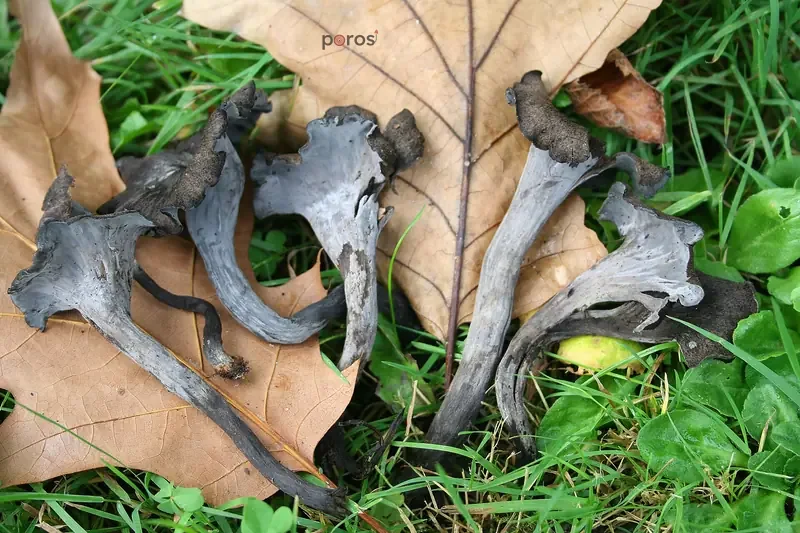

This page brings together mushrooms in black, charcoal and very dark brown tones. For a closer look at a single species, see our black trumpet page (borazan mantarı in Turkish): a hollow, black to grey funnel found under beech and oak.
Black is uncommon in mushrooms, and dark species are hard to spot in leaf litter. Some mushrooms also darken with age or as they dry: ink caps dissolve into black liquid, and the wood ear turns dark when dry.
Colour alone never tells you whether a mushroom is edible: the same colour includes both edible and poisonous species. To identify a black mushroom, look at the gills or their absence, the stem, the spore print and where it grows.
Black mushrooms: edible or poisonous, and when?
| Mushroom | Status | Season |
|---|---|---|
| Black trumpetCraterellus cornucopioides | Edible species | Aug–Jan |
| Magpie inkcapCoprinopsis picacea | Inedible | Oct–Jan |
The status column is a guide and is not enough to decide to eat a mushroom. Do not eat a wild mushroom unless an expert has seen it in person. Edible mushrooms · Poisonous mushrooms
Poisonous lookalikes of the same colour
The common ink cap (Coprinopsis atramentaria) has a grey-brown cap that turns into black ink with age. Eaten with alcohol, or even followed by alcohol days later, it causes poisoning.
The elfin saddle (Helvella lacunosa) has a black-grey, folded cap and a ribbed stem; it can cause poisoning when eaten raw or undercooked. The dark brown, brain-like false morel (Gyromitra esculenta) can be deadly.
If poisoning is suspected in Türkiye, call 112 or the National Poison Information Centre (114) straight away, and keep a piece of the mushroom if you can.
Types of black mushrooms
In this encyclopedia the edible black trumpet (Craterellus cornucopioides) leads the black group. The similar ashen chanterelle (Craterellus cinereus) is also edible, while the devil's urn (Urnula craterium) is not worth eating. Each species has its own page with details.
Why gills and stem matter
The black trumpet has no gills: its outer surface is smooth or slightly wrinkled and it is a hollow tube. The ink cap has crowded gills that liquefy, and the elfin saddle has a ribbed, chambered stem. These are clues, not a firm identification.
Frequently asked questions
Are black mushrooms edible?
The black trumpet (Craterellus cornucopioides) is edible, but should not be eaten without expert identification. Other dark species, such as the common ink cap and the elfin saddle, can be poisonous.
Which mushrooms are black?
The best known is the black trumpet, also called horn of plenty. The ashen chanterelle, devil's urn, elfin saddle and ink caps, which blacken with age, are dark too.
Are black mushrooms poisonous?
Black is not a sign of poison on its own; the edible black trumpet is black. But the common ink cap is toxic with alcohol and the elfin saddle is poisonous raw. Rely on firm identification of the species, not colour.
How do you tell a black trumpet from an ink cap?
The black trumpet has no gills and is a hollow funnel. The ink cap has crowded gills and a distinct stem, and dissolves into black liquid with age. These are clues; a firm identification is a job for an expert.
Is a black truffle a black mushroom?
Black truffles (Tuber species) grow underground as tubers with a black skin and have no cap or stem. This page covers black mushrooms that grow above ground with a cap or funnel.
I ate a black mushroom. What should I do?
If poisoning is suspected in Türkiye, call 112 or the National Poison Information Centre (114) straight away, and keep a piece of the mushroom if you can. Symptoms can start hours later.
Sources
- Wikipedia (EN): Craterellus cornucopioides en.wikipedia.org
- First Nature: Craterellus cornucopioides first-nature.com
- Wikipedia (EN): Coprinopsis atramentaria en.wikipedia.org
All sources (5)
- Wikipedia (EN): Helvella lacunosa en.wikipedia.org
- Wikipedia (EN): Gyromitra esculenta en.wikipedia.org
Other colours
Last updated: Prepared by the Poros Mantar editorial teamReport a correction