



Box, stage and plate photos are illustrative. Packaging may vary by batch.
Product details
Taste and texture: Mild and earthy; dried and brewed as a tea.
- Species
- Cordyceps militaris
- Maker
- evdemantar
- Difficulty
- Medium
- Delivery
- Confirmed by email
How does it grow?
How to use the Cordyceps kit at home, day by day
First harvest around weeks 6–9. Expect 1 flush(es) per block. Timings are ranges and shift with room temperature and humidity.
-
Day 0
1. Unpack, lift out the jar
Open the window and lift out the small jar. The filter lid stays on: the rice substrate is sterile and opening it invites mould. Cordyceps needs no scoring and no misting.
Temperature, humidity, watering, problems
- Temperature
- 20–22 °C
- Humidity
- Kavanoz içi
- Watering
- No water, lid on
- What you see
- Yellowish rice and a filter lid
A loose lid: Tighten it but never cover the filter; it lets the jar breathe.
-
 Weeks 1–2
2. Colonise in the dark
Keep the jar in a dark, closed cupboard. White mycelium wraps the rice (7–10 days).
Temperature, humidity, watering, problems
- Temperature
- 20–25 °C
- Humidity
- Kavanoz içi
- Watering
- No water
- What you see
- The rice turning white
Green or black patch: Discard it without opening; that is mould.
-
 Weeks 3–4
3. Into the light: orange shoots
Move the jar to a bright shelf out of the sun; it needs 12–16 hours of light a day (a lamp is fine). The surface turns orange and small knots appear.
Temperature, humidity, watering, problems
- Temperature
- 18–22 °C
- Humidity
- Kavanoz içi
- Watering
- No water
- What you see
- Orange surface and knots
Pale, thin shoots: Too little light: move it brighter and for longer.
-
 Weeks 5–8
4. Maturing
Knots grow into finger-like shoots 3–8 cm tall. Do not move the jar and keep it away from heat.
Temperature, humidity, watering, problems
- Temperature
- 18–22 °C
- Humidity
- Kavanoz içi
- Watering
- No water
- What you see
- Club-shaped orange shoots
Condensation on the lid: Normal; if the temperature swings, change the shelf.
-
Weeks 6–9
5. Harvest: cut at the base
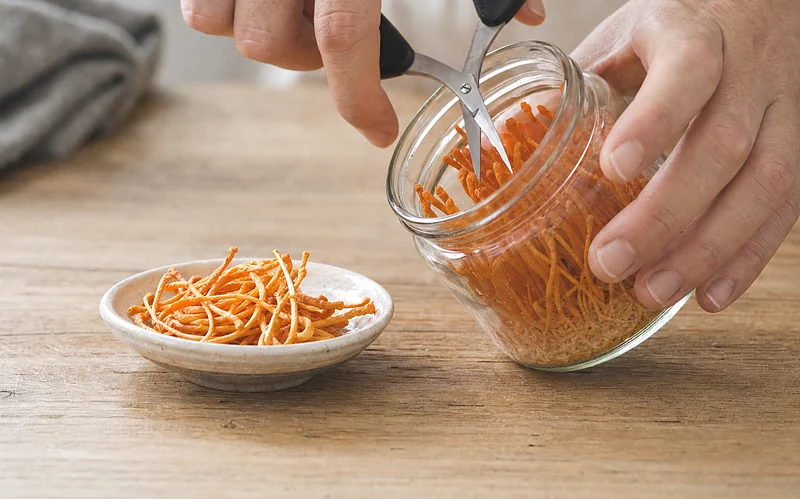
When the tips thicken a little and growth slows, open the lid and cut the shoots at the base with clean scissors. The kit gives one harvest; no second flush.
Temperature, humidity, watering, problems
- Temperature
- Oda sıcaklığı
- Humidity
- Oda nemi
- Watering
- No water
- What you see
- Bright orange shoots, 3–8 cm
Shoots stayed short: Too few hours of light; wait another week.
-
After harvest
6. Dry and brew like tea
Dry the shoots somewhere airy and store in glass. You can steep them in hot water. We make no health claims.
Temperature, humidity, watering, problems
- Temperature
- Oda sıcaklığı
- Humidity
- Kuru ortam
- Watering
- No water
- What you see
- Brittle orange threads when dry
Shoots stayed soft: Dry for longer; do not store damp.
Stage photos are illustrative.
Watch it
The kit step by step: source videos
Picked from growing channels; where we use a Turkish video it is marked. Videos belong to their channels.
Care guide
The right conditions and what to watch for
- Temperature
- 18–22 °C (20–25 °C to colonise)
- Humidity
- Jar closed, filter lid
- Light
- Dark to colonise, then 12–16 hours of light a day
- Air
- Keep the lid on; the filter lets it breathe
Things to watch
- Keep the jar out of direct sun and away from heat; use indirect light or a lamp.
- No water, no misting and no cutting.
- Opening the jar invites mould; keep it closed until harvest.
- Do not cover the lid filter; the jar breathes through it.
Problems and fixes
- Pale, thin shoots
- Too little light: move the jar somewhere brighter.
Contamination
Contamination variations in the Cordyceps grow kit
Mould or normal? Coloured moulds, cobweb, dry bubble and gnats next to the normal things that look like mould. Details and fixes in the guide.
 Green mould (Trichoderma)Vicenny · CC BY-SA 4.0
 Blue-green mould (Penicillium)Luis Fernández García · CC BY-SA 4.0
 Black mould (Rhizopus)Nikolai Bulykin · CC BY-SA 4.0
 Cobweb (Cladobotryum)An et al. (2022) · CC BY 4.0
 Dry bubble (Verticillium)(c) Brian Hunt, some rights reserved (CC BY) · CC BY 4.0
 Fungus gnatJohn Tann from Sydney, Australia · CC BY 2.0
 Healthy mycelium (normal)Rob Hille · CC BY-SA 3.0
 Cotton-like fuzz (normal)Rickproser · CC BY-SA 3.0
 Spore dust (normal)Keeblur · CC BY-SA 3.0
About the Cordyceps grow kit
About this product
Cordyceps (Cordyceps militaris) comes on a rice-based substrate in a glass jar. Over a few weeks you watch bright orange, club-shaped shoots rise inside the jar.
Cordyceps needs light; it takes its best colour on a cool, bright shelf. Harvested shoots are dried and brewed as a tea.
What conditions does it like?
- Temperature: 18–22 °C (20–25 °C to colonise)
- Humidity: Jar closed, filter lid
- Light: Dark to colonise, then 12–16 hours of light a day
- Air: Keep the lid on; the filter lets it breathe
Sources
- Cordyceps militaris Commercial Cultivation Technology, Hindistan PSA/ICAR özeti (35–40 günde meyve)
- Naresuan Üniversitesi Fen Dergisi, Cordyceps militaris pirinçte kültür (karanlıkta 7–10 gün, 12–16 saat ışık)
- GUIDE, SOP Cordyceps militaris cultivation (18–22 °C, yüksek nem, günde 12 saat dolaylı ışık)
- Paul Stamets, Growing Gourmet and Medicinal Mushrooms, 3. baskı, Ten Speed Press (türlerin büyüme parametreleri)
Other mushroom grow kits
Mushroom grow kits
The easiest place to start: open the box, mist twice a day, first cluster in about two weeks.
900 ₺Difficulty 1/3

Coral pink, fast and showy; a tropical oyster that loves a warm home.
1.080 ₺Difficulty 1/3

Lemon-yellow clusters that open like flowers; the most cheerful kit we make.
1.080 ₺Difficulty 1/3

Woody and full of umami; a kit that asks for some patience and pays it back.
1.500 ₺Difficulty 2/3

 Day 0
Day 14
Corporate gift kit
This year, give your team a good experience
A closed box today, a small forest bursting from the desk two weeks later. It teaches something and ends as a good memory at the table.
- Box, ribbon and card with Poros and your logo
- Day 0 → first harvest in about 2 weeks
- Care card in Turkish and English
1.000 ₺ per person