

Mushroom glossary · Mushroom anatomy
What are pores?
Also called: tubes, pore surface
Pores are the small holes on the underside of boletes and polypores. Each pore is the mouth of a short tube that opens downwards, and the inner walls of the tubes are lined with spore-producing cells. In these fungi a layer of closely packed tubes does the job that gills do in gilled mushrooms.
What do pores do?
The underside of the cap is a mass of closely packed vertical tubes. Their inner walls are lined with basidia, and this is where the spores are produced. Ripe spores drop down the tube and out through the pore. Slice the mushroom from top to bottom and the tubes show as parallel lines beneath the flesh of the cap.
Which fungi have pores?
Two large groups have them. Boletes are fleshy and have a stem, and the tube layer under the cap is spongy. In the cep the pores are white when young, then yellow and at last olive green.
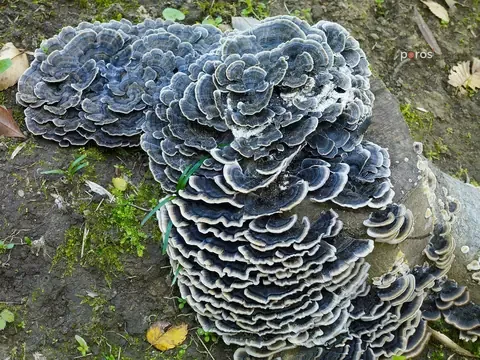
Polypores mostly grow on wood as brackets and are tough, from corky to woody. The hoof fungus and turkey tail belong here. The name polypore comes from the Greek for many pores. In the beefsteak fungus the tubes stand separate from one another.
How are pores used in identification?
You note the colour of the pores, their size and how they react to pressure. In some species they are easy to see with the naked eye, in others you need a hand lens. The devil's bolete has red pores that turn blue when pressed. Most poisonous boletes have red pores. The reverse does not hold. Yellow or white pores do not make a mushroom safe, and pore features are not enough on their own.
Pages related to Pores


Related terms
- HymeniumThe thin, fertile layer of cells on a fruiting body where the spores are produced.
- BasidiumThe microscopic, club-shaped cell that bears the spores of basidiomycete fungi on its tip.
- GillsThe thin, spore-bearing plates that radiate under the cap of many mushrooms.
- CapThe top part of a mushroom, which carries the spore-bearing surface on its underside.
- Spore printThe powdery deposit of spores a mushroom cap drops on paper, used for its colour in identification.
Frequently asked questions
What is the difference between pores and gills?
Gills are thin plates that radiate under the cap. Pores are the mouths of vertical tubes, so the underside looks like a sponge full of holes. Both carry the spore-producing surface and differ only in form.
Can mushrooms with pores be poisonous?
Yes. The devil's bolete has pores and is poisonous. Having pores does not make a mushroom safe. The boletes include poisonous and very bitter species, so pore colour, stem pattern and flesh colour are all weighed together.
Are tubes and pores the same thing?
Close, but not quite. The tube is the whole vertical channel under the cap, and the pore is its opening on the lower surface. In the hoof fungus and turkey tail the pores are tiny, with several to a millimetre.
Sources
- Australian National Botanic Gardens – Boletes & Polypores anbg.gov.au
- Australian National Botanic Gardens – Types of fruiting bodies: boletes & polypores anbg.gov.au
- Wikipedia (EN) – Bolete en.wikipedia.org
All sources (4)
- Wikipedia (EN) – Polypore en.wikipedia.org