
Dead man’s fingers (dead man's fingers)
Xylaria polymorpha · Xylariaceae

Dead man's fingers (Xylaria polymorpha) is a hard, black, finger- or club-shaped fungus 3–10 cm tall that rises from the base of rotting hardwood stumps; a group of them looks like black fingers poking out of the ground. When young it is dusted bluish-grey to white. The flesh is white and tough; it is not edible.
Also called: dead man's fingers Turkish: Xylaria polymorpha Synonyms: Sphaeria polymorpha
Last updated: Prepared by the Poros Mantar editorial team5 sources checkedReport a correction
Dead man’s fingers photos
-
© Nova Patch · CC BY-SA 4.0
-

© aarongunnar · CC BY 4.0
-

© Bethany Teigen · CC0
-

© Ken Kneidel · CC0
-

© Christian Kahle · CC0
-

© Senna Bryce Robeson · CC BY 4.0
-

© Jackson Kusack · CC0
-

© Julia Beach · CC BY 4.0
-
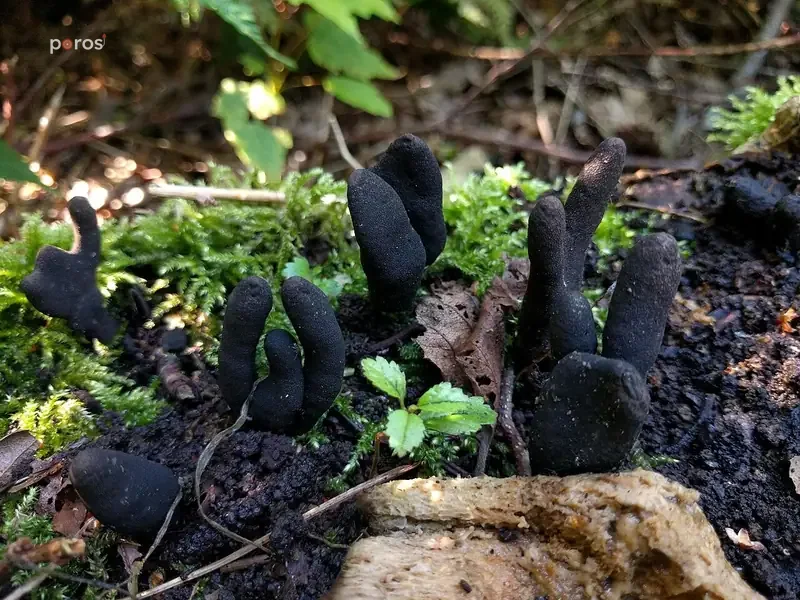
In habitat© Michel Langeveld · CC BY-SA 4.0
-

Stem© Christine · CC BY 4.0
-

© Anne Parker · CC BY 4.0


These are licensed records of this species; photos alone are not enough to identify a mushroom.
Is the dead man's fingers poisonous?
Dead man's fingers is not known to be poisonous, but it is hard and not edible. If poisoning is suspected, call 112 at once (Turkish poison centre: 114) and keep any leftover mushroom.
Is the dead man's fingers edible?
No. It is hard and not edible; it is not known to be poisonous.
How to recognise it
Appearance of dead man's fingers
No ring or volva Spore print: Black Not distinctive.
When and where
When to find dead man's fingers
May
The fruit bodies appear in spring and persist for months. The single Turkish GBIF record is from May.
Where does dead man's fingers grow?
It grows, usually in groups, at the base of rotting hardwood stumps and on buried wood, especially beech and maple.
In Turkey
GBIF holds 1 Turkish record, without a province. The records are from May.
GBIF lists 1 records from Turkey; none yet has verified coordinates for our map.
Look-alikes
What could it be confused with?
Dead man’s fingers can be mistaken for the species below. Each comparison shows Dead man’s fingers on the left, the look-alike on the right, and how to tell them apart.

Candlesnuff fungus Xylaria hypoxylon
How to tell The candlesnuff fungus is slimmer, often forked, with white-powdery tips.
Earth tongues Geoglossum spp.
How to tell Earth tongues are also black and club-shaped, but soft and flattened like a tongue, and grow in grassland soil rather than on wood.
Dead man's fingers is not known to be poisonous, but it is hard and not edible. If poisoning is suspected, call 112 or the Turkish poison centre (114).
Frequently asked questions
Is the dead man's fingers poisonous?
Dead man's fingers is not known to be poisonous, but it is hard and not edible. If poisoning is suspected, call 112 at once (Turkish poison centre: 114) and keep any leftover mushroom.
Is the dead man's fingers edible?
No. It is hard and not edible; it is not known to be poisonous.
How do you identify it?
Hard, black, finger- or club-shaped bodies with a rough surface rising from the base of a rotting stump; white inside when cut.
What can it be confused with?
The main look-alikes are: Candlesnuff fungus, Earth tongues. The differences are listed in the look-alikes section; with poisonous look-alikes, always check the cross-section and habitat.
Where does it grow?
It grows, usually in groups, at the base of rotting hardwood stumps and on buried wood, especially beech and maple.
When does it appear?
The fruit bodies appear in spring and persist for months. The single Turkish GBIF record is from May.
Why is it white inside?
Only the outer crust is black; the white, hard tissue inside is the body of the fungus. Sexual spores form in tiny chambers just under the crust.
Is it found in Turkey?
Records are very scarce: GBIF holds a single Turkish record from May 2024 without a province; iNaturalist has no research-grade Turkish observation.
When is dead man's fingers season in Turkey?
In our calendar, dead man's fingers season runs May. The fruit bodies appear in spring and persist for months. The single Turkish GBIF record is from May.
Where does dead man's fingers grow?
It grows, usually in groups, at the base of rotting hardwood stumps and on buried wood, especially beech and maple.
Where is dead man's fingers found in Turkey?
GBIF holds 1 Turkish record, without a province. The records are from May.
What can dead man's fingers be confused with?
Dead man's fingers can be confused with candlesnuff fungus (Xylaria hypoxylon, inedible) and earth tongues (Geoglossum spp., inedible). Look-alikes are compared on this page.
What is dead man's fingers called in Turkish?
In Turkish, dead man's fingers (Xylaria polymorpha) is called Xylaria polymorpha.
Related species
-
Candlesnuff fungusXylaria hypoxylonInedible
-
 Amethyst deceiverLaccaria amethystinaInedible
-
 Anemone stinkhornAseroe rubraInedible
-
 Artist’s bracketGanoderma applanatumInedible
-
 Barometer earthstarAstraeus hygrometricusInedible
-
 Birch polyporeFomitopsis betulinaInedible
-
 Bitter boleteTylopilus felleusInedible
-
 Bitter oysterPanellus stipticusInedible
Sources
- Wikipedia (EN): Xylaria polymorpha en.wikipedia.org
- iNaturalist: Xylaria polymorpha (takson, adlar ve fotoğraflar) inaturalist.org
- GBIF: Xylaria polymorpha gbif.org
All sources (5)
- GBIF: Türkiye kayıtları gbif.org
- iNaturalist: Türkiye gözlemleri (araştırma düzeyi) inaturalist.org
Photo credits (11)
- Xylaria polymorpha · iNaturalist #12913671 · Nova Patch · CC BY-SA 4.0
- Xylaria polymorpha · iNaturalist #28599457 · aarongunnar · CC BY 4.0
- Xylaria polymorpha · iNaturalist #217134047 · Bethany Teigen · CC0
- Xylaria polymorpha · iNaturalist #118551928 · Ken Kneidel · CC0
- Xylaria polymorpha · iNaturalist #30705107 · Christian Kahle · CC0
- Xylaria polymorpha · iNaturalist #214294328 · Senna Bryce Robeson · CC BY 4.0
- Xylaria polymorpha · iNaturalist #132964233 · Jackson Kusack · CC0
- Xylaria polymorpha · iNaturalist #50113487 · Julia Beach · CC BY 4.0
- File:Xylaria polymorpha 147218869.jpg · Michel Langeveld · CC BY-SA 4.0
- File:Xylaria polymorpha 108738158.jpg · Christine · CC BY 4.0
- Xylaria polymorpha · iNaturalist #161905009 · Anne Parker · CC BY 4.0

