
Flying saucer mushroom (blue angel)
Psilocybe azurescens · Hymenogastraceae

A mushroom with a chestnut to caramel cap and a broad, persistent bump that fades to straw colour as it dries, and which bruises deep blue. In the wild it is confined to the Oregon and Washington coast of the United States. It is among the species with the highest reported psilocybin content. It is one of the so-called magic mushrooms. This page is for identification and warning only.
Also called: flying saucer mushroom, blue angel Turkish: Psilocybe azurescens
Last updated: Prepared by the Poros Mantar editorial team9 sources checkedReport a correction
Flying saucer mushroom photos
-
© Alan Rockefeller · CC BY 4.0
-

Cap© Alan Rockefeller · CC BY 4.0
-

Gills© Alan Rockefeller · CC BY 4.0
-

Stem© Alan Rockefeller · CC BY 4.0
-

Spore print© Alan Rockefeller · CC BY 4.0
-
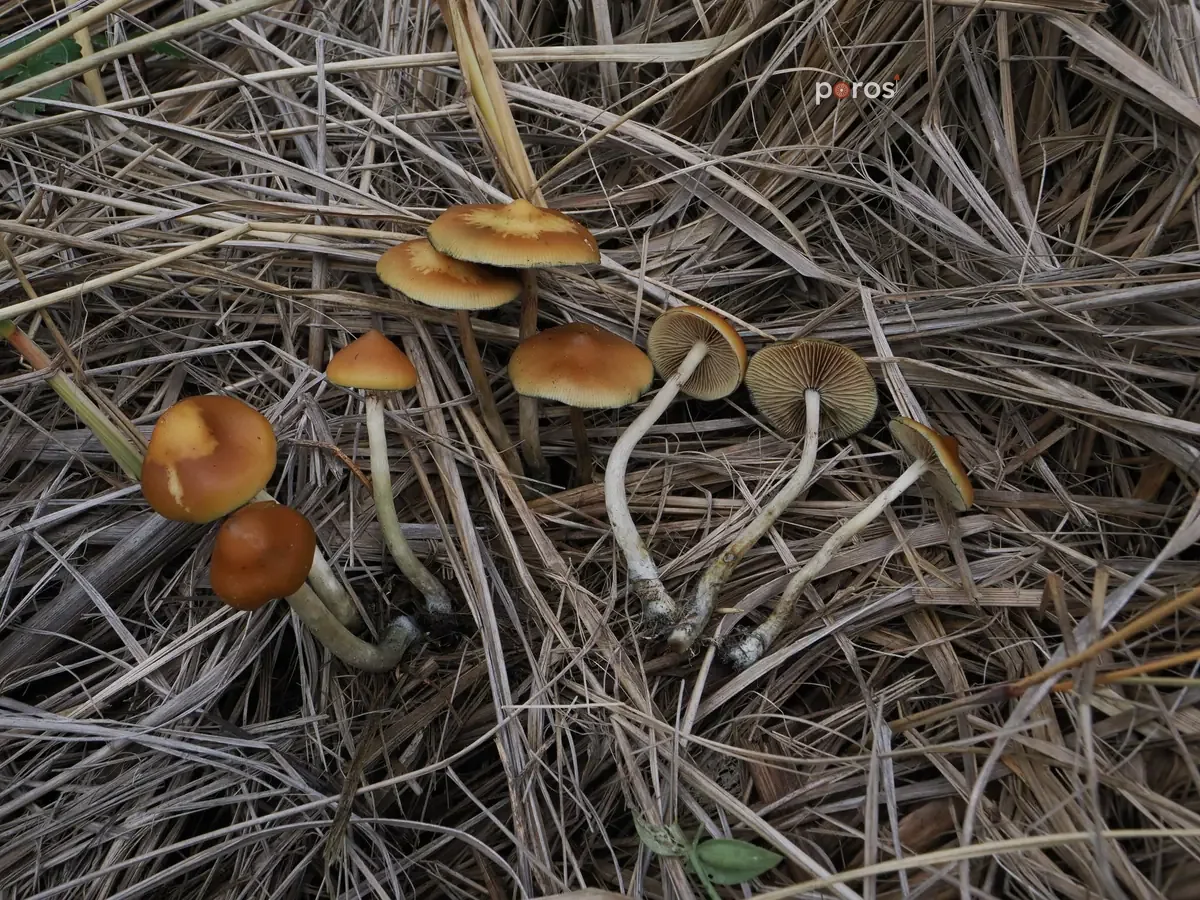
In habitat© Alan Rockefeller · CC BY 4.0
-

Cap© Alan Rockefeller · CC BY 4.0
-

© moorebuesing · CC0
These are licensed records of this species; photos alone are not enough to identify a mushroom.
Are flying saucer mushrooms poisonous?
Not safe: flying saucer mushrooms contain psilocybin and psilocin and are legally controlled. The deadly risk is confusion with small brown look-alikes: deadly galerina (Galerina marginata). If poisoning is suspected, call 112 at once (Turkish poison centre: 114) and keep any leftover mushroom.
Are flying saucer mushrooms edible?
No, flying saucer mushrooms are not a food. Psilocybin and psilocin are Schedule I substances under the UN 1971 Convention; in Turkey, picking or possessing them may be a crime (Penal Code arts. 188 and 191). This page is for identification and warning only. If poisoning is suspected, call 112 at once (Turkish poison centre: 114) and keep any leftover mushroom.
How to recognise it
Appearance of flying saucer mushrooms
No volva Spore print: Dark purplish brown to purplish black Never taste it.
Where do flying saucer mushrooms grow?
In clusters on hardwood chips and in sandy soil rich in woody debris, often among coastal dune grasses, centred on the Columbia River delta (Oregon, Washington).
In Turkey
There are no records in Turkey; its natural range is the west coast of North America. A few feral specimens have been reported in Stuttgart, Germany (Wikipedia).
Our map has no observations of flying saucer mushrooms from Turkey yet.
Look-alikes
What is it mistaken for?
Flying saucer mushroom can be mistaken for the species below. Each comparison shows Flying saucer mushroom on the left, the look-alike on the right, and how to tell them apart.

Deadly galerina Galerina marginata
How to tell It grows in the same wood chips and rotting wood and contains deadly amatoxins. Galerina has a rusty brown spore print and a membranous ring, and it does not bruise blue.
Frequently asked questions
Are flying saucer mushrooms poisonous?
Not safe: flying saucer mushrooms contain psilocybin and psilocin and are legally controlled. The deadly risk is confusion with small brown look-alikes: deadly galerina (Galerina marginata). If poisoning is suspected, call 112 at once (Turkish poison centre: 114) and keep any leftover mushroom.
Are flying saucer mushrooms edible?
No, flying saucer mushrooms are not a food. Psilocybin and psilocin are Schedule I substances under the UN 1971 Convention; in Turkey, picking or possessing them may be a crime (Penal Code arts. 188 and 191). This page is for identification and warning only. If poisoning is suspected, call 112 at once (Turkish poison centre: 114) and keep any leftover mushroom.
Is Psilocybe azurescens found in Turkey?
No, there are no known records from Turkey. Its natural range is a narrow strip of the north-west US coast. Brown mushrooms on wood chips in Turkey include the deadly Galerina marginata.
Why is Psilocybe azurescens counted among the most potent species?
Because high psilocybin levels by dry weight have been reported. Published values vary greatly between specimens, and DNA studies have shown that misnaming is common even in museum collections, which adds to the risk.
Why is the flying saucer mushroom a health risk?
Psilocin alters perception and thinking; panic, anxiety, disorientation, accidents and, in susceptible people, prolonged psychotic states have been reported. Content varies greatly between specimens and is unpredictable. Clinical studies use purified, measured psilocybin under medical supervision, not mushrooms, and it is not an approved medicine in Turkey.
Is the flying saucer mushroom legal in Turkey?
No. The psilocybin and psilocin it contains are in Schedule I of the UN 1971 Convention and count as narcotic substances in Turkey under Penal Code arts. 188 and 191. Picking, possessing, selling or using it may be a crime; this page is for identification and warning only.
What should you do if the flying saucer mushroom is eaten by mistake?
Call 112 or the Turkish National Poison Information Centre (114) straight away, and keep a piece or a photo of the mushroom. Seek help even without symptoms: misidentified little brown mushrooms can cause deadly amatoxin poisoning whose symptoms start hours later.
Related species
-
Deadly galerinaGalerina marginataDeadly poisonous
-
 Almond mushroomAgaricus subrufescensEdible species
-
 Amanita proximaAmanita proximaDeadly poisonous
-
 Amethyst deceiverLaccaria amethystinaInedible
-
 Anatolian matsutakeTricholoma anatolicumEdible species
-
 Anemone stinkhornAseroe rubraInedible
-
 Aniseed funnelClitocybe odoraEdible species
-
 Artist’s bracketGanoderma applanatumInedible
Sources
- Mevzuat: 5237 sayılı Türk Ceza Kanunu (md. 188, 191) mevzuat.gov.tr
- T.C. Sağlık Bakanlığı: Mantar zehirlenmelerine dikkat saglik.gov.tr
- Ulusal Zehir Danışma Merkezi (UZEM), 114 uzem.saglik.gov.tr
All sources (9)
- Bradshaw ve ark. (2022), Applied and Environmental Microbiology: Psilocybe örneklerinde DNA ile tür doğrulama ve kimyasal analiz pubmed.ncbi.nlm.nih.gov
- Wikipedia (EN): Psilocybe azurescens en.wikipedia.org
- GBIF: Psilocybe azurescens gbif.org
- Wikipedia (EN): Galerina marginata en.wikipedia.org
- UNODC: 1971 Psikotrop Maddeler Sözleşmesi çizelgeleri (Çizelge I: psilosibin, psilosin) importlicensing.wto.org
- BM Antlaşmalar Derlemesi: 1971 Sözleşmesi tarafları (Türkiye, onay 1 Nisan 1981) treaties.un.org
Photo credits (8)
- Psilocybe azurescens · iNaturalist #84401768 · Alan Rockefeller · CC BY 4.0
- Psilocybe azurescens · iNaturalist #100805969 · Alan Rockefeller · CC BY 4.0
- Psilocybe azurescens · iNaturalist #84401768 · Alan Rockefeller · CC BY 4.0
- Psilocybe azurescens · iNaturalist #84401768 · Alan Rockefeller · CC BY 4.0
- Psilocybe azurescens · iNaturalist #4751112 · Alan Rockefeller · CC BY 4.0
- Psilocybe azurescens · iNaturalist #413939424 · Alan Rockefeller · CC BY 4.0
- Psilocybe azurescens · iNaturalist #100534496 · Alan Rockefeller · CC BY 4.0
- Psilocybe azurescens · iNaturalist #18807188 · moorebuesing · CC0