
Bleeding tooth fungus (strawberries and cream, devil's tooth)
Hydnellum peckii · Bankeraceae

The bleeding tooth fungus (Hydnellum peckii) has a white cap that, when young and moist, oozes blood-red droplets, and spines instead of gills underneath; it is also called strawberries and cream or devil's tooth. The droplets are the fungus's own fluid (guttation). It is intensely bitter and not edible, though not known to be poisonous. It lives in partnership with conifers.
Also called: strawberries and cream, devil's tooth, red-juice tooth Turkish: Kanağlayan mantar, kanağlayan mantar Synonyms: Calodon peckii
Last updated: Prepared by the Poros Mantar editorial team5 sources checkedReport a correction
Bleeding tooth fungus photos
-
© Morten Ross · CC BY 4.0
-

© Alan Rockefeller · CC BY 4.0
-

© Alan Rockefeller · CC BY 4.0
-

© Jan Smith · CC BY 4.0
-

© Mandy Hackney · CC BY 4.0
-

© Alan Rockefeller · CC BY 4.0
-

© Jake Nitta · CC BY 4.0
-

© Mandy Hackney · CC BY 4.0
-

Spines© Bryan Smith · CC0
-

Stem© Doug Macaulay · CC BY 4.0
-
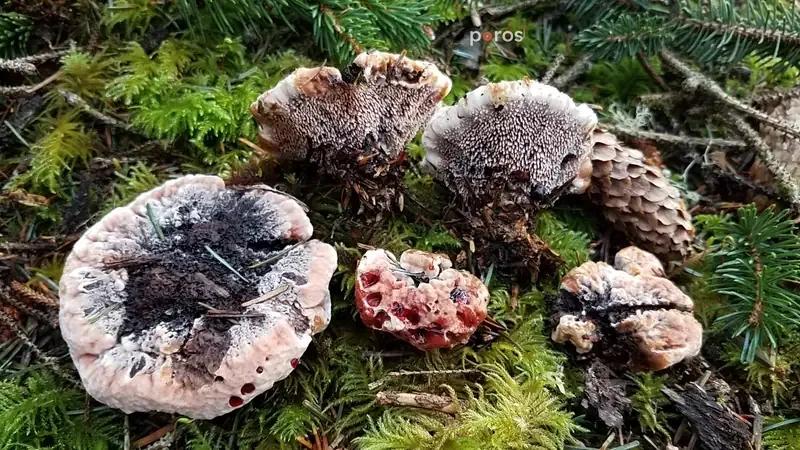
In habitat© Alan Rockefeller · CC BY 4.0


These are licensed records of this species; photos alone are not enough to identify a mushroom.
Is the bleeding tooth fungus poisonous?
The bleeding tooth fungus is not known to be poisonous, but it is extremely bitter and tough, so it is not edible.
Is the bleeding tooth fungus edible?
No. It is not known to be poisonous, but it is extremely bitter and tough; it is not edible.
How to recognise it
Appearance of bleeding tooth fungus
No ring or volva Spore print: Brown Mild; taste extremely bitter.
Where does bleeding tooth fungus grow?
It forms mycorrhizae with conifers, especially spruce and pine, and grows on mossy, nutrient-poor forest soil. It occurs in North America and Europe and is on declining-species lists in many European countries.
Where is bleeding tooth fungus found in Turkey?
Our map data (GBIF and iNaturalist) holds 2 Turkish records: Trabzon (1), Artvin (1). The records are from August.
Which months
- Jan0
- Feb0
- Mar0
- Apr0
- May0
- Jun0
- Jul0
- Aug2
- Sep0
- Oct0
- Nov0
- Dec0
2 provinces, 2 observations (GBIF, iNaturalist); months from observation dates. Record density also reflects where observers work.
Latest bleeding tooth fungus observations
-
 Illustrative
Trabzon10 Aug 2024 · iNaturalist
-
 Illustrative
Artvin21 Aug 2021 · iNaturalist
- See on the map
On "illustrative" cards the image is a photo of the species; the observation photo cannot be shown here because of its licence, but can be seen at the source.
Look-alikes
What could it be confused with?
Bleeding tooth fungus can be mistaken for the species below. Each comparison shows Bleeding tooth fungus on the left, the look-alike on the right, and how to tell them apart.

Hedgehog mushroom Hydnum repandum
How to tell The hedgehog mushroom has a pale orange-cream cap, soft flesh and never oozes red droplets; its spines are brittle.
Mealy tooth Hydnellum ferrugineum
How to tell The mealy tooth can also ooze red droplets, but its cap turns rusty brown sooner, it smells mealy and is not bitter.
The bleeding tooth fungus is not known to be poisonous, but it is extremely bitter and tough, so it is not edible. The red droplets are harmless, but do not take it for a food mushroom. If poisoning is suspected, call poison control.
Frequently asked questions
Is the bleeding tooth fungus poisonous?
The bleeding tooth fungus is not known to be poisonous, but it is extremely bitter and tough, so it is not edible.
Is the bleeding tooth fungus edible?
No. It is not known to be poisonous, but it is extremely bitter and tough; it is not edible.
How do you identify it?
A young white, velvety cap beaded with blood-red droplets, spines instead of gills underneath, on mossy soil under conifers.
What can it be confused with?
The main look-alikes are: Hedgehog mushroom, Mealy tooth. The differences are listed in the look-alikes section; with poisonous look-alikes, always check the cross-section and habitat.
Where does it grow?
It forms mycorrhizae with conifers, especially spruce and pine, and grows on mossy, nutrient-poor forest soil. It occurs in North America and Europe and is on declining-species lists in many European countries.
When does it appear?
It fruits from late summer into autumn. Both Turkish records are from August.
Are the red droplets blood?
No. The fast-growing young fungus pushes out excess water (guttation), and the fluid carries a red pigment. Sources identify it as atromentin, which has anticoagulant activity.
Is it found in Turkey?
Yes, but rarely: our map data holds one record each from Trabzon and Artvin, both in August, from the conifer forests of the eastern Black Sea region.
When is bleeding tooth fungus season in Turkey?
In our calendar, bleeding tooth fungus season runs Aug. It fruits from late summer into autumn. Both Turkish records are from August.
Where does bleeding tooth fungus grow?
It forms mycorrhizae with conifers, especially spruce and pine, and grows on mossy, nutrient-poor forest soil. It occurs in North America and Europe and is on declining-species lists in many European countries.
Where is bleeding tooth fungus found in Turkey?
Our map data (GBIF and iNaturalist) holds 2 Turkish records: Trabzon (1), Artvin (1). The records are from August.
What can bleeding tooth fungus be confused with?
Bleeding tooth fungus can be confused with hedgehog mushroom (Hydnum repandum, edible species) and mealy tooth (Hydnellum ferrugineum, inedible). Look-alikes are compared on this page.
What is bleeding tooth fungus called in Turkish?
In Turkish, bleeding tooth fungus (Hydnellum peckii) is called Kanağlayan mantar.
Related species
-
 Amethyst deceiverLaccaria amethystinaInedible
-
 Anemone stinkhornAseroe rubraInedible
-
 Artist’s bracketGanoderma applanatumInedible
-
 Barometer earthstarAstraeus hygrometricusInedible
-
 Birch polyporeFomitopsis betulinaInedible
-
 Bitter boleteTylopilus felleusInedible
-
 Bitter oysterPanellus stipticusInedible
-
 Black witches’ butterExidia glandulosaInedible
Sources
- Wikipedia (EN): Hydnellum peckii en.wikipedia.org
- iNaturalist: Hydnellum peckii (takson, adlar ve fotoğraflar) inaturalist.org
- GBIF: Hydnellum peckii gbif.org
All sources (5)
- GBIF: Türkiye kayıtları gbif.org
- iNaturalist: Türkiye gözlemleri (araştırma düzeyi) inaturalist.org
Photo credits (11)
- Hydnellum peckii · iNaturalist #68330164 · Morten Ross · CC BY 4.0
- Hydnellum peckii · iNaturalist #106192167 · Alan Rockefeller · CC BY 4.0
- Hydnellum peckii · iNaturalist #102591814 · Alan Rockefeller · CC BY 4.0
- Hydnellum peckii · iNaturalist #183173830 · Jan Smith · CC BY 4.0
- Hydnellum peckii · iNaturalist #366222117 · Mandy Hackney · CC BY 4.0
- Hydnellum peckii · iNaturalist #51192030 · Alan Rockefeller · CC BY 4.0
- Hydnellum peckii · iNaturalist #29155692 · Jake Nitta · CC BY 4.0
- Hydnellum peckii · iNaturalist #46807745 · Mandy Hackney · CC BY 4.0
- Hydnellum peckii · iNaturalist #320556912 · Bryan Smith · CC0
- Hydnellum peckii · iNaturalist #31125580 · Doug Macaulay · CC BY 4.0
- Hydnellum peckii · iNaturalist #37048719 · Alan Rockefeller · CC BY 4.0