
Bridal veil stinkhorn (veiled lady, bamboo fungus)
Phallus indusiatus · Phallaceae

The bridal veil stinkhorn (Phallus indusiatus) is a tropical stinkhorn with a dark, slimy cap and a white, lacy skirt that hangs almost to the ground. It grows in warm parts of South Asia, Africa, the Americas and Australia. It is sold dried and cultivated in China for cooking, but it does not grow wild in Turkey, and our advice for wild specimens is not to eat them.
Also called: veiled lady, bamboo fungus, long net stinkhorn Turkish: Phallus indusiatus Synonyms: Dictyophora indusiata
Last updated: Prepared by the Poros Mantar editorial team5 sources checkedReport a correction
Bridal veil stinkhorn photos
-
© Tess McGrigor · CC0
-

© Teodoro Chivatá Bedoya · CC BY 4.0
-

© reagan peschke · CC BY 4.0
-

© Donald Hobern · CC BY 4.0
-

© Oleg Kosterin · CC BY 4.0
-

© Ben Hayden · CC BY 4.0
-

© Francisco Emilio Roldán Velasco · CC BY 4.0
-

© David Bird · CC0
-

Cap© Laurimar Sepulveda · CC BY 4.0
-
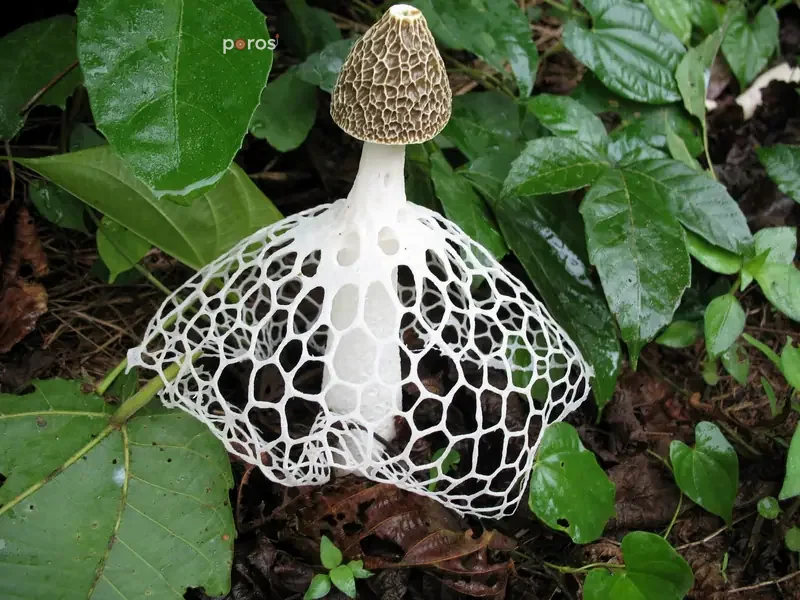
In habitat© Lucy Keith-Diagne · CC BY 4.0
-

Stem© E Santos Ortega · CC BY 4.0


These are licensed records of this species; photos alone are not enough to identify a mushroom.
Is the bridal veil stinkhorn poisonous?
The bridal veil stinkhorn is not known to be poisonous and is cultivated and eaten in China.
Is the bridal veil stinkhorn edible?
It is eaten cultivated and dried in Chinese cooking, but our advice for wild specimens is not to eat them; it does not grow wild in Turkey.
How to recognise it
Appearance of bridal veil stinkhorn
No ring Spore print: Olive-brown, in the slimy gleba Of rotting flesh.
Where does bridal veil stinkhorn grow?
It grows in tropical and subtropical forests, under bamboo, on soil rich in rotting wood and leaf litter. It hatches from an egg, opens within a few hours and collapses within a day.
In Turkey
There are no Turkish records on GBIF or iNaturalist (checked 2026-11-11). Phallus indusiatus is not known from Turkey; its natural range lies on other continents.
Our map has no observations of bridal veil stinkhorn from Turkey yet.
Look-alikes
What could it be confused with?
Bridal veil stinkhorn can be mistaken for the species below. Each comparison shows Bridal veil stinkhorn on the left, the look-alike on the right, and how to tell them apart.
Take care when foraging: Poisonous look-alikes of Bridal veil stinkhorn come first. If in doubt, leave it.

Other look-alikes (1)
 Inedible
not Bridal veil stinkhorn
Common stinkhorn Phallus impudicus
The common stinkhorn has no lacy skirt, or only a short remnant; it is the species found in Turkey.
Bridal veil stinkhorn and its look-alikes compared
| Species | Status | Underside | Spore print | Season |
|---|---|---|---|---|
| Bridal veil stinkhornPhallus indusiatus | Inedible | A white, perforated, lace-like skirt (indusium) hanging from under the cap | Olive-brown, in the slimy gleba | — |
| Common stinkhornPhallus impudicus | Inedible | The honeycomb surface of the head carries the spore mass | Olive-brown (in the slimy spore mass) | May–Nov |
| Death capAmanita phalloides | Deadly poisonous | Gills white and free from the stem | White | Jul–Nov |
The table is compiled from each species page. The status column is a guide only; do not eat a wild mushroom unless an expert has seen it in person. Compare look-alikes side by side
The bridal veil stinkhorn is not known to be poisonous and is cultivated and eaten in China. It does not grow wild in Turkey, though; do not eat local stinkhorns or any egg-shaped fungi, since the egg stage can be confused with deadly Amanitas. If poisoning is suspected, call poison control.
Frequently asked questions
Is the bridal veil stinkhorn poisonous?
The bridal veil stinkhorn is not known to be poisonous and is cultivated and eaten in China.
Is the bridal veil stinkhorn edible?
It is eaten cultivated and dried in Chinese cooking, but our advice for wild specimens is not to eat them; it does not grow wild in Turkey.
How do you identify it?
A dark slimy cap, a white hollow stem and a white lacy skirt hanging from the cap almost to the ground; no other common species has a skirt this long.
What can it be confused with?
The main look-alikes are: Common stinkhorn, Death cap. The differences are listed in the look-alikes section; with poisonous look-alikes, always check the cross-section and habitat.
Where does it grow?
It grows in tropical and subtropical forests, under bamboo, on soil rich in rotting wood and leaf litter. It hatches from an egg, opens within a few hours and collapses within a day.
When does it appear?
In the tropics it opens in the rainy season, usually around dawn. It has no Turkish record, so it is not on our month lists.
What is the skirt for?
Its purpose is not settled. One idea is that it keeps away slugs that eat the gleba without spreading spores; another is that it is a visual cue that attracts flies.
Is it found in Turkey?
There are no Turkish records on GBIF or iNaturalist. The similar species found in Turkey is the common stinkhorn (Phallus impudicus).
When is bridal veil stinkhorn season in Turkey?
In the tropics it opens in the rainy season, usually around dawn. It has no Turkish record, so it is not on our month lists.
Where does bridal veil stinkhorn grow?
It grows in tropical and subtropical forests, under bamboo, on soil rich in rotting wood and leaf litter. It hatches from an egg, opens within a few hours and collapses within a day.
Where is bridal veil stinkhorn found in Turkey?
There are no Turkish records on GBIF or iNaturalist (checked 2026-11-11). Phallus indusiatus is not known from Turkey; its natural range lies on other continents.
What can bridal veil stinkhorn be confused with?
Bridal veil stinkhorn can be confused with common stinkhorn (Phallus impudicus, inedible) and death cap (Amanita phalloides, deadly). Look-alikes are compared on this page.
What is bridal veil stinkhorn called in Turkish?
In Turkish, bridal veil stinkhorn (Phallus indusiatus) is called Phallus indusiatus.
Related species
-
 Anemone stinkhornAseroe rubraInedible
-
Common stinkhornPhallus impudicusInedible
-
 Devil’s fingersClathrus archeriInedible
-
 Dog stinkhornMutinus caninusInedible
-
 Red cage fungusClathrus ruberInedible
-
 Amethyst deceiverLaccaria amethystinaInedible
-
 Artist’s bracketGanoderma applanatumInedible
-
 Barometer earthstarAstraeus hygrometricusInedible
Sources
- Wikipedia (EN): Phallus indusiatus en.wikipedia.org
- iNaturalist: Phallus indusiatus (takson, adlar ve fotoğraflar) inaturalist.org
- GBIF: Phallus indusiatus gbif.org
All sources (5)
- GBIF: Türkiye kayıtları gbif.org
- iNaturalist: Türkiye gözlemleri (araştırma düzeyi) inaturalist.org
Photo credits (11)
- Phallus indusiatus · iNaturalist #108495371 · Tess McGrigor · CC0
- Phallus indusiatus · iNaturalist #302227750 · Teodoro Chivatá Bedoya · CC BY 4.0
- Phallus indusiatus · iNaturalist #378082004 · reagan peschke · CC BY 4.0
- Phallus indusiatus · iNaturalist #20328941 · Donald Hobern · CC BY 4.0
- Phallus indusiatus · iNaturalist #37739128 · Oleg Kosterin · CC BY 4.0
- Phallus indusiatus · iNaturalist #18707534 · Ben Hayden · CC BY 4.0
- Phallus indusiatus · iNaturalist #30613308 · Francisco Emilio Roldán Velasco · CC BY 4.0
- Phallus indusiatus · iNaturalist #321884130 · David Bird · CC0
- Phallus indusiatus · iNaturalist #345456581 · Laurimar Sepulveda · CC BY 4.0
- Phallus indusiatus · iNaturalist #92923616 · Lucy Keith-Diagne · CC BY 4.0
- Phallus indusiatus · iNaturalist #148791809 · E Santos Ortega · CC BY 4.0