
Red-capped scaber stalk (orange birch bolete, red aspen bolete)
Leccinum aurantiacum · Boletaceae

The red-capped scaber stalk (Leccinum aurantiacum) is a large bolete that stands out with its bright orange to reddish-orange cap and a white stem with darkening scabers. Its flesh is white and turns pinkish grey, then purplish black when cut. It is eaten in Europe but must be cooked thoroughly. Although its Turkish name refers to birch, it lives mainly with poplar and oak.
Also called: orange birch bolete, red aspen bolete, orange oak bolete Turkish: Altın huş mantarı Synonyms: Leccinum quercinum, Krombholziella aurantiaca
Last updated: Prepared by the Poros Mantar editorial team3 sources checkedReport a correction
Red-capped scaber stalk photos
-
© Chuck Wilson · CC0
-

© Chuck Wilson · CC0
-

© Alexey Shkolikov · CC BY 4.0
-

Cross-section© Katrin Simon · CC BY 4.0
-

© Hans Hillewaert · CC BY-SA 4.0
-

Stem© Andrey Gaverdovsky · CC BY 2.5
-

© Jerzy Opioła · CC BY-SA 3.0
-

Stem© Dimitǎr Boevski · CC BY-SA 4.0
-

Pores© bjoerns · CC BY-SA 4.0
-

Cap© victor laborde · CC BY 4.0
-
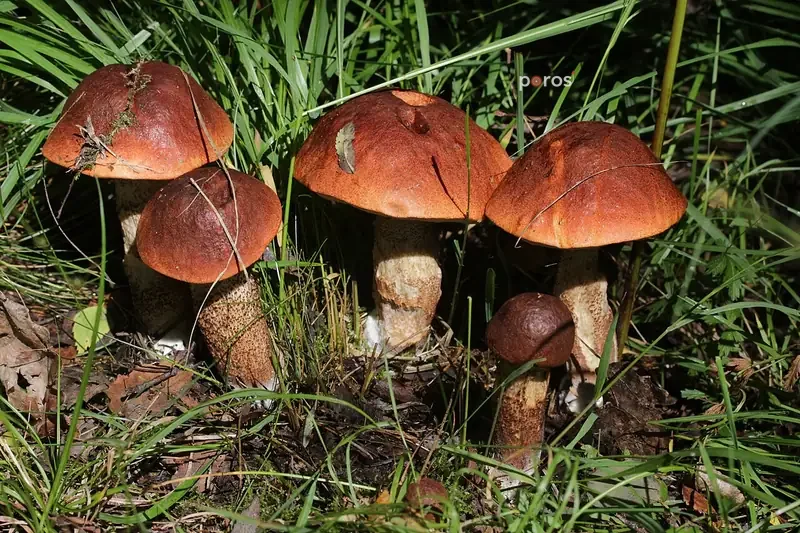
In habitat© Björn S... · CC BY-SA 2.0


These are licensed records of this species; photos alone are not enough to identify a mushroom.
Is the red-capped scaber stalk poisonous?
The red-capped scaber stalk is not listed as poisonous in our sources. The red-capped scaber stalk is edible when cooked thoroughly; parboiling is not enough, and undercooked it can cause vomiting and stomach upsets. Even so, never eat a wild one without certain identification.
Is the red-capped scaber stalk edible?
The red-capped scaber stalk is listed as edible in our sources; even so, never eat a wild one without certain identification. Do not eat it without an expert's approval. The red-capped scaber stalk is edible when cooked thoroughly; parboiling is not enough, and undercooked it can cause vomiting and stomach upsets. At least one death linked to this species has been reported in North America. Do not eat a wild one an expert has not checked.
How to recognise it
Appearance of red-capped scaber stalk
No ring or volva Spore print: Brown Mild and pleasant.
Where does red-capped scaber stalk grow?
It grows under aspen, other poplars and oak, sometimes birch and willow, at woodland edges and in clearings.
Where is red-capped scaber stalk found in Turkey?
Turkish records are very scarce: GBIF holds a single record without a province, and iNaturalist has no research-grade Turkish observation. Worldwide it ranges through the temperate forests of Europe and Asia; similar orange Leccinum species in North America are separate species.
- Bolu1
Which months
- Jan0
- Feb0
- Mar0
- Apr0
- May0
- Jun0
- Jul0
- Aug1
- Sep0
- Oct0
- Nov0
- Dec0
1 provinces, 1 observations (GBIF, iNaturalist); months from observation dates. Record density also reflects where observers work.
Latest red-capped scaber stalk observations
 Illustrative
On "illustrative" cards the image is a photo of the species; the observation photo cannot be shown here because of its licence, but can be seen at the source.
Look-alikes
What could it be confused with?
Red-capped scaber stalk can be mistaken for the species below. Each comparison shows Red-capped scaber stalk on the left, the look-alike on the right, and how to tell them apart.

Brown birch bolete Leccinum scabrum
How to tell Its cap is brown rather than orange; its flesh usually does not change colour when cut, and it grows only under birch.
Orange birch bolete Leccinum versipelle
How to tell Its cap is a more yellowish orange, its scabers are black even when young, and it grows under birch; it too must be well cooked.
Other look-alikes (1)
 Inedible
not Red-capped scaber stalk
Bitter bolete Tylopilus felleus
Its cap is brown, its stem netted, its pores turn pink and it tastes very bitter; it is not eaten.
Red-capped scaber stalk and its look-alikes compared
| Species | Status | Underside | Spore print | Season |
|---|---|---|---|---|
| Red-capped scaber stalkLeccinum aurantiacum | Edible species | Pores whitish to cream, bruising brownish when pressed | Brown | Jun–Oct |
| Brown birch boleteLeccinum scabrum | Edible species | Pores whitish to greyish cream, bruising brownish when pressed | Brown | Jun–Oct |
| Bitter boleteTylopilus felleus | Inedible | Pores whitish when young, pink to pinkish brown with age | Pinkish brown | Jul–Oct |
The table is compiled from each species page. The status column is a guide only; do not eat a wild mushroom unless an expert has seen it in person. Compare look-alikes side by side
How to cook and eat red-capped scaber stalk
Safety first. The red-capped scaber stalk is edible when cooked thoroughly; parboiling is not enough, and undercooked it can cause vomiting and stomach upsets. At least one death linked to this species has been reported in North America. Do not eat a wild one an expert has not checked. If poisoning is suspected, call 112 or the poison centre on 114 and keep any leftover mushroom.
How to store red-capped scaber stalk
Grow it, buy it
Red-capped scaber stalk price list
| Product | Poros Mantar | Market |
|---|---|---|
| Fresh red-capped scaber stalk | Made to order · ask | — |
| Dried red-capped scaber stalk | Made to order · ask | — |
We make our red-capped scaber stalk products in small batches, to order; send a request and we email you the price and delivery date. The market column shows prices seen on other sellers' pages on the date given; they are not our prices and may have changed.
Frequently asked questions
Is the red-capped scaber stalk poisonous?
The red-capped scaber stalk is not listed as poisonous in our sources. The red-capped scaber stalk is edible when cooked thoroughly; parboiling is not enough, and undercooked it can cause vomiting and stomach upsets. Even so, never eat a wild one without certain identification.
Is the red-capped scaber stalk edible?
The red-capped scaber stalk is listed as edible in our sources; even so, never eat a wild one without certain identification. Do not eat it without an expert's approval. The red-capped scaber stalk is edible when cooked thoroughly; parboiling is not enough, and undercooked it can cause vomiting and stomach upsets. At least one death linked to this species has been reported in North America. Do not eat a wild one an expert has not checked.
Why does it blacken when cut?
Compounds in its flesh oxidise on contact with air; the flesh turns pinkish grey and then purplish black. It also darkens when cooked, which does not mean it is poisonous.
Why is it linked to birch when it grows under poplar?
Its Turkish name (iNaturalist TR) groups it with the birch-loving species of the genus. Leccinum aurantiacum itself mostly partners aspen, poplar and oak.
Does it grow in Turkey?
Records are very scarce: GBIF holds a single record without a province, and there is no Turkish iNaturalist observation.
How is it different from Leccinum versipelle?
Leccinum versipelle has a more yellowish-orange cap, scabers that are black from the start, and grows under birch. L. aurantiacum's scabers are white when young, then reddish brown.
When does it fruit?
From early summer to mid-autumn.
Are the orange boletes in North America the same?
No. Similar orange Leccinum species in North America are separate species, and poisonings have been reported from some of them.
When is red-capped scaber stalk season in Turkey?
In our calendar, red-capped scaber stalk season runs Jun–Oct. It fruits from early summer to mid-autumn under poplar, aspen and oak.
Where does red-capped scaber stalk grow?
It grows under aspen, other poplars and oak, sometimes birch and willow, at woodland edges and in clearings.
Where is red-capped scaber stalk found in Turkey?
Turkish records are very scarce: GBIF holds a single record without a province, and iNaturalist has no research-grade Turkish observation. Worldwide it ranges through the temperate forests of Europe and Asia; similar orange Leccinum species in North America are separate species.
What can red-capped scaber stalk be confused with?
Red-capped scaber stalk can be confused with brown birch bolete (Leccinum scabrum, edible species), orange birch bolete (Leccinum versipelle, edible species) and bitter bolete (Tylopilus felleus, inedible). Look-alikes are compared on this page.
What is red-capped scaber stalk called in Turkish?
In Turkish, red-capped scaber stalk (Leccinum aurantiacum) is called Altın huş mantarı.
Related species
-
 Bay boleteImleria badiaEdible species
-
 Bronze boleteBoletus aereusEdible species
-
Brown birch boleteLeccinum scabrumEdible species
-
 Pine boleteBoletus pinophilusEdible species
-
 PorciniBoletus edulisEdible species
-
 Suede boleteXerocomus subtomentosusEdible species
-
 Summer cepBoletus reticulatusEdible species
-
Bitter boleteTylopilus felleusInedible
Sources
- Wikipedia (EN): Leccinum aurantiacum en.wikipedia.org
- iNaturalist: Leccinum aurantiacum (Türkçe ad ve Türkiye gözlemleri) inaturalist.org
- GBIF: Türkiye kayıtları gbif.org
Photo credits (11)
- Leccinum aurantiacum · iNaturalist #127747348 · Chuck Wilson · CC0
- Leccinum aurantiacum · iNaturalist #127747348 · Chuck Wilson · CC0
- Leccinum aurantiacum · iNaturalist #317083236 · Alexey Shkolikov · CC BY 4.0
- Leccinum aurantiacum · iNaturalist #410759577 · Katrin Simon · CC BY 4.0
- File:Leccinum aurantiacum cropped cropped.jpg · Hans Hillewaert · CC BY-SA 4.0
- File:Leccinum aurantiacum (24681626283) cropped.jpg · Andrey Gaverdovsky · CC BY 2.5
- File:Leccinum aurantiacum G3 (1).jpg · Jerzy Opioła · CC BY-SA 3.0
- File:Leccinum aurantiacum 100673397.jpg · Dimitǎr Boevski · CC BY-SA 4.0
- File:Leccinum aurantiacum duo.jpg · bjoerns · CC BY-SA 4.0
- Leccinum aurantiacum · iNaturalist #322831933 · victor laborde · CC BY 4.0
- File:Botanical Garden Gothenburg and Anggårdsbergen 13.08.2017 Red-capped Scaber Stalk - Leccinum aurantiacum (23477648968).jpg · Björn S... · CC BY-SA 2.0


