Wood blewit in Turkey: the cincile and its look-alikes
In Turkey the wood blewit (Lepista nuda) is called cincile. How to identify it, its poisonous purple look-alikes, when it fruits and how to cook it safely.
 Cihat Murat Yüksel
Species guides
Updated: 9 min read
Cincile is mostly a Turkish local name for the wood blewit (Lepista nuda); around Bolu it goes by “mavi cincile”, the blue cincile. With a lilac to purple cap, gills and stout stem, it is among the last mushrooms of autumn. It is edible but never eaten raw, and because it can be confused with poisonous purple webcaps (Cortinarius), it shouldn't be picked unless identified with certainty.
The short answer: cincile is usually the wood blewit
Most Turkish sources treat cincile as a local name for the wood blewit (Lepista nuda). According to the Turkish Wikipedia article, it is “mavi cincile” around Bolu and “mor mantar” (purple mushroom) around Karaman. The FAO's multilingual thesaurus AGROVOC also gives “mavi cincile” as a Turkish label for Lepista nuda, and the food site Yemek.com's mushroom glossary defines cincile the same way.
So is cincile the same as the wood blewit? Most of the time, yes. But folk names aren't tied to one species the way scientific names are: the same name can mean one mushroom in one village and another in the next valley. Here we cover the most common meaning, how to recognise it and, most importantly, what it gets confused with.
One warning first: knowing a mushroom's name is not the same as knowing the mushroom. Anything picked as cincile shouldn't reach the table until you are certain it is a wood blewit and that no poisonous purple species has slipped in.
Purple, blue and scented: the local names
Around Turkey the name comes with a colour or a smell; the forms you hear most are mavi cincile (blue) and mor cincile (purple). Blue and purple describe the same mushroom, deep violet when young and fading to pale lilac or brown with age. The names and their meanings:
- Mavi cincile: the name used around Bolu; Wikipedia and AGROVOC link it to Lepista nuda.
- Mor mantar: the name used around Karaman (Wikipedia), and the name of our species page.
- Mor cincile: a colour name for the same mushroom.
- Sahte mor cincile (false purple cincile): a news report from Bilecik uses this name for Lepista sordida, which looks very similar and, according to the report, differs in its smell and thinner stem.
- In English: wood blewit or simply blewit; in North America also “blue foot”.
Some Turkish sources describe cincile as a late-spring mushroom appearing around June. Lepista nuda is an autumn species, so the name is probably also used for other, spring-fruiting mushrooms in some areas. On this site St George's mushroom (Calocybe gambosa, “cincile mantarı” on iNaturalist) is a white-to-cream spring grassland mushroom, while the poisonous cincile (Clitocybe rivulosa) can be deadly. When you hear “cincile”, ask when and where it was picked.
How to identify it: colour, smell and spore print
Four features together give the most reliable identification: lilac gills, a stout stem with no veil remnants, a faint pleasant smell and a white to pale pink spore print. No single feature is enough, least of all colour; First Nature stresses that some very poisonous fungi also have blue or violet tints, so cap colour can't be trusted.
Here is the description we compiled from the sources on our species page:
- Cap: 4–15 cm; lilac to purple-pink, convex when young, flattening and turning brownish with age.
- Gills: distinctly lilac when young, later pale buff to brown; notched where they meet the stem.
- Stem: short, stout, swollen at the base, fibrous; deep violet when young. First Nature notes that the stem never carries cobweb-like veil (cortina) remnants.
- Smell: First Nature describes a faint aniseed smell; Turkish sources mention a pleasant scent around where it grows.
- Spore print: pale pinkish-buff. Leave the cap gills-down on white paper for a few hours to see it.
The spore print is the most valuable clue here: the poisonous purple look-alikes leave a rusty brown print. Our photo identification tool can give you a first idea, but it never confirms that a mushroom is edible.
Look-alikes: the purple webcaps
Purple-tinted webcaps (Cortinarius species) are the most dangerous look-alikes, and the stem and spore print are how you separate them. Cortinarius is a huge genus that includes species carrying orellanine, a toxin that targets the kidneys. Its best-known deadly member, the fool's webcap (Cortinarius orellanus), is orange-brown rather than purple, but many purple webcaps may also be poisonous, and telling them apart in the field takes expertise.
Prof. İbrahim Türkekul of Tokat Gaziosmanpaşa University summed up the difference to the newspaper Cumhuriyet: the blue cincile's stem carries no remnants, while the webcap's stem has cotton-like, cobweb-like fibres. The decision goes like this:
- Cobweb-like fibres or a rusty ring zone on the stem: it may be a webcap; leave it.
- Rusty brown spore print: points to Cortinarius; the wood blewit's print is white to pinkish.
- No violet tint on the cap, growing in grassland: possibly the field blewit (Lepista personata, syn. Lepista saeva), also edible, but that is a call for an expert.
- Earthy smell and a thinner stem: possibly Lepista sordida.
- Any doubt at all: it stays out of the basket. Purple or blue colour proves nothing on its own.
All poisonous species and the edible ones they're mistaken for are on our poisonous mushrooms pages. Why folk tests fail is covered in how to tell if a mushroom is poisonous.
When and where does it grow?
Late autumn is its time; in Turkey, November and December are the most likely months. First Nature says it is most plentiful from August to December in Britain and Ireland, continues into December in mild weather, and can occasionally turn up in any month. The few Turkish records on GBIF fall in November and December, from Istanbul, Düzce and Yalova.
It grows in leaf litter: on the forest floor of mixed woodland, under hedges, even on garden compost heaps, often in rings or arcs (fairy rings). It is a saprotroph that breaks down dead plant matter, so it isn't tied to any particular tree.
It's no accident that the Bolu area has its own name for it: the damp mixed forests of the western Black Sea suit it well. To explore the area, see our Bolu forests and Yedigöller route; for what fruits when, see the mushroom calendar, and for recorded sightings, the Turkey mushroom map.
How to take a spore print and pick blewits
A spore print is the most concrete evidence separating the wood blewit from purple webcaps, and it takes only a few hours at home with white and dark paper and a glass. It isn't an identification on its own; as Wikipedia points out, a mushroom can't be identified from its spore print alone, it is one feature among several. The colour difference between these two groups is clear, though, so don't skip it.
- Lift the whole mushroom with the base of the stem rather than cutting it; the base and any marks on the stem are part of the identification.
- Keep each species in a separate bag; one doubtful mushroom makes the whole basket doubtful.
- Leave very old, soggy or maggoty specimens; colour and texture clues are lost at that stage.
- At home, clean them with a brush or damp cloth; see how to clean mushrooms. If you won't cook them straight away, see how to store mushrooms.
- Carefully separate the cap from the stem; keep the stem to examine separately.
- Place the cap gills-down on paper that is half white, half dark.
- Cover it with a glass or bowl so it doesn't dry out or get disturbed.
- Wait a few hours, overnight if needed, then lift the cap.
- Check the colour of the deposit: pale pinkish-buff for the wood blewit, rusty brown for webcaps.
The cooking rule: never eat it raw
The wood blewit is never eaten raw; it must always be cooked thoroughly. First Nature is explicit: undercooked blewits can cause indigestion and, in some people, more serious stomach upsets, and a minority find even well-cooked ones hard to digest. Turkish Wikipedia also warns that eaten raw it can cause mild poisoning or stomach trouble.
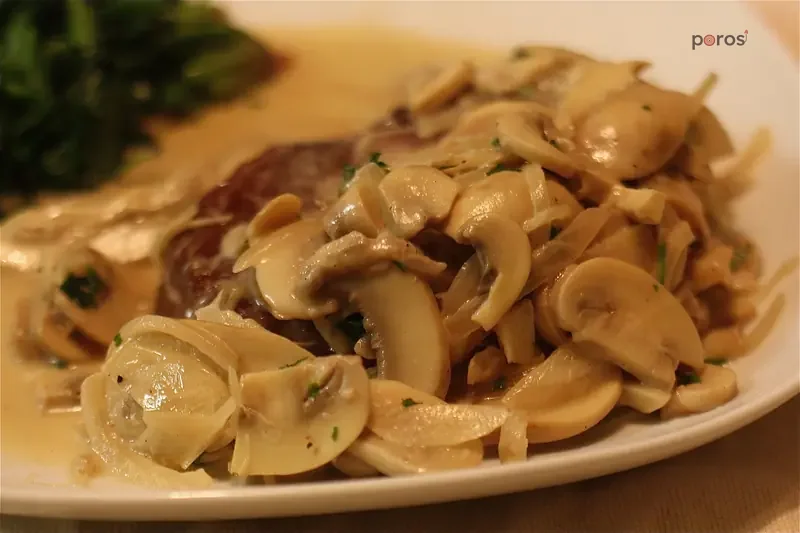
In regional Turkish cooking, cincile is always cooked and valued for its strong flavour. According to Yemek.com, it is first blanched for a few minutes, then made into a tomato-paste stew, an onion sauté or soup; in Bolu it goes with diced meat into pide and börek, and in Kastamonu into a pilaf called üçürdüm. Our mushroom börek recipe uses button mushrooms, but the method is the same, provided the species is certain and the mushrooms are cooked through.
We cover which mushrooms must never be eaten raw, and why, in which mushrooms can you eat raw. As with any wild mushroom, the most important step comes before cooking: certain identification. Cooking never makes a poisonous species safe.
If poisoning is suspected, don't wait: call 112 in Turkey (the national poison centre is 114; elsewhere, your local emergency or poison line) and keep any leftover mushroom.
FAQ
Is cincile poisonous?
The mushroom most often called cincile, the wood blewit (Lepista nuda), is edible, but never raw, and it can be confused with poisonous purple webcaps (Cortinarius). Never eat a mushroom you can't identify with certainty.
Can you eat wood blewits raw?
No. Raw or undercooked wood blewits can upset the stomach; always cook them thoroughly.
Are purple cincile and blue cincile different?
In most areas they are names for the same mushroom, Lepista nuda; its colour shifts from deep violet to pale lilac with age. The name “false purple cincile” has been used for Lepista sordida.
When do wood blewits appear in Turkey?
It's a late-autumn mushroom; Turkish records are from November and December. In Europe it fruits from August to December, later in mild weather. A spring “cincile” may be a different species.
How is cincile cooked in Turkey?
It's usually blanched briefly, then sautéed, stewed with tomato paste, made into soup or used as a börek filling. It's always cooked through.
What are the other names for cincile?
Its scientific name is Lepista nuda. In Turkish it is also mavi cincile, mor cincile and mor mantar; in English, wood blewit or blewit.
Sources
- FAO AGROVOC — Lepista nuda (Türkçe karşılık: mavi cincile) agrovoc.fao.org
- iNaturalist — Calocybe gambosa (Türkçe ad: cincile mantarı; Türkiye gözlemleri) inaturalist.org
- First Nature — Lepista nuda, Wood Blewit first-nature.com
All sources (9)
- Wikipedia (EN) — Collybia nuda (Lepista nuda) en.wikipedia.org
- Vikipedi (TR) — Lepista nuda tr.wikipedia.org
- GBIF — Lepista nuda, Türkiye kayıtları gbif.org
- Yemek.com Sözlük — Cincile mantarı yemek.com
- Cumhuriyet (12.05.2026) — Mantar toplayanlar dikkat: sapındaki o detay hayatınızı kurtarabilir cumhuriyet.com.tr
- Yeni Akit (07.01.2026) — Sahte mor cincile (Lepista sordida), Bilecik yeniakit.com.tr
Last updated: 23 November 2026