
St George’s mushroom (St George's mushroom, May mushroom)
Calocybe gambosa · Lyophyllaceae

St George's mushroom (Calocybe gambosa) is a fleshy white to cream mushroom that appears in spring in meadows, pastures and woodland edges, often in rings or rows. It has crowded white gills and a distinct smell of fresh flour. It is a well-liked edible in Europe, but it can be confused with the deadly red-staining fibrecap and the poisonous livid pinkgill, which appear in the same season.
Also called: St George's mushroom, May mushroom Turkish: Mayıs mantarı, cincile mantarı Synonyms: Tricholoma gambosum, Lyophyllum gambosum
Last updated: Prepared by the Poros Mantar editorial team5 sources checkedReport a correction
St George’s mushroom photos
-
© User:Strobilomyces · CC BY-SA 4.0
-

© User:Strobilomyces · CC BY-SA 4.0
-

© Lucian Clanet · CC BY 4.0
-

Gills© Björn S... · CC BY-SA 2.0
-

Gills© Ellie B · CC BY 4.0
-

Cross-section© Ellie B · CC BY 4.0
-
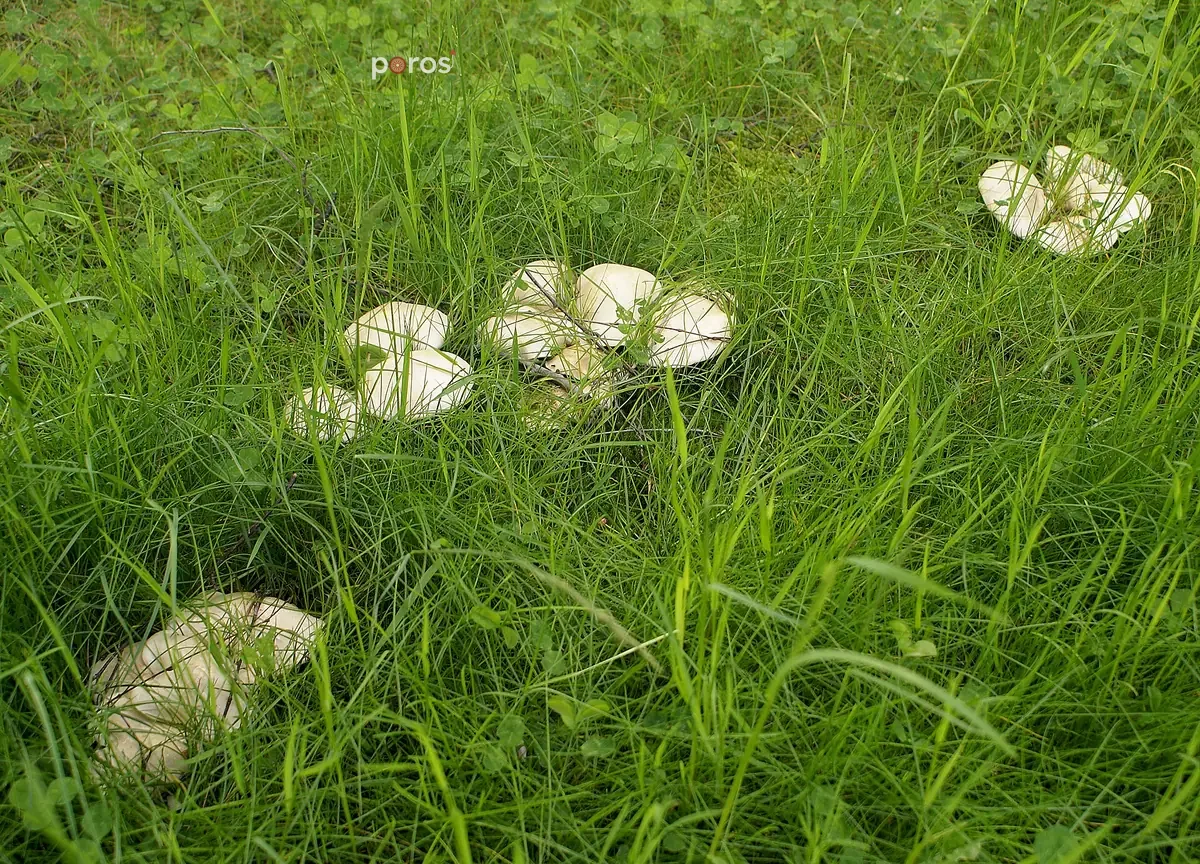
In habitat© Calocybe_gambosa_4.jpg: Harlekin96 derivative work: Ak ccm (talk) · CC BY-SA 3.0
-

Cap© Drepanostoma · CC BY 4.0
-

Gills© Lukas Large · CC BY 4.0
-
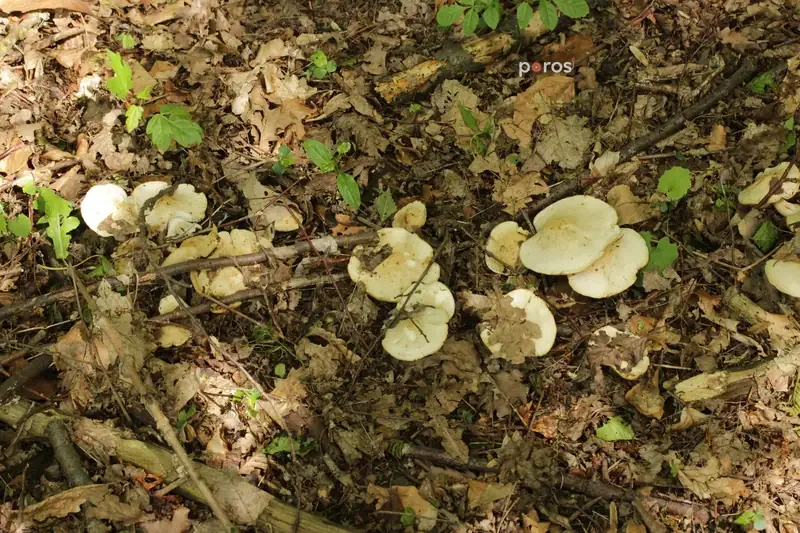
In habitat© Björn Sothmann · CC BY-SA 4.0
-

© User:Strobilomyces; kırpma: Ak ccm · CC BY-SA 3.0


These are licensed records of this species; photos alone are not enough to identify a mushroom.
Are st George's mushrooms poisonous?
St George's mushrooms are not listed as poisonous in our sources. St George's mushroom is edible when well cooked, but the margin for error with white mushrooms is high. The real risk is confusing them with deadly fibrecap (Inosperma erubescens), livid pinkgill (Entoloma sinuatum) and fool's funnel (Clitocybe rivulosa), so never eat wild ones without certain identification. If poisoning is suspected, call 112 at once (Turkish poison centre: 114) and keep any leftover mushroom.
Are st George's mushrooms edible?
St George's mushrooms are listed as edible in our sources; even so, never eat wild ones without certain identification: they have poisonous look-alikes, such as deadly fibrecap (Inosperma erubescens), livid pinkgill (Entoloma sinuatum) and fool's funnel (Clitocybe rivulosa). Do not eat them without an expert's approval. St George's mushroom is edible when well cooked, but the margin for error with white mushrooms is high. It can be confused with the deadly red-staining fibrecap and the poisonous livid pinkgill, which fruit in the same season; do not eat it if the spore print is not white or if it stains red. Do not eat a wild one an expert has not checked.
How to recognise it
Appearance of st George's mushrooms
No ring or volva Spore print: White Strong, of fresh flour or dough.
Where do st George's mushrooms grow?
It grows in meadows, pastures, gardens, verges and woodland edges, often near hawthorn, blackthorn and other shrubs, in rings or rows on calcareous soil.
Where is st George's mushrooms found in Turkey?
Our map data holds 4 Turkish GBIF records (Bolu, Gümüşhane, Istanbul and Kastamonu) and 7 research-grade iNaturalist observations. Worldwide it ranges through temperate Europe and western Asia.
Which months
- Jan0
- Feb0
- Mar0
- Apr2
- May1
- Jun1
- Jul0
- Aug0
- Sep0
- Oct0
- Nov0
- Dec0
4 provinces, 4 observations (GBIF, iNaturalist); months from observation dates. Record density also reflects where observers work.
Latest st George's mushroom observations
-
 Illustrative
Gümüşhane17 May 2025 · iNaturalist
-
 Illustrative
İstanbul24 Apr 2024 · iNaturalist
-
 Illustrative
Kastamonu27 Apr 2023 · iNaturalist
-
 Illustrative
Bolu7 Jun 2020 · iNaturalist
- See on the map
On "illustrative" cards the image is a photo of the species; the observation photo cannot be shown here because of its licence, but can be seen at the source.
Look-alikes
What could it be confused with?
St George’s mushroom can be mistaken for the species below. Each comparison shows St George’s mushroom on the left, the look-alike on the right, and how to tell them apart.
Take care when foraging: Poisonous look-alikes of St George’s mushroom come first. If in doubt, leave it.

Deadly fibrecap Inosperma erubescens
How to tell Its cap is pointed and radially fibrous, bruising from white to brick red; the gills turn brown and the spore print is brown. It is deadly and fruits in the same season.

Fool's funnel Clitocybe rivulosa
How to tell It is smaller and thinner-fleshed, its gills run down the stem and its cap is frosty white; it contains muscarine and is poisonous.

Livid pinkgill Entoloma sinuatum
How to tell Its gills are yellowish when young and pink when mature, with a pink spore print; its cap is greyer. It is poisonous.
St George’s mushroom and its look-alikes compared
| Species | Status | Underside | Spore print | Season |
|---|---|---|---|---|
| St George’s mushroomCalocybe gambosa | Edible species | White to cream, very crowded and narrow, attached or notched | White | Apr–Jun |
| Deadly fibrecapInosperma erubescens | Deadly poisonous | Reddish-pink, adnexed | Brown | Apr–Jul |
| Livid pinkgillEntoloma sinuatum | Poisonous | Distant, notched at the stem | Pink (reddish brown) | Aug–Dec |
| Fool’s funnelClitocybe rivulosa | Deadly poisonous | Crowded, whitish-cream gills running slightly down the stem | White | Aug–Nov |
The table is compiled from each species page. The status column is a guide only; do not eat a wild mushroom unless an expert has seen it in person. Compare look-alikes side by side
How to cook and eat st George's mushrooms
Safety first. St George's mushroom is edible when well cooked, but the margin for error with white mushrooms is high. It can be confused with the deadly red-staining fibrecap and the poisonous livid pinkgill, which fruit in the same season; do not eat it if the spore print is not white or if it stains red. Do not eat a wild one an expert has not checked. If poisoning is suspected, call 112 (Turkish poison centre UZEM: 114) and keep any leftover mushroom.
How to store st George's mushrooms
Grow it, buy it
St George's mushroom price list
| Product | Poros Mantar | Market |
|---|---|---|
| Fresh st George's mushrooms | Made to order · ask | — |
| Dried st George's mushrooms | Made to order · ask | — |
We make our st George's mushrooms products in small batches, to order; send a request and we email you the price and delivery date. The market column shows prices seen on other sellers' pages on the date given; they are not our prices and may have changed.
Frequently asked questions
Are st George's mushrooms poisonous?
St George's mushrooms are not listed as poisonous in our sources. St George's mushroom is edible when well cooked, but the margin for error with white mushrooms is high. The real risk is confusing them with deadly fibrecap (Inosperma erubescens), livid pinkgill (Entoloma sinuatum) and fool's funnel (Clitocybe rivulosa), so never eat wild ones without certain identification. If poisoning is suspected, call 112 at once (Turkish poison centre: 114) and keep any leftover mushroom.
Are st George's mushrooms edible?
St George's mushrooms are listed as edible in our sources; even so, never eat wild ones without certain identification: they have poisonous look-alikes, such as deadly fibrecap (Inosperma erubescens), livid pinkgill (Entoloma sinuatum) and fool's funnel (Clitocybe rivulosa). Do not eat them without an expert's approval. St George's mushroom is edible when well cooked, but the margin for error with white mushrooms is high. It can be confused with the deadly red-staining fibrecap and the poisonous livid pinkgill, which fruit in the same season; do not eat it if the spore print is not white or if it stains red. Do not eat a wild one an expert has not checked.
Is St George's mushroom edible?
Yes, it is edible when well cooked. Because it can be confused with poisonous white mushrooms of the same season, show any wild ones to an expert.
When does St George's mushroom appear?
In spring, from late April to early June; its English name comes from St George's Day, 23 April.
How is it recognised?
By its fleshy white to cream cap, very crowded white gills, thick stem, white spore print and strong smell of fresh flour. Growing in rings or rows in spring meadows is another clue.
How do you tell it from the red-staining fibrecap?
The red-staining fibrecap has a pointed, fibrous cap that bruises brick red and gills that turn brown. St George's mushroom is smooth and fleshy, does not redden and keeps white gills.
Where is St George's mushroom found in Turkey?
GBIF holds records from Bolu, Gümüşhane, Istanbul and Kastamonu, and iNaturalist has 7 research-grade observations.
Why does it smell of flour?
A smell of fresh flour or dough is a hallmark of the species. However, the poisonous livid pinkgill can smell similar, so smell alone is not enough.
How is St George's mushroom cooked?
Its firm flesh suits sautéing in butter, omelettes and creamy sauces; it should be cooked thoroughly.
What other names does St George's mushroom have?
In Turkish it is also called mayıs mantarı (May mushroom). In English it is St George's mushroom or May mushroom. Its Latin name is Calocybe gambosa; older names are Tricholoma gambosum and Lyophyllum gambosum.
When is st George's mushroom season in Turkey?
In our calendar, st George's mushroom season runs Apr–Jun. It is a spring mushroom: its English name comes from St George's Day, 23 April, and it fruits from late April to early June.
Where do st George's mushrooms grow?
It grows in meadows, pastures, gardens, verges and woodland edges, often near hawthorn, blackthorn and other shrubs, in rings or rows on calcareous soil.
Where are st George's mushrooms found in Turkey?
Our map data holds 4 Turkish GBIF records (Bolu, Gümüşhane, Istanbul and Kastamonu) and 7 research-grade iNaturalist observations. Worldwide it ranges through temperate Europe and western Asia.
What can the st George's mushroom be confused with?
The st George's mushroom can be confused with deadly fibrecap (Inosperma erubescens, deadly), livid pinkgill (Entoloma sinuatum, poisonous) and Fool's funnel (Clitocybe rivulosa, deadly). Look-alikes are compared on this page.
What is the st George's mushroom called in Turkish?
In Turkish, the st George's mushroom (Calocybe gambosa) is called Mayıs mantarı; other local names include cincile mantarı.
Related species
-
 Buna-shimejiHypsizygus tessulatusEdible species
-
 Elm oysterHypsizygus ulmariusEdible species
-
 Fried chicken mushroomLyophyllum decastesEdible species
-
 Almond mushroomAgaricus subrufescensEdible species
-
 Anatolian matsutakeTricholoma anatolicumEdible species
-
 Aniseed funnelClitocybe odoraEdible species
-
 Bay boleteImleria badiaEdible species
-
 Beefsteak fungusFistulina hepaticaEdible species
Sources
- FAO AGROVOC: Lepista nuda (Türkçe karşılık: mavi cincile) agrovoc.fao.org
- Wikipedia (EN): Calocybe gambosa en.wikipedia.org
- iNaturalist: Calocybe gambosa (Türkçe ad ve Türkiye gözlemleri) inaturalist.org
All sources (5)
- GBIF: Türkiye kayıtları gbif.org
- Vikipedi (TR): Lepista nuda (yöresel adı mavi cincile) tr.wikipedia.org
Photo credits (11)
- File:Calocybe gambosa 080420wb.jpg · User:Strobilomyces · CC BY-SA 4.0
- File:Calocybe gambosa 080420wa.jpg · User:Strobilomyces · CC BY-SA 4.0
- File:Calocybe gambosa collection.jpg · Lucian Clanet · CC BY 4.0
- File:Calocybe gambosa (34412661523).jpg · Björn S... · CC BY-SA 2.0
- Calocybe gambosa · iNaturalist #150415220 · Ellie B · CC BY 4.0
- Calocybe gambosa · iNaturalist #150415220 · Ellie B · CC BY 4.0
- File:Calocybe gambosa 4 cropped.jpg · Calocybe_gambosa_4.jpg: Harlekin96 derivative work: Ak ccm (talk) · CC BY-SA 3.0
- Calocybe gambosa · iNaturalist #18409800 · Drepanostoma · CC BY 4.0
- Calocybe gambosa · iNaturalist #351707452 · Lukas Large · CC BY 4.0
- Calocybe gambosa · iNaturalist #80153482 · Björn Sothmann · CC BY-SA 4.0
- File:Calocybe gambosa 080420wa cropped.jpg · User:Strobilomyces; kırpma: Ak ccm · CC BY-SA 3.0


