The death cap (Amanita phalloides) is generally considered the world's deadliest mushroom; in Turkish it's also called köygöçüren, “the one that empties villages”. It causes most fatal mushroom poisonings, and half a cap is estimated to be enough to kill an adult. It grows in Turkey: GBIF holds records from several provinces, led by Artvin, Istanbul and Yalova. Cooking, drying or freezing doesn't destroy its toxins; if it may have been eaten, call 112 or 114 in Turkey without waiting for symptoms.
The short answer: the death cap (Amanita phalloides)
The world's deadliest mushroom is generally considered to be the death cap (Amanita phalloides). The sources Wikipedia brings together describe it as the most poisonous mushroom known, responsible for the great majority of deaths from mushroom poisoning. Half a cap, about 30 g, is estimated to contain enough toxin to kill an adult.
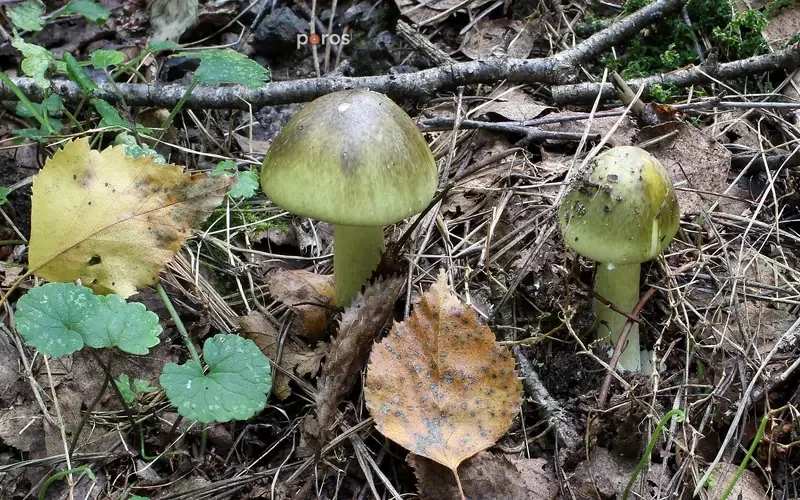
In Turkish it's also called köygöçüren (the one that empties villages), evcikkıran (house-wrecker) and ölüm meleği (angel of death). The harsh names aren't for nothing: the death cap is both extremely toxic and ordinary-looking. Its cap is usually pale olive green, sometimes yellowish or bronze, rarely white. The gills are white, and the stem has a hanging ring and a sac-like volva at the base.
What makes the death cap the deadliest isn't just the strength of its toxin but how that combines with deceptive traits. First Nature notes that young death caps are almost odourless and are reported to taste pleasant; Tox Info Suisse stresses that symptoms often begin hours later. The mushroom gives itself away neither by smell, taste nor an immediate reaction.
What amatoxins do in the body
The death cap's main toxins are amatoxins, which kill cells by stopping them making proteins; they hit the liver hardest, then the kidneys. According to Wikipedia, the main amatoxin, alpha-amanitin, blocks an enzyme the cell needs to make messenger RNA (RNA polymerase II). With protein production stopped, the cell dies. The liver, the first organ the toxin reaches after absorption from the gut, suffers the most damage.
These toxins are also heat- and cold-stable. Wikipedia notes that cooking or freezing doesn't reduce their effect. Boiling, frying, drying, freezing or pouring away the cooking water won't make a death cap safe.
The timing of symptoms is one of the things that makes this poisoning so dangerous. According to Tox Info Suisse, symptoms in the death cap group usually start 6 to 15 hours after the meal, sometimes as late as 24 hours. After vomiting and diarrhoea, people may feel better for a while as liver damage continues. We cover the symptoms in mushroom poisoning symptoms.
This section is general information, not treatment advice. Poisoning is treated only in hospital. If you suspect it, call 112 in Turkey or the National Poison Centre on 114 (elsewhere, your local emergency or poison line).
Other deadly species: galerina, webcap and false morel
The death cap isn't the only deadly species; several others carry the same toxin or target other organs. Knowing them matters, because each is confused with a different edible mushroom:
- Destroying angel (Amanita virosa): a white Amanita with a ring and volva, as toxic as the death cap. Young, unopened specimens are confused with edible white mushrooms.
- Deadly galerina (Galerina marginata): a “little brown mushroom” growing in clusters on wood. It contains the same amatoxins as the death cap and can be confused with edible wood-growing species.
- Fool's webcap (Cortinarius orellanus): an orange-brown forest mushroom whose orellanine targets the kidneys, with symptoms that can take days to appear. Wikipedia reports that eleven people died in a mass poisoning in Poland in 1952.
- False morel (Gyromitra esculenta): a dark brown, brain-like spring mushroom that fruits alongside morels. Its gyromitrin turns into monomethylhydrazine in the body, affecting the liver and nervous system, and cooking doesn't remove all of it. More in morels vs false morels.
None of these species is edible. All of them, and the edible species they're mistaken for, are on our poisonous mushrooms pages.
Does the death cap grow in Turkey? GBIF records
Yes, the death cap grows in Turkey, and the Amanita group it belongs to is blamed for nearly all fatal mushroom poisonings there. The global biodiversity database GBIF holds dozens of Turkish records of Amanita phalloides, most from Artvin, Istanbul and Yalova, followed by Kastamonu, Kırklareli, Trabzon, İzmir and Osmaniye. With records stretching from the Black Sea to the Aegean and Mediterranean, it would be wrong to see it as a regional problem.
Turkish research underlines the importance of the Amanita group. A study by Turkish researchers published in Toxicon states that poisonings by Amanita mushrooms make up about 3% of all poisonings in the country and account for nearly all fatal mushroom poisonings.
Turkish Wikipedia likewise holds the death cap responsible for most fatal poisonings in Turkey and says it is common in forests in early summer and autumn. In short, this is a mushroom of nearby woods, not distant countries.
The death cap partners with broadleaf trees, especially oak; First Nature gives July to November as its season in Britain. In Turkey, too, late summer and autumn are the riskiest months. See the distribution of records on the Turkey mushroom map, and why poisonings rise in autumn in why mushroom poisonings peak in autumn.
GBIF has no georeferenced Turkish records of the destroying angel or the fool's webcap. That reflects gaps in recording, not absence from Turkey.
Why toxicity can't be ranked on a single scale
A ranking of the “most poisonous mushroom” can't rest on a single measure, because species carry different toxins, toxin levels vary even between individuals of the same species, and the risk of death depends on the toxin, the amount eaten and how early treatment starts. The death cap tops the list because it's highly toxic, widespread and easily confused with edible species.
Two studies from Turkey show this complexity well:
- Spring destroying angel (Amanita verna): in the Toxicon study, specimens collected in April on the Kozak Plateau near Ayvalık, Balıkesir, were analysed for amatoxins. Alpha- and beta-amanitin levels were about three times higher than in the death cap, with the highest levels in the gills. The authors conclude that Amanita verna is more toxic than the death cap and may have a higher mortality rate.
- Amanitas that target the kidneys: a study of 13 patients admitted with acute kidney injury in Uşak in November and December 2020 identified the mushrooms that could be examined as Amanita proxima, which closely resembles an edible Mediterranean Amanita (A. ovoidea). All patients needed kidney replacement therapy, and two died.
- Different toxins, different organs: amatoxins mainly hit the liver, orellanine the kidneys, and gyromitrin the liver and nervous system. So the answer to “which is more poisonous” depends on what you're measuring.
The practical lesson: rather than ranking deadly species, treat every mushroom with white gills, a ring and a volva, every little brown mushroom clustered on wood, and every brain-like spring mushroom as dangerous.
What does a death cap look like, and what is it mistaken for?
The death cap is most often confused with button and field mushrooms, green-capped brittlegills and, when young, puffballs. First Nature describes the cap as olive to yellowish green, rarely white; the gills as white, turning cream with age; and the stem as having a fragile, hanging ring and a large, white, sac-like volva around its swollen base.
The most common sources of confusion:
- Field mushroom and button mushroom: their gills turn from pink to brown, and they have no volva. Death cap gills are never grey or pinky-brown.
- Puffballs: First Nature notes that death cap buttons can be mistaken for puffballs, but a lengthwise cut immediately reveals the embryonic mushroom inside.
- Green-capped edible species: a green cap tells you nothing on its own; always check for the volva and ring.
- Cut mushrooms: if the stem is cut with a knife, the volva stays in the ground and the most important sign is lost.
What to look for in a photo is covered in poisonous mushroom photos.
The only way to stay safe
The only way to stay safe from the death cap is never to eat a wild mushroom you can't identify with certainty. Folk tests such as silver spoons, garlic, taste, smell or animals having nibbled the mushroom don't work; we explain why in how to tell if a mushroom is poisonous.
Rules for everyday life:
- Don't eat any mushroom you haven't identified with certainty and had confirmed by an expert; a photo, an app or a social media comment is not an identification.
- Take care when buying wild mushrooms at markets; mushrooms on a stall can be misidentified too.
- When picking, take the whole mushroom including the stem base, and don't mix species in one basket.
- Don't touch wild mushrooms in gardens or parks with bare hands; as the ACT government advises, remove them with gloves, bag them for household rubbish, wash your hands and keep children and pets away.
- If poisoning is suspected, don't wait for symptoms: call 112 in Turkey or the National Poison Centre on 114 straight away (elsewhere, your local emergency or poison line). Take the leftover mushroom to hospital and make sure everyone who ate the dish is checked.
FAQ
Does the death cap grow in Turkey?
Yes. GBIF holds records from Artvin, Istanbul and Yalova, as well as Kastamonu, Kırklareli, Trabzon, İzmir and Osmaniye. Late summer and autumn are the riskiest months.
Can you be poisoned by touching a death cap?
The real danger is eating it. Still, it's advised not to touch wild mushrooms with bare hands, to remove them with gloves and to wash your hands afterwards.
Does cooking make a death cap safe?
No. Amatoxins are heat- and cold-stable; cooking, drying and freezing don't destroy them.
What does a death cap look like?
An olive-green, yellowish-green or occasionally white cap; white gills; a hanging ring on the stem and a white, sac-like volva at the base, often hidden in the soil.
Which mushroom is köygöçüren?
Köygöçüren is a Turkish folk name for the death cap (Amanita phalloides). It is also called evcikkıran and ölüm meleği.
What should you do if a poisonous mushroom is eaten?
Don't wait for symptoms: call 112 in Turkey or the National Poison Centre on 114 (elsewhere, your local emergency or poison line). Take the leftovers to hospital and have everyone who ate it checked.
Which mushrooms are harmful to eat?
Harmful mushrooms range from deadly species such as the death cap, destroying angels, deadly galerina and fool's webcap to the many that cause stomach upsets, such as the yellow stainer, sulphur tuft and common earthball. Some, like the common ink cap, are harmful only together with alcohol. Because the deadly ones can look ordinary, we never eat a wild mushroom that has not been identified to species.
Which poisonous mushroom species grow in Turkey?
Dangerous species recorded in Turkey include the death cap, panther cap, fly agaric, false morel, deadly galerina and deadly dapperling. Our poisonous mushrooms section describes each of them with the edible species they are mistaken for.
Sources
- Yilmaz I., Kaya E., Sinirlioglu Z.A. ve ark. — Clinical importance of toxin concentration in Amanita verna mushroom, Toxicon 87, 2014 (PubMed) pubmed.ncbi.nlm.nih.gov
- Adibelli Z., Sermenli H.B., Uc Z.A. — Outbreaks of mushroom poisoning associated with acute kidney injury, Human & Experimental Toxicology 43, 2024 (PubMed) pubmed.ncbi.nlm.nih.gov
- ACT Government — Death cap mushrooms act.gov.au
All sources (11)
- Wikipedia (EN) — Amanita phalloides en.wikipedia.org
- First Nature — Amanita phalloides, Deathcap first-nature.com
- GBIF — Amanita phalloides, Türkiye kayıtları gbif.org
- Wikipedia (EN) — Cortinarius orellanus en.wikipedia.org
- First Nature — Galerina marginata, Funeral Bell first-nature.com
- First Nature — Gyromitra esculenta, False Morel first-nature.com
- Vikipedi (TR) — Köygöçüren mantarı tr.wikipedia.org
- Tox Info Suisse — Toxic tales from daily life at the Tox: Mushrooms toxinfo.ch
Last updated: 2 November 2026