

Look-alikes · comparison
Enoki vs deadly galerina (funeral bell): how to tell them apart
Enoki (Flammulina filiformis) and the deadly galerina or funeral bell (Turkish: ölümcül galerina) are two separate species that grow on dead wood. Enoki has no ring on the stem, cream to yellowish-white gills and a white spore print. The deadly galerina has a skin-like ring, brown gills and a rusty-brown spore print, and it contains deadly amatoxins.

Enoki vs deadly galerina: the three signs that matter
-
Ring on the stem: absent or present?
Enoki has no ring; in the wild the top of its stem is pale yellow, darkening downwards from yellow-brown to dark brown. The deadly galerina (Galerina marginata) has a thin brown stem 2–8 cm long, with a clear, skin-like ring in young specimens. That ring can disappear with age, so we do not treat a missing ring as a sign of safety on its own.
-
Spore print: white or rusty brown?
Enoki leaves a white spore print and has cream to yellowish-white gills. The deadly galerina leaves a rusty-brown (snuff-brown) print; its gills are crowded, pale brown when young and rusty brown when mature. A mealy smell and taste are also reported for the galerina, but it is never tasted. In wild specimens whose cap colours come close, the spore print is the clearest sign separating the two.
-
Shop enoki and the wild form
In shops enoki is sold as bundles of long, thin white stems; that look comes from growing it in the dark. In the wild its cap is up to 4.5 cm across, ochre-yellow to yellow-brown and sticky when damp. The deadly galerina's cap is 1–6 cm, brown to yellow-brown. In the wild, then, both are small yellow-brown mushrooms on wood, and the mix-up happens when wild velvet shank is picked.
We do not pick little brown mushrooms growing on wood; even without a visible ring, one could be a deadly galerina. We never rely on a single sign, or eat wild finds without firm, expert identification.
Side-by-side differences
This table is built from the sourced descriptions on the two species pages.
| Feature | Enoki | Deadly galerina |
|---|---|---|
| Cap | Up to 4.5 cm in the wild, convex to flat; ochre-yellow to yellow-brown and sticky when damp. Tiny and white in cultivation. | 1–6 cm; brown to yellow-brown, fading as it dries; convex then flat, sometimes with a boss. |
| Gills | Cream to yellowish-white gills. | Crowded, pale brown when young, tawny when mature. |
| Stem | Pale yellow at the top, yellow-brown to dark brown towards the base; no ring. Long and white in cultivation. | 2–8 cm, slender, brownish. |
| Ring | None. | A clear membranous ring on young specimens; often lost with age. |
| Volva (cup at the base) | None. | None. |
| Smell and taste | Crisp texture; keeps about a week in the fridge. | Mealy smell and taste. Never taste it. |
| Spore print | White. | Rusty (snuff) brown. |
| Habitat | Enoki grows in the wild on dead wood of broadleaf trees such as birch, paper mulberry and willow. In cultivation it is grown on sawdust, wheat straw and rice straw. | The deadly galerina grows on rotting conifer (sometimes hardwood) stumps, trunks and fallen branches. It usually grows in small clusters, sometimes scattered or singly. |
| Season | All year in cultivation | Aug–Nov |
| Edibility | Edible species | Deadly poisonous |
The same view of both species


This page is not a definitive identification. The signs we describe help separate these two species, but they do not prove what your mushroom is; other poisonous species can grow in the same place.
Frequently asked questions
Are enoki and the deadly galerina the same mushroom?
No. Enoki (Flammulina filiformis) is an Asian mushroom in the family Physalacriaceae; it is cultivated and listed in our sources as an eaten species. The deadly galerina (Galerina marginata) belongs to the Hymenogastraceae and contains the same amatoxins as the death cap. Because both grow on wood, their wild forms can be confused.
Enoki or deadly galerina: which one is poisonous?
The deadly galerina is the poisonous one: it contains the same amatoxins as the death cap, causes severe liver damage and is never eaten. Enoki is not listed as a poisonous species in our sources; it is listed as an eaten one. Even so, enoki is not eaten raw: because it can carry Listeria, health agencies advise cooking it.
How do we tell enoki from the deadly galerina?
We look at the stem, the gills and the spore print together. Enoki has no ring, cream to yellowish-white gills and a white spore print. The deadly galerina has a skin-like ring (which can vanish with age), brown gills and a rusty-brown spore print. Telling them apart takes expertise; a wild specimen is not eaten unless an expert has seen it.
Can shop-bought enoki be confused with the deadly galerina?
Shop enoki is cultivated on sawdust, wheat straw and rice straw and sold as bundles of long, thin white stems. Enoki does not grow naturally in Turkey; what is on sale is imported or cultivated. The confusion arises in the wild, between the velvet shank growing on wood and the deadly galerina.
What happens if someone eats a deadly galerina?
The deadly galerina causes amatoxin poisoning: vomiting, diarrhoea and hypothermia, and death if untreated, with severe damage to the liver. If one may have been eaten, call emergency services at once (112 in Turkey; Poison Information Centre: 114) and keep any leftover piece of the mushroom.
Do enoki and the deadly galerina grow in the same places?
Enoki is native to China, Korea and Japan, where it grows on the dead wood of broadleaf trees such as birch, mulberry and willow; there is no wild record from Turkey. The deadly galerina grows on stumps, trunks and branches of rotting conifers and sometimes broadleaf trees. It has been recorded in Turkey, though most records carry no province.
When do enoki and the deadly galerina appear?
Enoki is cultivated all year round and, as it does not grow wild in Turkey, has no wild season there. The deadly galerina fruits in summer and autumn; GBIF records from Turkey fall in August, October, November and January. The velvet shank, enoki's wild European relative, appears on dead broadleaf wood in winter.
Can we tell enoki from the deadly galerina in a photo?
A photo helps, but it is not a firm identification. The spore print that separates the two does not show in a picture, and the galerina's ring can disappear with age. Telling little brown mushrooms on wood apart takes expertise, so we never suggest eating a wild mushroom on the strength of a photo; the specimen goes to an expert.
Sources
The facts in this comparison come from the sourced data on our enoki and deadly galerina pages:
- Wikipedia (EN): Flammulina filiformis
- Wikipedia (EN): Flammulina velutipes
- GBIF: Flammulina filiformis
- Wang ve ark. (2018), Mycological Progress: Flammulina filogenisi ve Doğu Asya kış mantarının statüsü
- Wikipedia (EN): Galerina marginata
- First Nature: Galerina marginata
- GBIF: Türkiye kayıtları
- Wikipedia (EN): Psilocybe cyanescens
More comparisons
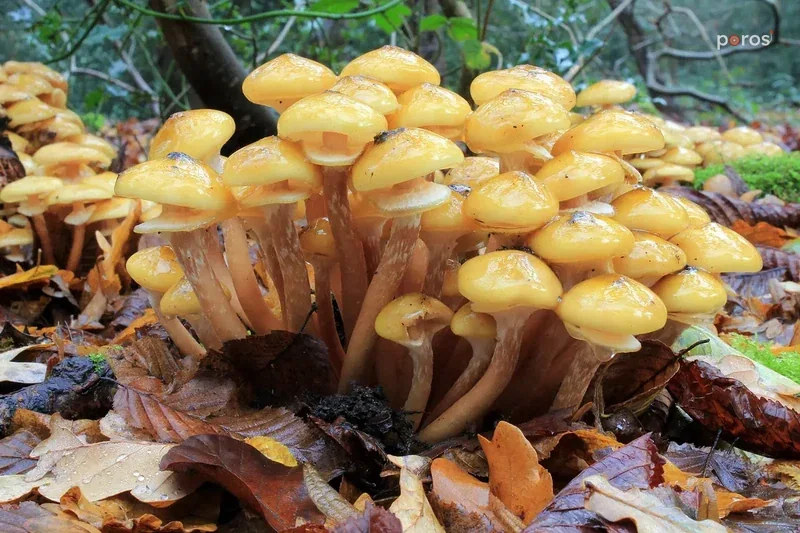 ≠Honey fungus vs deadly galerinaArmillaria mellea · Galerina marginataDeadly poisonous
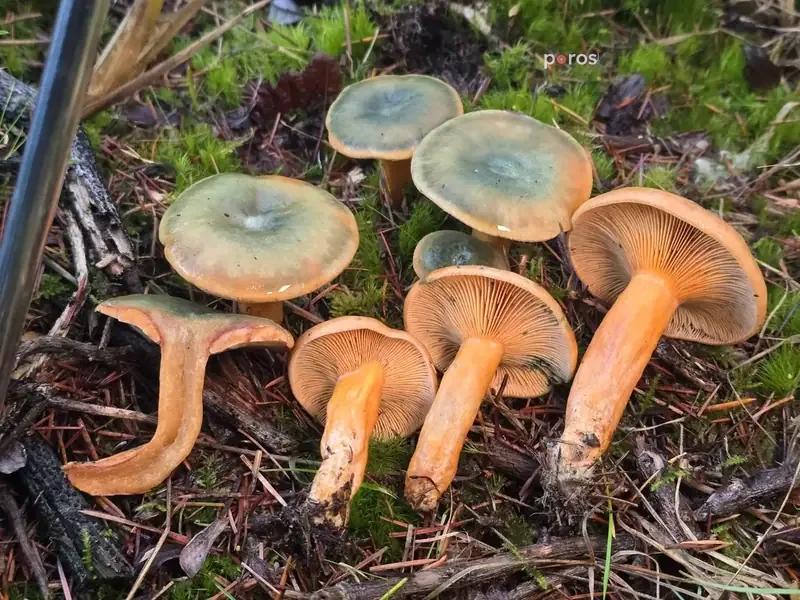
 ≠Saffron milk cap vs woolly milkcapLactarius deliciosus · Lactarius torminosusPoisonous
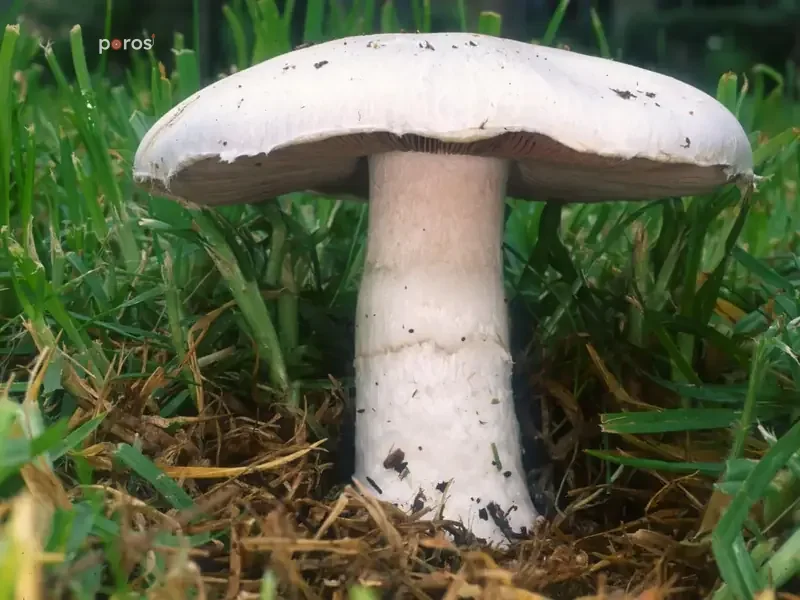
 ≠Field mushroom vs death capAgaricus campestris · Amanita phalloidesDeadly poisonous
 ≠Field mushroom vs yellow stainerAgaricus campestris · Agaricus xanthodermusPoisonous
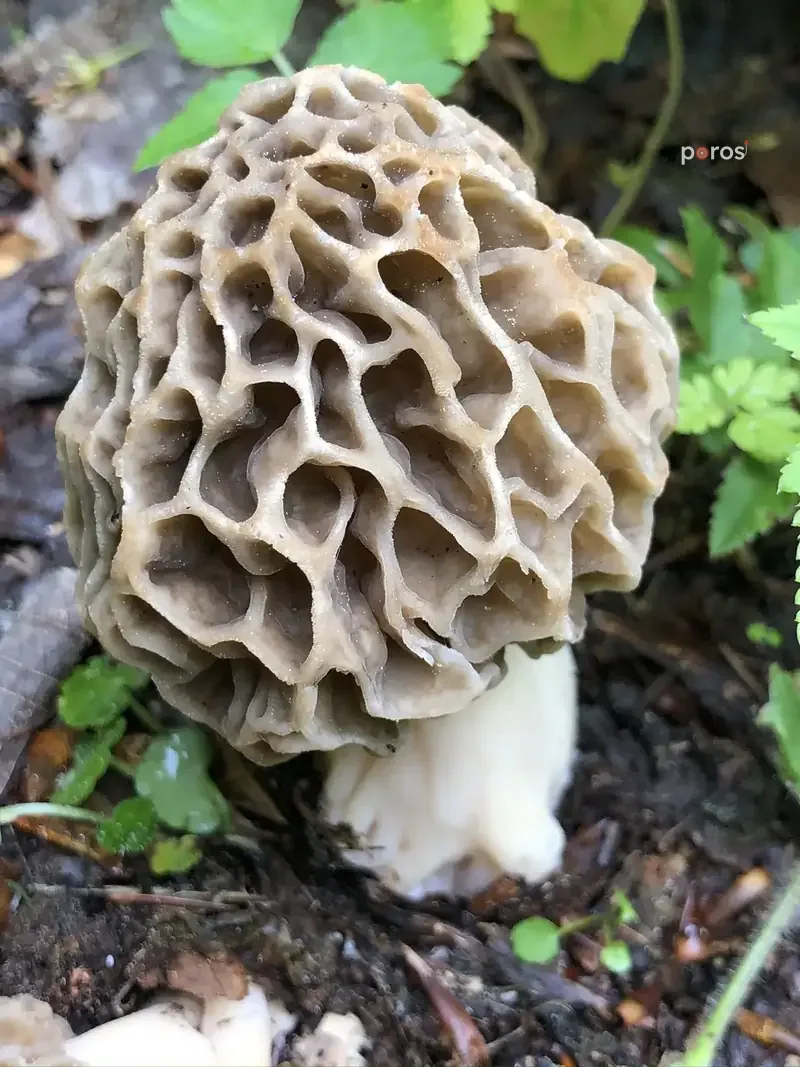
 ≠Morel vs false morelMorchella esculenta · Gyromitra esculentaDeadly poisonous
 ≠Parasol mushroom vs green-spored parasolMacrolepiota procera · Chlorophyllum molybditesPoisonous
Last updated: Prepared by the Poros Mantar editorial teamReport a correction