
Green pepe (glowing mycena)
Mycena chlorophos · Mycenaceae

Mycena chlorophos is a small gilled mushroom that glows green in the dark (bioluminescence). By day it is a plain, pale grey-brown, sticky-capped mushroom; at night its cap and gills shine. It grows on decaying wood and bamboo in Southeast Asia, Japan, Pacific islands, Australia and Brazil. Its edibility is unknown, so treat it as inedible.
Also called: green pepe, glowing mycena Turkish: Mycena chlorophos Synonyms: Agaricus chlorophos
Last updated: Prepared by the Poros Mantar editorial team5 sources checkedReport a correction
Green pepe photos
-
© Cheng-Tao Lin · CC BY 4.0
-

© Cheng-Tao Lin · CC BY 4.0
-

© Jie-Hao Ou · CC BY 4.0
-

© Cheng-Tao Lin · CC BY 4.0
-

© Licheng Shih · CC BY 4.0
-

© Chen Jia Hong · CC BY 4.0
-

© RT · CC BY 4.0
-

© Caleb Catto · CC BY 4.0
-

Gills© Kristof Zyskowski · CC BY 4.0
-

Cap© Licheng Shih · CC BY 4.0
-
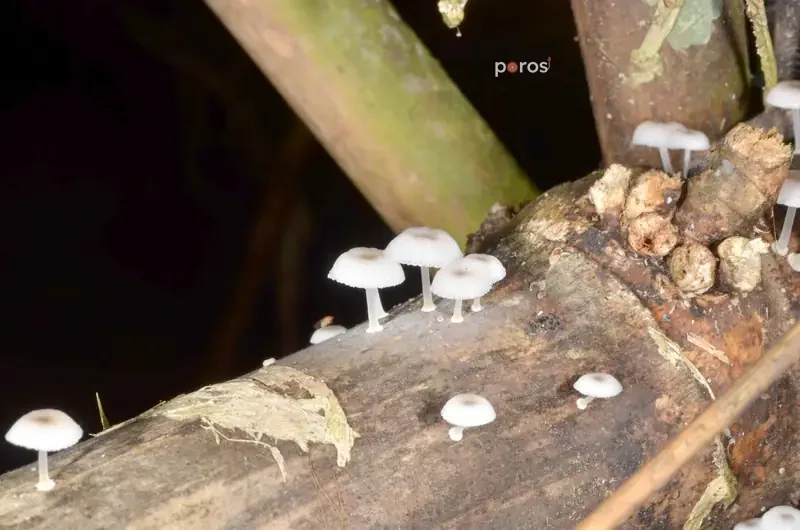
In habitat© Eugene Popov · CC BY 4.0


These are licensed records of this species; photos alone are not enough to identify a mushroom.
Is the green pepe poisonous?
Whether Mycena chlorophos is poisonous is unknown. If poisoning is suspected, call 112 at once (Turkish poison centre: 114) and keep any leftover mushroom.
Is the green pepe edible?
Its edibility is unknown; it is tiny and treated as inedible.
How to recognise it
Appearance of green pepe
No ring or volva Spore print: White Not distinctive.
When and where
When to find green pepe
No season data
It fruits in the rainy season, in early summer in Japan, and each fruit body lasts a day or two. It has no Turkish record, so it is not on our month lists.
Where does green pepe grow?
It grows in groups on decaying twigs, logs, palm and bamboo debris in warm, humid forests. Hachijō-jima in Japan is known for its glowing mushrooms.
In Turkey
There are no Turkish records on GBIF or iNaturalist (checked 2026-11-11). Mycena chlorophos is not known from Turkey; its natural range lies on other continents.
Our map has no observations of green pepe from Turkey yet.
Look-alikes
What could it be confused with?
Green pepe can be mistaken for the species below. Each comparison shows Green pepe on the left, the look-alike on the right, and how to tell them apart.
Take care when foraging: Poisonous look-alikes of Green pepe come first. If in doubt, leave it.

Ghost fungus Omphalotus nidiformis
How to tell Australia's ghost fungus also glows green, but it is much larger (up to 30 cm), funnel- or fan-shaped and poisonous.
Other look-alikes (1)
 Inedible
not Green pepe
Bitter oyster Panellus stipticus
The bitter oyster can also glow, but it is fan-shaped with a side stem and grows on dead hardwood in temperate forests.
Green pepe and its look-alikes compared
| Species | Status | Underside | Spore print | Season |
|---|---|---|---|---|
| Green pepeMycena chlorophos | Inedible | Whitish, fairly distant gills that glow in the dark | White | — |
| Ghost fungusOmphalotus nidiformis | Poisonous | Cream gills running down the stem | White | — |
| Bitter oysterPanellus stipticus | Inedible | Crowded, narrow cinnamon gills ending sharply at the stem | White | Jan–Feb, Apr, Aug–Sep |
The table is compiled from each species page. The status column is a guide only; do not eat a wild mushroom unless an expert has seen it in person. Compare look-alikes side by side
Whether Mycena chlorophos is poisonous is unknown. Some glowing fungi, such as Omphalotus species, are poisonous; glowing says nothing about edibility. Do not eat it. If poisoning is suspected, call 112 or the Turkish poison centre (114).
Frequently asked questions
Is the green pepe poisonous?
Whether Mycena chlorophos is poisonous is unknown. If poisoning is suspected, call 112 at once (Turkish poison centre: 114) and keep any leftover mushroom.
Is the green pepe edible?
Its edibility is unknown; it is tiny and treated as inedible.
How do you identify it?
A small, thin-stemmed mushroom that is pale grey-brown and sticky by day and whose cap and gills glow green at night, on rotting wood in tropical forest.
What can it be confused with?
The main look-alikes are: Ghost fungus, Bitter oyster. The differences are listed in the look-alikes section; with poisonous look-alikes, always check the cross-section and habitat.
Where does it grow?
It grows in groups on decaying twigs, logs, palm and bamboo debris in warm, humid forests. Hachijō-jima in Japan is known for its glowing mushrooms.
When does it appear?
It fruits in the rainy season, in early summer in Japan, and each fruit body lasts a day or two. It has no Turkish record, so it is not on our month lists.
How does it glow?
A compound called luciferin reacts with oxygen with the help of a luciferase enzyme and gives off green light. The fungal system was worked out in 2018 and is shared by all glowing fungi.
Are there glowing mushrooms in Turkey?
Mycena chlorophos has no Turkish record. Species recorded in Turkey that can glow include the jack-o'-lantern (Omphalotus olearius), honey fungus mycelium and the bitter oyster (Panellus stipticus).
When is green pepe season in Turkey?
It fruits in the rainy season, in early summer in Japan, and each fruit body lasts a day or two. It has no Turkish record, so it is not on our month lists.
Where does green pepe grow?
It grows in groups on decaying twigs, logs, palm and bamboo debris in warm, humid forests. Hachijō-jima in Japan is known for its glowing mushrooms.
Where is green pepe found in Turkey?
There are no Turkish records on GBIF or iNaturalist (checked 2026-11-11). Mycena chlorophos is not known from Turkey; its natural range lies on other continents.
What can green pepe be confused with?
Green pepe can be confused with ghost fungus (Omphalotus nidiformis, poisonous) and bitter oyster (Panellus stipticus, inedible). Look-alikes are compared on this page.
What is green pepe called in Turkish?
In Turkish, green pepe (Mycena chlorophos) is called Mycena chlorophos.
Related species
-
Bitter oysterPanellus stipticusInedible
-
 Mycena seyniiMycena seyniiInedible
-
 Pixie’s parasolMycena interruptaInedible
-
 Lilac bonnetMycena puraPoisonous
-
 Amethyst deceiverLaccaria amethystinaInedible
-
 Anemone stinkhornAseroe rubraInedible
-
 Artist’s bracketGanoderma applanatumInedible
-
 Barometer earthstarAstraeus hygrometricusInedible
Sources
- Wikipedia (EN): Mycena chlorophos en.wikipedia.org
- iNaturalist: Mycena chlorophos (takson, adlar ve fotoğraflar) inaturalist.org
- GBIF: Mycena chlorophos gbif.org
All sources (5)
- GBIF: Türkiye kayıtları gbif.org
- iNaturalist: Türkiye gözlemleri (araştırma düzeyi) inaturalist.org
Photo credits (11)
- Mycena chlorophos · iNaturalist #12474215 · Cheng-Tao Lin · CC BY 4.0
- Mycena chlorophos · iNaturalist #13671322 · Cheng-Tao Lin · CC BY 4.0
- Mycena chlorophos · iNaturalist #103473763 · Jie-Hao Ou · CC BY 4.0
- Mycena chlorophos · iNaturalist #13661903 · Cheng-Tao Lin · CC BY 4.0
- Mycena chlorophos · iNaturalist #307182008 · Licheng Shih · CC BY 4.0
- Mycena chlorophos · iNaturalist #14134052 · Chen Jia Hong · CC BY 4.0
- Mycena chlorophos · iNaturalist #299451902 · RT · CC BY 4.0
- Mycena chlorophos · iNaturalist #252783921 · Caleb Catto · CC BY 4.0
- Mycena chlorophos · iNaturalist #10540953 · Kristof Zyskowski · CC BY 4.0
- Mycena chlorophos · iNaturalist #307182010 · Licheng Shih · CC BY 4.0
- Mycena chlorophos · iNaturalist #29830495 · Eugene Popov · CC BY 4.0