
Common conecap (fool's conecap)
Pholiotina rugosa · Bolbitiaceae

Pholiotina rugosa (formerly Conocybe filaris), the common conecap, is a tiny mushroom with a 1–3 cm orange-brown, conical cap and a small but distinct movable ring on its slender stem. It carries the same amatoxins as the death cap and can be deadly despite its size. Because it grows on lawns, in gardens and on wood-chip mulch, children and pets that put it in their mouths are at risk. It has not been recorded in Turkey.
Also called: fool's conecap Turkish: Pholiotina rugosa Synonyms: Conocybe filaris, Pholiotina filaris, Conocybe rugosa
Last updated: Prepared by the Poros Mantar editorial team6 sources checkedReport a correction
DEADLY POISONOUS — keep it out of any basket of mushrooms to eat.
Pholiotina rugosa is deadly. According to sources it carries amatoxins including α- and β-amanitin; symptoms usually begin 6–12 hours after eating, sometimes as late as 24 hours, with vomiting and diarrhoea, and liver damage can follow (Şahin et al. 2023; CDC MMWR 2017). Its small size makes it especially dangerous for children and dogs. If poisoning is suspected, call 112 without waiting for symptoms (Turkish poison centre UZEM: 114) and keep any leftover mushroom.
Common conecap photos
-
© Michael (inski) · CC BY-SA 3.0
-

© Richard Jacob · CC BY 4.0
-

Gills© Mark Richman · CC BY 4.0
-

Stem© Kevin Popowich · CC BY 4.0
-

Gills© Kevin Popowich · CC BY 4.0
-

© Luke Smithson · CC BY-SA 4.0
-
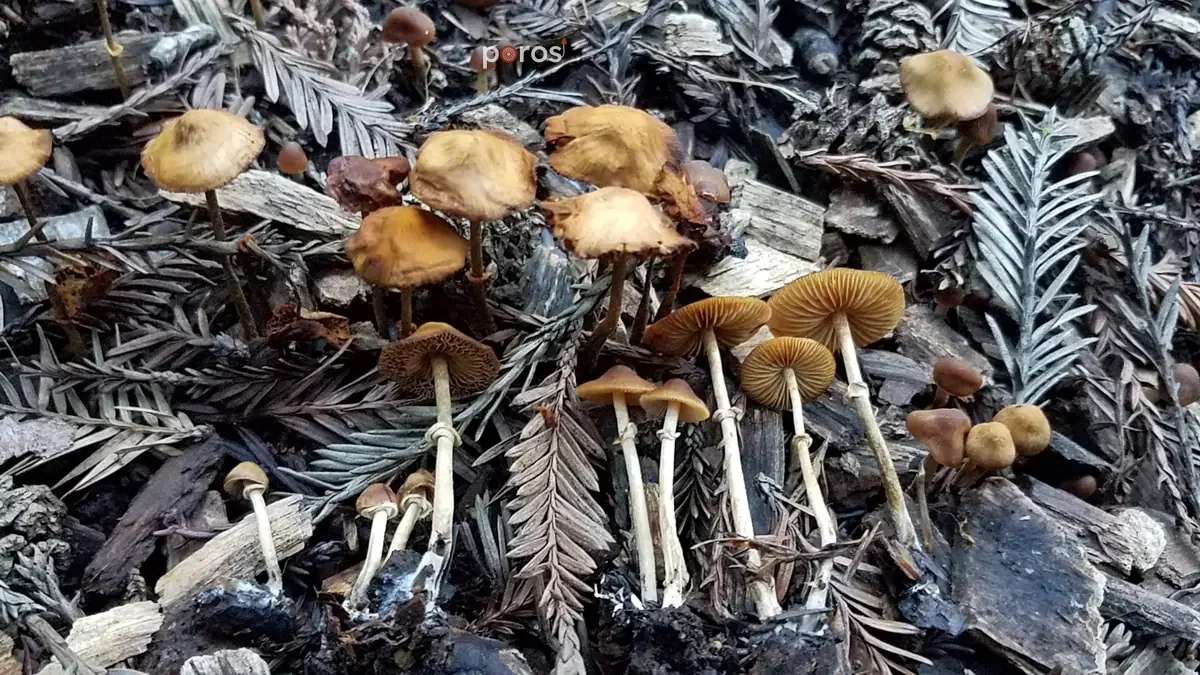
In habitat© Alan Rockefeller · CC BY 4.0
-

© Mandy Hackney · CC BY 4.0
-

Cap© fern Wildtruth · CC BY 4.0
-

© billyd at Mushroom Observer, a source for mycological images.You can · CC BY-SA 3.0


These are licensed records of this species; photos alone are not enough to identify a mushroom.
Are common conecaps poisonous?
Yes, common conecaps are deadly poisonous and must never be eaten. It carries the same amatoxins as the death cap. They can be mistaken for deadly galerina (Galerina marginata), fairy ring champignon (Marasmius oreades), liberty cap (Psilocybe semilanceata) and blue-staining panaeolus (Panaeolus cyanescens). If poisoning is suspected, call 112 at once (Turkish poison centre: 114) and keep any leftover mushroom.
Are common conecaps edible?
No, common conecaps must never be eaten; they are deadly poisonous. They can be picked by mistake for fairy ring champignon (Marasmius oreades). If poisoning is suspected, call 112 at once (Turkish poison centre: 114) and keep any leftover mushroom.
How to recognise it
Appearance of common conecaps
No volva Spore print: Rusty brown Not distinctive.
Where do common conecaps grow?
A saprotroph of wood chips, mulch, compost, watered lawns and garden soil, usually in groups.
In Turkey
There are no Turkish records: our map data (GBIF and iNaturalist) holds no observations from Turkey. It is common in Europe and North America, especially in towns where landscape mulch is used, and may well be overlooked in Turkish gardens and parks.
Our map has no observations of common conecaps from Turkey yet.
Look-alikes
What is it mistaken for?
Common conecap can be mistaken for the species below. Each comparison shows Common conecap on the left, the look-alike on the right, and how to tell them apart.
Deadly mix-up: Common conecap gets picked by people who think they have found one of the edible species below. If even one feature does not match, do not eat it.

Fairy ring champignon Marasmius oreades
How to tell The fairy ring champignon has no ring, a white spore print and a tough, bendy stem.
Other look-alikes (5)
 Deadly
not Common conecap
Deadly galerina Galerina marginata
The funeral bell grows in tufts on wood and is larger; it also carries amatoxins.
 Psilocybin
not Common conecap
Liberty cap Psilocybe semilanceata
The liberty cap has no ring on its stem and a purple-brown spore print.
 Psilocybin
not Common conecap
Blue-staining panaeolus Panaeolus cyanescens
Panaeolus cyanescens grows on dung; it has no ring, black-mottled gills and a black spore print, and bruises blue. Pholiotina rugosa has a small ring on the stem and a rusty brown spore print; it contains amatoxins and is deadly.
 Psilocybin
not Common conecap
Psilocybe cubensis (golden cap) Psilocybe cubensis
Psilocybe cubensis grows on manured pasture and also has a ring, but it is larger, has a dark purple-brown spore print and bruises blue. Pholiotina rugosa is smaller and more delicate, with a rusty brown spore print; it contains amatoxins and is deadly.
 Psilocybin
not Common conecap
Psilocybe mexicana Psilocybe mexicana
Psilocybe mexicana is a small, thin-stemmed mushroom of damp meadows; it has no ring, a dark purple-brown spore print and bruises blue. Pholiotina rugosa has a ring on the stem and a rusty brown spore print; it contains amatoxins and is deadly.
Common conecap and its look-alikes compared
| Species | Status | Underside | Spore print | Season |
|---|---|---|---|---|
| Common conecapPholiotina rugosa | Deadly poisonous | Adnate, fairly distant gills, pale ochre becoming rusty brown | Rusty brown | Jun–Nov |
| Deadly galerinaGalerina marginata | Deadly poisonous | Crowded, pale brown when young, tawny when mature | Rusty (snuff) brown | Aug–Nov |
| Fairy ring champignonMarasmius oreades | Edible species | Gills widely spaced, thick and whitish to cream, free or only just touching the stem, with short gills in between | White to pale cream | Apr–May, Sep–Dec |
| Liberty capPsilocybe semilanceata | Inedible · legally controlled | 15–27 narrow gills | Deep reddish purple-brown | Sep–Nov |
| Blue-staining panaeolusPanaeolus cyanescens | Inedible · legally controlled | Grey turning black, with a mottled look and white edges | Black | Jun–Oct |
| Psilocybe cubensis (golden cap)Psilocybe cubensis | Inedible · legally controlled | Narrow grey gills that turn purplish black and mottled with age | Dark purple-brown | Jun–Oct |
| Psilocybe mexicana | Inedible · legally controlled | Grey to purple-brown, with whitish edges | Dark purple-brown | Jun–Sep |
The table is compiled from each species page. The status column is a guide only; do not eat a wild mushroom unless an expert has seen it in person. Compare look-alikes side by side
Frequently asked questions
Are common conecaps poisonous?
Yes, common conecaps are deadly poisonous and must never be eaten. It carries the same amatoxins as the death cap. They can be mistaken for deadly galerina (Galerina marginata), fairy ring champignon (Marasmius oreades), liberty cap (Psilocybe semilanceata) and blue-staining panaeolus (Panaeolus cyanescens). If poisoning is suspected, call 112 at once (Turkish poison centre: 114) and keep any leftover mushroom.
Are common conecaps edible?
No, common conecaps must never be eaten; they are deadly poisonous. They can be picked by mistake for fairy ring champignon (Marasmius oreades). If poisoning is suspected, call 112 at once (Turkish poison centre: 114) and keep any leftover mushroom.
Is it the same as Conocybe filaris?
Yes. Conocybe filaris is the older name of the same species.
How do you recognise it?
A small orange-brown conical cap, a small movable ring midway up a very slender stem and a rusty brown spore print.
Where does it grow?
On wood chips, mulch, compost and watered lawns, especially in town gardens and parks.
Is it found in Turkey?
There are no Turkish records; it is common in Europe and North America and may be overlooked.
What if a child or dog eats one?
Even a single small mushroom can be dangerous. Call 112 without waiting for symptoms (UZEM: 114) and keep a sample.
When do symptoms start?
Usually 6–12 hours after eating, sometimes as late as 24 hours; the delay means the toxin has already been absorbed.
When is common conecap season in Turkey?
In our calendar, common conecap season runs Jun–Nov. Fruits from late June to November on watered lawns and wood-chip beds.
Where do common conecaps grow?
A saprotroph of wood chips, mulch, compost, watered lawns and garden soil, usually in groups.
Where are common conecaps found in Turkey?
There are no Turkish records: our map data (GBIF and iNaturalist) holds no observations from Turkey. It is common in Europe and North America, especially in towns where landscape mulch is used, and may well be overlooked in Turkish gardens and parks.
What can the common conecap be confused with?
The common conecap can be confused with deadly galerina (Galerina marginata, deadly), fairy ring champignon (Marasmius oreades, edible species), liberty cap (Psilocybe semilanceata, psilocybin), blue-staining panaeolus (Panaeolus cyanescens, psilocybin), psilocybe cubensis (golden cap) (Psilocybe cubensis, psilocybin) and psilocybe mexicana (Psilocybe mexicana, psilocybin). Look-alikes are compared on this page.
What is the common conecap called in Turkish?
In Turkish, the common conecap (Pholiotina rugosa) is called Pholiotina rugosa.
Related species
-
 Amanita proximaAmanita proximaDeadly poisonous
-
 Brown roll-rimPaxillus involutusDeadly poisonous
-
 Chestnut dapperlingLepiota castaneaDeadly poisonous
-
 Deadly dapperlingLepiota brunneoincarnataDeadly poisonous
-
 Deadly fibrecapInosperma erubescensDeadly poisonous
-
Deadly galerinaGalerina marginataDeadly poisonous
-
 Deadly webcapCortinarius rubellusDeadly poisonous
-
 Death capAmanita phalloidesDeadly poisonous
Sources
- Hallen ve ark. (2003), Mycol Res: Taxonomy and toxicity of Conocybe lactea and related species pubmed.ncbi.nlm.nih.gov
- CDC MMWR (2017): Amanita phalloides mushroom poisonings, Northern California, December 2016 cdc.gov
- Şahin ve ark. (2023), Recent Trends in Pharmacology: Assessment and management of poisonous mushrooms in Türkiye dergipark.org.tr
All sources (6)
- Wikipedia (EN): Pholiotina rugosa en.wikipedia.org
- iNaturalist: Pholiotina rugosa inaturalist.org
- GBIF: Türkiye kayıtları gbif.org
Photo credits (10)
- File:Pholiotina rugosa 62373.jpg · Michael (inski) · CC BY-SA 3.0
- Pholiotina rugosa · iNaturalist #239297773 · Richard Jacob · CC BY 4.0
- Pholiotina rugosa · iNaturalist #40560535 · Mark Richman · CC BY 4.0
- Pholiotina rugosa · iNaturalist #215042244 · Kevin Popowich · CC BY 4.0
- Pholiotina rugosa · iNaturalist #215042244 · Kevin Popowich · CC BY 4.0
- Pholiotina rugosa · iNaturalist #38832410 · Luke Smithson · CC BY-SA 4.0
- Pholiotina rugosa · iNaturalist #22316242 · Alan Rockefeller · CC BY 4.0
- Pholiotina rugosa · iNaturalist #341150659 · Mandy Hackney · CC BY 4.0
- Pholiotina rugosa · iNaturalist #261789443 · fern Wildtruth · CC BY 4.0
- File:Conocybe rugosa (Peck) Watling 944497.jpg · billyd at Mushroom Observer, a source for mycological images.You can · CC BY-SA 3.0

