
Red-belted conk (red-banded polypore)
Fomitopsis pinicola · Fomitopsidaceae

The red-belted conk (Fomitopsis pinicola) is a hard, woody, hoof-shaped bracket that lasts for years on conifers and hardwoods. Its top is dark brown to black with a distinct red-orange belt near the margin and a cream growing edge. It causes brown rot in wood. It is not edible.
Also called: red-belted conk, red-banded polypore Turkish: Çam kızılağlayanı, çam kızılağlayanı Synonyms: Boletus pinicola, Fomes pinicola
Last updated: Prepared by the Poros Mantar editorial team5 sources checkedReport a correction
Other brown mushrooms → · Other red mushrooms → · Other orange mushrooms →
Red-belted conk photos
-
© Roland Godon · CC BY 4.0
-

© Karol Filo III · CC BY 4.0
-

© Gonzalo Ganda Álvarez · CC BY 4.0
-

© Piotr Lukasik · CC BY 4.0
-

© rober025 · CC BY 4.0
-

© Sigrid Jakob · CC0
-

© Gilles San Martin · CC BY-SA 4.0
-

© Paulius Rupšas · CC BY 4.0
-

Pores© Евгений Маринкин · CC BY 4.0
-

Cap© George Chernilevsky · CC BY 4.0
-
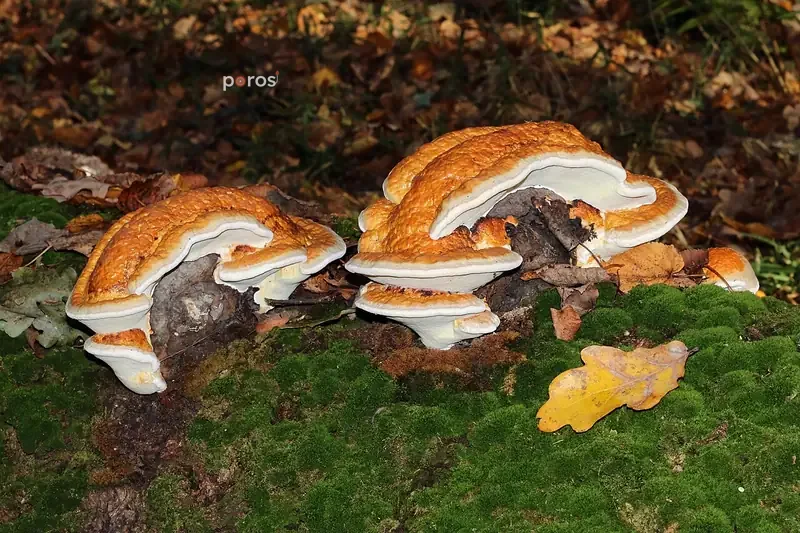
In habitat© George Chernilevsky · CC BY 4.0


These are licensed records of this species; photos alone are not enough to identify a mushroom.
Is the red-belted conk poisonous?
The red-belted conk is not known to be poisonous, but it is as hard as wood and not edible.
Is the red-belted conk edible?
No. It is as hard as wood and not edible; it is not known to be poisonous.
How to recognise it
Appearance of red-belted conk
No ring or volva Spore print: White to pale yellow Sourish, fungal.
When and where
When to find red-belted conk
Apr–Nov, Jan
It is perennial and visible all year; new growth is added in summer and autumn.
Where does red-belted conk grow?
It grows on dead or weakened spruce, fir, pine and beech trunks and stumps and plays a big part in breaking down wood. In Turkey it is seen most often in the beech–fir forests of the western Black Sea region.
Where is red-belted conk found in Turkey?
Our map data (GBIF and iNaturalist) holds 20 Turkish records: Bolu (7), Bartın (3), Kastamonu (2), İzmir (2), Osmaniye (1), Bursa (1), Karabük (1), Trabzon (1), Eskişehir (1), Muğla (1). The records are from January, April, May, June, July, August, September, October, November.
Which months
- Jan2
- Feb0
- Mar0
- Apr2
- May2
- Jun1
- Jul2
- Aug3
- Sep1
- Oct4
- Nov1
- Dec0
10 provinces, 18 observations (GBIF, iNaturalist); months from observation dates. Record density also reflects where observers work.
Latest red-belted conk observations
-
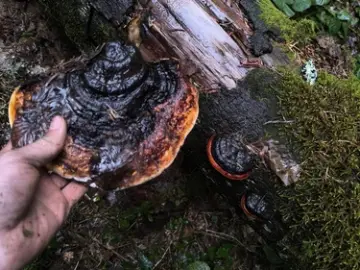 Bartın22 Apr 2026 · iNaturalist© Umut Nuri Erdoğan · CC BY
-
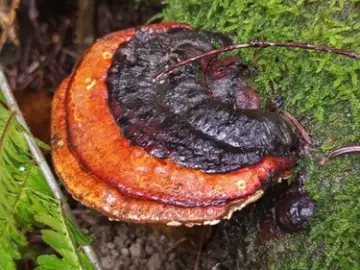 Bartın16 Nov 2024 · iNaturalist© Umut Nuri Erdoğan · CC BY
-
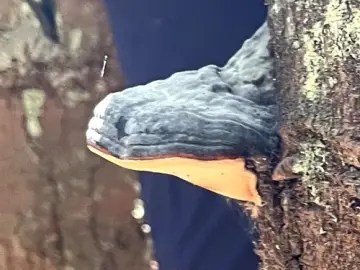 Kastamonu10 Jun 2024 · iNaturalist© Umut Nuri Erdoğan · CC BY
-
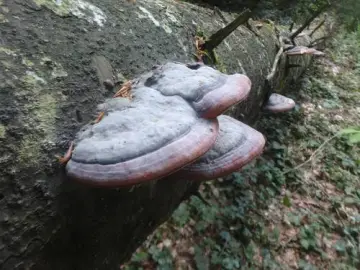 Karabük15 May 2022 · iNaturalist© Ben Costamagna · CC BY
-
 Illustrative
Bolu29 Oct 2026 · iNaturalist
-
 Illustrative
Osmaniye7 Jan 2025 · iNaturalist
-
 Illustrative
Bursa12 Oct 2024 · iNaturalist
-
 Illustrative
Bolu19 Apr 2023 · iNaturalist
- See on the map
On "illustrative" cards the image is a photo of the species; the observation photo cannot be shown here because of its licence, but can be seen at the source.
Look-alikes
What could it be confused with?
Red-belted conk can be mistaken for the species below. Each comparison shows Red-belted conk on the left, the look-alike on the right, and how to tell them apart.

Tinder fungus Fomes fomentarius
How to tell The tinder fungus is grey to silvery-banded on top, has no red belt and grows mostly on beech and birch.

Artist's bracket Ganoderma applanatum
How to tell The artist's bracket is flatter, its top is dusted with cocoa-brown spores and its white underside darkens when scratched.
Other look-alikes (2)
 Inedible
not Red-belted conk
Lacquered bracket Ganoderma resinaceum
The lacquered bracket has a varnished red-brown crust, is annual and grows mostly at the base of oaks.
 Inedible
not Red-belted conk
Birch polypore Fomitopsis betulina
The birch polypore is annual, grows only on birch, has a smooth pale brown skin on top and no red belt.
Red-belted conk and its look-alikes compared
| Species | Status | Underside | Spore print | Season |
|---|---|---|---|---|
| Red-belted conkFomitopsis pinicola | Inedible | Cream to pale yellow, very small pores | White to pale yellow | Jan, Apr–Nov |
| Tinder fungusFomes fomentarius | Inedible | No gills; cream underside that browns with age, with 2–3 round pores per millimetre | White to pale yellow | All year |
| Artist’s bracketGanoderma applanatum | Inedible | The underside is white to cream with very fine pores (4–6 per mm) | Cocoa brown; it dusts the top of the bracket and nearby surfaces | Mar, May, Jul–Oct |
| Lacquered bracketGanoderma resinaceum | Inedible | White to cream, small pores that brown when handled | Brown | Jun–Jan |
| Birch polyporeFomitopsis betulina | Inedible | White, very small pores that brown with age and peel away easily | White | — |
The table is compiled from each species page. The status column is a guide only; do not eat a wild mushroom unless an expert has seen it in person. Compare look-alikes side by side
The red-belted conk is not known to be poisonous, but it is as hard as wood and not edible. It is reportedly used as a tea in some countries; no medical benefit has been proven. If poisoning is suspected, call poison control.
Frequently asked questions
Is the red-belted conk poisonous?
The red-belted conk is not known to be poisonous, but it is as hard as wood and not edible.
Is the red-belted conk edible?
No. It is as hard as wood and not edible; it is not known to be poisonous.
How do you identify it?
A hard, hoof-shaped bracket on conifer or beech; dark on top with a red-orange belt near the margin, a cream growing edge and small cream pores.
What can it be confused with?
The main look-alikes are: Tinder fungus, Artist's bracket, Lacquered bracket. The differences are listed in the look-alikes section; with poisonous look-alikes, always check the cross-section and habitat.
Where does it grow?
It grows on dead or weakened spruce, fir, pine and beech trunks and stumps and plays a big part in breaking down wood. In Turkey it is seen most often in the beech–fir forests of the western Black Sea region.
When does it appear?
It is perennial and visible all year; new growth is added in summer and autumn.
Where does the Turkish name come from?
Çam kızılağlayanı (roughly 'red weeper of the pine') is the Turkish name used on iNaturalist; it comes from the red belt and the droplets it weeps in damp weather.
Does it harm the tree?
It mostly grows on dead or weakened trees and causes brown rot; on a living tree it can indicate that the trunk is decaying inside.
Is it found in Turkey?
Our map data (GBIF and iNaturalist) holds 20 Turkish records: Bolu (7), Bartın (3), Kastamonu (2), İzmir (2), Osmaniye (1), Bursa (1), Karabük (1), Trabzon (1), Eskişehir (1), Muğla (1). The records are from January, April, May, June, July, August, September, October, November.
When is red-belted conk season in Turkey?
In our calendar, red-belted conk season runs Apr–Nov, Jan. It is perennial and visible all year; new growth is added in summer and autumn.
Where does red-belted conk grow?
It grows on dead or weakened spruce, fir, pine and beech trunks and stumps and plays a big part in breaking down wood. In Turkey it is seen most often in the beech–fir forests of the western Black Sea region.
Where is red-belted conk found in Turkey?
Our map data (GBIF and iNaturalist) holds 20 Turkish records: Bolu (7), Bartın (3), Kastamonu (2), İzmir (2), Osmaniye (1), Bursa (1), Karabük (1), Trabzon (1), Eskişehir (1), Muğla (1). The records are from January, April, May, June, July, August, September, October, November.
What can red-belted conk be confused with?
Red-belted conk can be confused with tinder fungus (Fomes fomentarius, inedible), Artist's bracket (Ganoderma applanatum, inedible), lacquered bracket (Ganoderma resinaceum, inedible) and birch polypore (Fomitopsis betulina, inedible). Look-alikes are compared on this page.
What is red-belted conk called in Turkish?
In Turkish, red-belted conk (Fomitopsis pinicola) is called Çam kızılağlayanı.
Related species
-
Birch polyporeFomitopsis betulinaInedible
-
 Amethyst deceiverLaccaria amethystinaInedible
-
 Anemone stinkhornAseroe rubraInedible
-
Artist’s bracketGanoderma applanatumInedible
-
 Barometer earthstarAstraeus hygrometricusInedible
-
 Bitter boleteTylopilus felleusInedible
-
 Bitter oysterPanellus stipticusInedible
-
 Black witches’ butterExidia glandulosaInedible
Sources
- Wikipedia (EN): Fomitopsis pinicola en.wikipedia.org
- iNaturalist: Fomitopsis pinicola (takson, adlar ve fotoğraflar) inaturalist.org
- GBIF: Fomitopsis pinicola gbif.org
All sources (5)
- GBIF: Türkiye kayıtları gbif.org
- iNaturalist: Türkiye gözlemleri (araştırma düzeyi) inaturalist.org
Photo credits (15)
- Fomitopsis pinicola · iNaturalist #331548896 · Roland Godon · CC BY 4.0
- Fomitopsis pinicola · iNaturalist #184556014 · Karol Filo III · CC BY 4.0
- Fomitopsis pinicola · iNaturalist #206594464 · Gonzalo Ganda Álvarez · CC BY 4.0
- Fomitopsis pinicola · iNaturalist #141054583 · Piotr Lukasik · CC BY 4.0
- Fomitopsis pinicola · iNaturalist #66886782 · rober025 · CC BY 4.0
- Fomitopsis pinicola · iNaturalist #150568190 · Sigrid Jakob · CC0
- Fomitopsis pinicola · iNaturalist #105046991 · Gilles San Martin · CC BY-SA 4.0
- Fomitopsis pinicola · iNaturalist #151913798 · Paulius Rupšas · CC BY 4.0
- Fomitopsis pinicola · iNaturalist #407816842 · Евгений Маринкин · CC BY 4.0
- File:Fomitopsis pinicola 2025 G1.jpg · George Chernilevsky · CC BY 4.0
- File:Fomitopsis pinicola 2023 G1.jpg · George Chernilevsky · CC BY 4.0
- iNaturalist: Bartın, 22 Apr 2026 · Umut Nuri Erdoğan · CC BY
- iNaturalist: Bartın, 16 Nov 2024 · Umut Nuri Erdoğan · CC BY
- iNaturalist: Kastamonu, 10 Jun 2024 · Umut Nuri Erdoğan · CC BY
- iNaturalist: Karabük, 15 May 2022 · Ben Costamagna · CC BY

