
Scarlet elf cup (scarlet cup)
Sarcoscypha coccinea · Sarcoscyphaceae

The scarlet elf cup (Sarcoscypha coccinea) is a cup fungus 1–5 cm across that appears in winter and early spring on mossy, fallen, rotting twigs, bright scarlet inside and whitish and downy outside. It is one of the most striking colours on the winter forest floor. Some sources say it is edible when cooked, but it is small and insubstantial; our advice is not to eat it.
Also called: scarlet elf cup, scarlet cup Turkish: Kırmız peri kasesi, kırmız peri kasesi Synonyms: Peziza coccinea
Last updated: Prepared by the Poros Mantar editorial team5 sources checkedReport a correction
Scarlet elf cup photos
-
© T. Pedro Hafermann · CC0
-

© Lucian Clanet · CC BY 4.0
-

© Harry Podschwit · CC BY 4.0
-

© sharoncooper · CC BY 4.0
-

© Davide Puddu · CC BY 4.0
-

© Benjamin Hidalgo · CC BY 4.0
-

© Ryane Snow (snowman) at Mushroom Observer, a source for mycological i · CC BY-SA 3.0
-

© Erik E · CC0
-
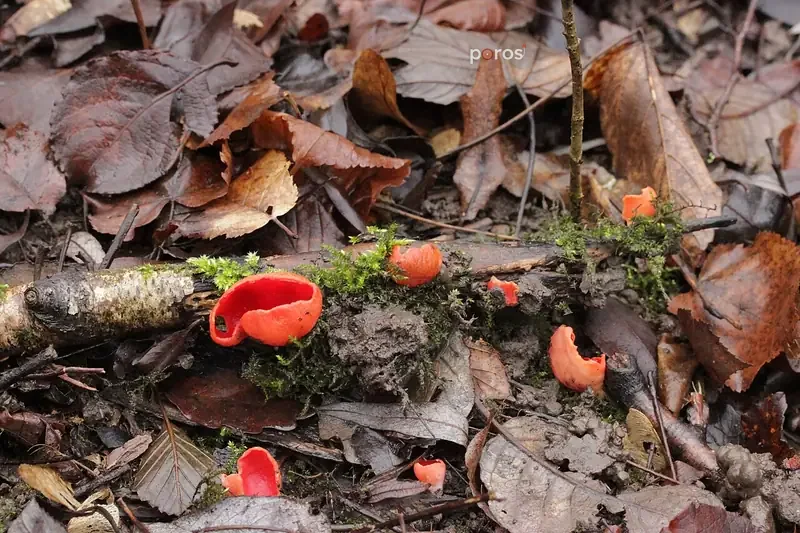
In habitat© bjoerns · CC BY-SA 4.0
-

Spore print© bjoerns · CC BY-SA 4.0
-

Cap© bjoerns · CC BY-SA 4.0


These are licensed records of this species; photos alone are not enough to identify a mushroom.
Is the scarlet elf cup poisonous?
The scarlet elf cup is not known to be poisonous, and some sources say it is edible when cooked.
Is the scarlet elf cup edible?
Some sources say it is edible when cooked, but it is small and insubstantial; our advice is not to eat it.
How to recognise it
Appearance of scarlet elf cup
No ring or volva Spore print: White Not distinctive.
Where does scarlet elf cup grow?
It grows on fallen, moss-covered, rotting twigs of hazel, willow, maple and oak in damp broadleaf woods and along streams.
Where is scarlet elf cup found in Turkey?
Our map data (GBIF and iNaturalist) holds 4 Turkish records: Istanbul (3), Trabzon (1). The records are from January, February, December. GBIF lists 8 Turkish records in total, including literature surveys.
Which months
- Jan1
- Feb1
- Mar1
- Apr0
- May0
- Jun0
- Jul0
- Aug0
- Sep0
- Oct0
- Nov0
- Dec2
2 provinces, 5 observations (GBIF, iNaturalist); months from observation dates. Record density also reflects where observers work.
Latest scarlet elf cup observations
-
 Illustrative
Trabzon23 Dec 2024 · iNaturalist
-
 Illustrative
İstanbul13 Dec 2024 · Mushroom Observer
-
 Illustrative
İstanbul20 Feb 2024 · Mushroom Observer
-
 Illustrative
İstanbul25 Jan 2020 · Mushroom Observer
-
 Illustrative
İstanbul2 Mar 2016 · Observation.org, Nature data from around the World
- See on the map
On "illustrative" cards the image is a photo of the species; the observation photo cannot be shown here because of its licence, but can be seen at the source.
Look-alikes
What could it be confused with?
Scarlet elf cup can be mistaken for the species below. Each comparison shows Scarlet elf cup on the left, the look-alike on the right, and how to tell them apart.

Orange peel fungus Aleuria aurantia
How to tell The orange peel fungus is orange rather than scarlet, grows on bare soil and paths in autumn, and has no stalk.
Scarlet elf cup (Austrian) Sarcoscypha austriaca
How to tell Sarcoscypha austriaca looks almost identical; it is separated by the curled hairs on the outer surface seen under a microscope.
The scarlet elf cup is not known to be poisonous, and some sources say it is edible when cooked. It is small, and the edibility of some red cup fungi is unknown; our advice is not to eat it. If poisoning is suspected, call poison control.
Frequently asked questions
Is the scarlet elf cup poisonous?
The scarlet elf cup is not known to be poisonous, and some sources say it is edible when cooked.
Is the scarlet elf cup edible?
Some sources say it is edible when cooked, but it is small and insubstantial; our advice is not to eat it.
How do you identify it?
In winter, a cup 1–5 cm across on a mossy, fallen, rotting twig, bright scarlet inside, whitish and downy outside, with a short stalk.
What can it be confused with?
The main look-alikes are: Orange peel fungus, Scarlet elf cup. The differences are listed in the look-alikes section; with poisonous look-alikes, always check the cross-section and habitat.
Where does it grow?
It grows on fallen, moss-covered, rotting twigs of hazel, willow, maple and oak in damp broadleaf woods and along streams.
When does it appear?
It appears in winter and early spring, December to March; our Turkish records are from December, January and February.
Where does the Turkish name come from?
Kırmız peri kasesi ('kermes fairy cup') is the Turkish name used on iNaturalist; kırmız is the old name for the kermes insect used to make crimson dye, and for that colour.
Why does it appear in winter?
It likes cool, damp weather; its mycelium in rotting twigs fruits in winter and early spring, making it one of the first fungi of the year in deciduous woods.
Is it found in Turkey?
Our map data (GBIF and iNaturalist) holds 4 Turkish records: Istanbul (3), Trabzon (1). The records are from January, February, December. GBIF lists 8 Turkish records in total, including literature surveys.
When is scarlet elf cup season in Turkey?
In our calendar, scarlet elf cup season runs Dec–Feb. It appears in winter and early spring, December to March; our Turkish records are from December, January and February.
Where does scarlet elf cup grow?
It grows on fallen, moss-covered, rotting twigs of hazel, willow, maple and oak in damp broadleaf woods and along streams.
Where is scarlet elf cup found in Turkey?
Our map data (GBIF and iNaturalist) holds 4 Turkish records: Istanbul (3), Trabzon (1). The records are from January, February, December. GBIF lists 8 Turkish records in total, including literature surveys.
What can scarlet elf cup be confused with?
Scarlet elf cup can be confused with orange peel fungus (Aleuria aurantia, inedible) and scarlet elf cup (Austrian) (Sarcoscypha austriaca, inedible). Look-alikes are compared on this page.
What is scarlet elf cup called in Turkish?
In Turkish, scarlet elf cup (Sarcoscypha coccinea) is called Kırmız peri kasesi.
Related species
-
 Amethyst deceiverLaccaria amethystinaInedible
-
 Anemone stinkhornAseroe rubraInedible
-
 Artist’s bracketGanoderma applanatumInedible
-
 Barometer earthstarAstraeus hygrometricusInedible
-
 Birch polyporeFomitopsis betulinaInedible
-
 Bitter boleteTylopilus felleusInedible
-
 Bitter oysterPanellus stipticusInedible
-
 Black witches’ butterExidia glandulosaInedible
Sources
- Wikipedia (EN): Sarcoscypha coccinea en.wikipedia.org
- iNaturalist: Sarcoscypha coccinea (takson, adlar ve fotoğraflar) inaturalist.org
- GBIF: Sarcoscypha coccinea gbif.org
All sources (5)
- GBIF: Türkiye kayıtları gbif.org
- iNaturalist: Türkiye gözlemleri (araştırma düzeyi) inaturalist.org
Photo credits (11)
- Sarcoscypha coccinea · iNaturalist #200103117 · T. Pedro Hafermann · CC0
- Sarcoscypha coccinea · iNaturalist #338707263 · Lucian Clanet · CC BY 4.0
- Sarcoscypha coccinea · iNaturalist #37930326 · Harry Podschwit · CC BY 4.0
- Sarcoscypha coccinea · iNaturalist #260164032 · sharoncooper · CC BY 4.0
- Sarcoscypha coccinea · iNaturalist #19162160 · Davide Puddu · CC BY 4.0
- Sarcoscypha coccinea · iNaturalist #286932942 · Benjamin Hidalgo · CC BY 4.0
- File:Sarcoscypha coccinea 74716.jpg · Ryane Snow (snowman) at Mushroom Observer, a source for mycological i · CC BY-SA 3.0
- File:Sarcoscypha coccinea 114861133.jpg · Erik E · CC0
- File:Sarcoscypha coccinea 109863763.jpg · bjoerns · CC BY-SA 4.0
- File:Sarcoscypha coccinea 109863984.jpg · bjoerns · CC BY-SA 4.0
- File:Sarcoscypha coccinea 109863694.jpg · bjoerns · CC BY-SA 4.0


