
Yellow knight (man on horseback)
Tricholoma equestre · Tricholomataceae

The yellow knight (Tricholoma equestre) is a knight of sandy pine forests with a yellow to greenish-yellow cap and sulphur-yellow gills. For a long time it was considered a good edible mushroom; but in France and Poland people who ate it at several meals in a row developed muscle breakdown (rhabdomyolysis), and some died. Its sale has been banned in France since 2004. In Turkey there are GBIF records from Istanbul and Izmir.
Also called: man on horseback Turkish: Kükürt cincile Synonyms: Tricholoma flavovirens, Tricholoma auratum
Last updated: Prepared by the Poros Mantar editorial team5 sources checkedReport a correction
POISONOUS — do not eat.
The yellow knight should be treated as poisonous. According to sources people who ate it at several meals in a row developed muscle pain, weakness, dark urine and muscle breakdown (rhabdomyolysis) 24–72 hours later; in severe cases heart and breathing muscles were affected and deaths were reported. Older books listing it as edible are therefore out of date. If muscle pain or dark urine appears in the days after a mushroom meal, call 112 (Turkish poison centre UZEM: 114).
Yellow knight photos
-
© mycowalt · CC BY-SA 4.0
-

© Alan Rockefeller · CC BY 4.0
-

Gills© Veeti Varjo · CC0
-

Cap© Alan Rockefeller · CC BY 4.0
-

© Виктория Билоус · CC BY 4.0
-

Stem© Alan Rockefeller · CC BY 4.0
-

Gills© Mary K. Hanson · CC BY 4.0
-

Cap© Viktoria Bilous · CC BY 4.0
-

Gills© Peter Gabler · CC0
-

Stem© mycowalt · CC BY-SA 4.0
-

Cap© pinonbistro · CC BY-SA 4.0


These are licensed records of this species; photos alone are not enough to identify a mushroom.
Is the yellow knight poisonous?
Yes, the yellow knight is poisonous and must not be eaten. it should be treated as poisonous. Muscle breakdown (rhabdomyolysis) and deaths have been reported in people who ate it at several meals in a row. If poisoning is suspected, call 112 at once (Turkish poison centre: 114) and keep any leftover mushroom.
Is the yellow knight edible?
No, the yellow knight must not be eaten; it is poisonous. If poisoning is suspected, call 112 at once (Turkish poison centre: 114) and keep any leftover mushroom.
How to recognise it
Appearance of yellow knight
No ring or volva Spore print: White Faintly mealy.
Where does yellow knight grow?
Mycorrhizal mainly with pine, sometimes with beech and poplar; grows on sandy, dry, acid soils, including coastal pine forest.
Where is yellow knight found in Turkey?
Our map data holds four GBIF records from Turkey (Istanbul, Izmir) and two research-grade iNaturalist observations. Its Turkish name on iNaturalist is Kükürt Cincile (sulphur knight).
Which months
- Jan1
- Feb0
- Mar0
- Apr0
- May0
- Jun0
- Jul0
- Aug0
- Sep0
- Oct0
- Nov1
- Dec0
2 provinces, 2 observations (GBIF, iNaturalist); months from observation dates. Record density also reflects where observers work.
Latest yellow knight observations
-
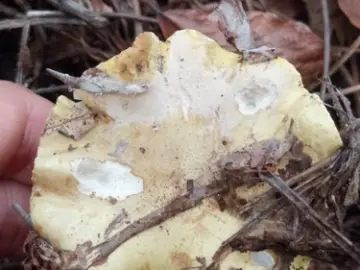 İstanbul23 Nov 2025 · iNaturalist© Umut Nuri Erdoğan · CC BY
-
 Illustrative
İzmir5 Jan 2019 · iNaturalist
- See on the map
On "illustrative" cards the image is a photo of the species; the observation photo cannot be shown here because of its licence, but can be seen at the source.
Look-alikes
What is it mistaken for?
Yellow knight can be mistaken for the species below. Each comparison shows Yellow knight on the left, the look-alike on the right, and how to tell them apart.

Sulphur knight Tricholoma sulphureum
How to tell The sulphur knight is yellow all over but has a dry cap and a strong smell like coal gas.
Other look-alikes (1)
not Yellow knight
Yellow swamp brittlegill Russula claroflava
The yellow swamp brittlegill has brittle flesh and pale yellow gills and grows under birch in wet places.
Frequently asked questions
Is the yellow knight poisonous?
Yes, the yellow knight is poisonous and must not be eaten. it should be treated as poisonous. Muscle breakdown (rhabdomyolysis) and deaths have been reported in people who ate it at several meals in a row. If poisoning is suspected, call 112 at once (Turkish poison centre: 114) and keep any leftover mushroom.
Is the yellow knight edible?
No, the yellow knight must not be eaten; it is poisonous. If poisoning is suspected, call 112 at once (Turkish poison centre: 114) and keep any leftover mushroom.
Wasn't it once considered edible?
Yes, for centuries. That changed when 12 cases of muscle breakdown (three fatal) seen in France between 1992 and 2000 after repeated meals were published in 2001, followed by cases in Poland; France banned its sale in 2004.
What are the symptoms?
According to sources after 24–72 hours: muscle pain, weakness, dark urine and sweating; heart and breathing problems in severe cases. If in doubt, call 112.
Is it found in Turkey?
Yes. GBIF holds four records from Istanbul and Izmir and iNaturalist two observations. Its Turkish name on iNaturalist is Kükürt Cincile.
How is it confused with the death cap?
Both have yellowish-green caps. The yellow knight has yellow gills and no volva; the death cap has white gills, a ring and a volva.
Where does it grow?
In sandy, dry pine forests, often near the coast, in late autumn.
Is eating it once dangerous?
The severe cases reported mostly involved several meals in a row, but no safe amount is known; it should not be eaten at all.
When is yellow knight season in Turkey?
In our calendar, yellow knight season runs Sep–Dec. Fruits in late autumn, from September to December, in sandy pine forests.
Where does yellow knight grow?
Mycorrhizal mainly with pine, sometimes with beech and poplar; grows on sandy, dry, acid soils, including coastal pine forest.
Where is yellow knight found in Turkey?
Our map data holds four GBIF records from Turkey (Istanbul, Izmir) and two research-grade iNaturalist observations. Its Turkish name on iNaturalist is Kükürt Cincile (sulphur knight).
What can yellow knight be confused with?
Yellow knight can be confused with death cap (Amanita phalloides, deadly), sulphur knight (Tricholoma sulphureum, poisonous) and yellow swamp brittlegill (Russula claroflava, inedible). Look-alikes are compared on this page.
What is yellow knight called in Turkish?
In Turkish, yellow knight (Tricholoma equestre) is called Kükürt cincile.
Related species
-
 Tiger tricholomaTricholoma pardinumPoisonous
-
 Anatolian matsutakeTricholoma anatolicumEdible species
-
 Aniseed funnelClitocybe odoraEdible species
-
 Field blewitLepista personataEdible species
-
 Fool’s funnelClitocybe rivulosaDeadly poisonous
-
 Grey knightTricholoma terreumInedible
-
 MatsutakeTricholoma matsutakeEdible species
-
 Tawny funnelParalepista flaccidaInedible
Sources
- Chodorowski ve ark. (2002), Przegl Lek: Acute poisoning with Tricholoma equestre pubmed.ncbi.nlm.nih.gov
- Afssa/ANSES (2005): Tricholoma equestre satış yasağı kararname taslağı hakkında görüş (1992–2000 arası 12 vaka, 3 ölüm; 16.06.2004 bakanlık kararı) anses.fr
- Wikipedia (EN): Tricholoma equestre en.wikipedia.org
All sources (5)
- iNaturalist: Tricholoma equestre (Türkçe ad) inaturalist.org
- GBIF: Türkiye kayıtları gbif.org
Photo credits (12)
- File:Tricholoma equestre 13086453.jpg · mycowalt · CC BY-SA 4.0
- Tricholoma equestre · iNaturalist #4744527 · Alan Rockefeller · CC BY 4.0
- Tricholoma equestre · iNaturalist #183837798 · Veeti Varjo · CC0
- Tricholoma equestre · iNaturalist #4744527 · Alan Rockefeller · CC BY 4.0
- Tricholoma equestre · iNaturalist #50585804 · Виктория Билоус · CC BY 4.0
- Tricholoma equestre · iNaturalist #2621902 · Alan Rockefeller · CC BY 4.0
- Tricholoma equestre · iNaturalist #67875586 · Mary K. Hanson · CC BY 4.0
- File:Tricholoma equestre 97146702.jpg · Viktoria Bilous · CC BY 4.0
- File:Tricholoma equestre 54044044.jpg · Peter Gabler · CC0
- Tricholoma equestre · iNaturalist #9592927 · mycowalt · CC BY-SA 4.0
- File:Tricholoma equestre 24558285.jpg · pinonbistro · CC BY-SA 4.0
- iNaturalist: İstanbul, 23 Nov 2025 · Umut Nuri Erdoğan · CC BY


