
Chaga (clinker polypore, birch canker polypore)
Inonotus obliquus · Hymenochaetaceae

Chaga (Inonotus obliquus) is a hard lump that grows mostly on living birch trunks, charcoal-black and cracked outside and rusty orange inside. The lump is not the fruiting body but a sterile mass of mycelium and wood. It has been used as a tea for centuries in Russia, Siberia and northern Europe. It is not eaten as food.
Also called: chaga, clinker polypore, birch canker polypore, cinder conk Turkish: Çaga mantarı, chaga, çaga
Last updated: Prepared by the Poros Mantar editorial team5 sources checkedReport a correction
Chaga photos
-
© Eric Vehe · CC0
-

© Matt Bowser · CC BY 4.0
-

© Pierre Cartier · CC0
-

Cross-section© Pierre Cartier · CC0
-

Cross-section© Vince La Tassa · CC0
-
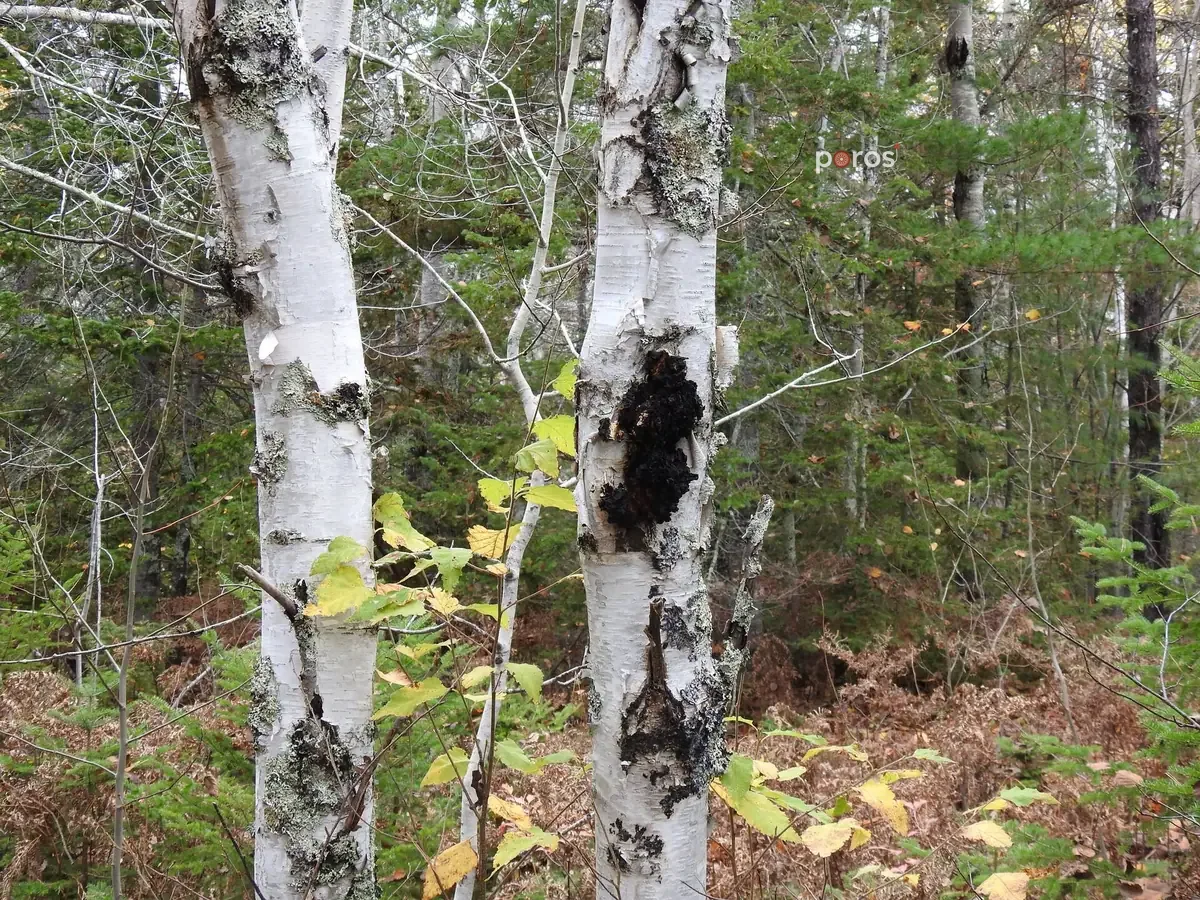
In habitat© Alexis Godin · CC BY 4.0
-

Cross-section© JBouchez · CC BY-SA 4.0
-

© David McCorquodale · CC BY 4.0
-
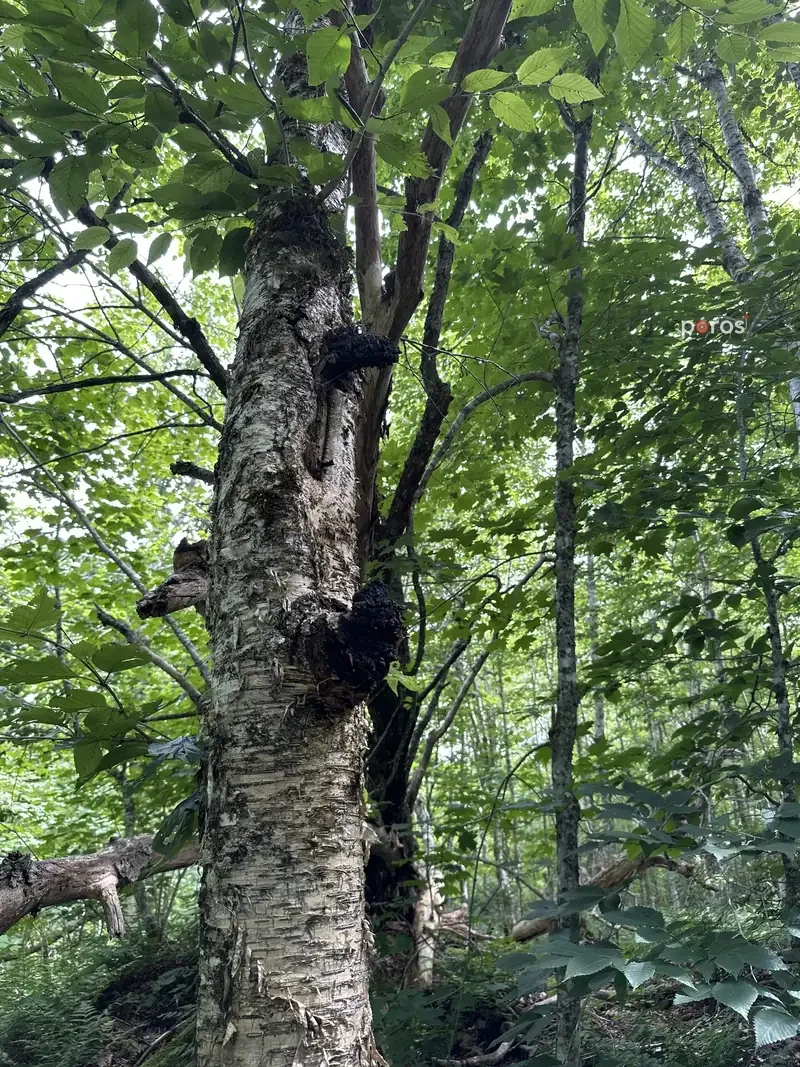
In habitat© Mary E. Macaulay, P.Eng. · CC BY 4.0
-

© Полина Полежанкина · CC BY 4.0


These are licensed records of this species; photos alone are not enough to identify a mushroom.
Is the chaga poisonous?
If kidney pain, reduced urine or other symptoms follow chaga use, call 112 or the Turkish poison centre (114). If poisoning is suspected, call 112 at once (Turkish poison centre: 114) and keep any leftover mushroom.
Is the chaga edible?
We advise against eating it. Chaga is not eaten as food; it is traditionally dried and made into tea. It is very high in oxalate, and kidney damage has been reported after long-term use of large amounts of chaga powder. It may affect blood sugar and clotting. Its traditional use does not make it a treatment; ask your doctor if you have an illness or take medicines. If kidney pain, reduced urine or other symptoms follow chaga use, call 112 or the Turkish poison centre (114).
How to recognise it
Appearance of chaga
No ring or volva Spore print: Brown Not distinctive.
When and where
When to find chaga
All year
Chaga's charcoal-black lump is perennial and visible all year; it is traditionally gathered mostly in winter.
Where does chaga grow?
It grows in cool and cold forests, mostly from wounds on living birch trunks and occasionally on alder, beech and elm, killing the tree over years.
Where is chaga found in Turkey?
Turkish records are very scarce: GBIF holds one record from Bolu and iNaturalist has one research-grade observation; birch has a limited natural range in Turkey. Worldwide it ranges through the birch forests of Russia, Siberia, Scandinavia, northern Europe, Canada, the northern USA, Korea and Japan.
- Bolu1
Which months
- Jan0
- Feb0
- Mar0
- Apr0
- May0
- Jun0
- Jul0
- Aug0
- Sep0
- Oct1
- Nov0
- Dec0
1 provinces, 1 observations (GBIF, iNaturalist); months from observation dates. Record density also reflects where observers work.
Latest chaga observations
 Illustrative
On "illustrative" cards the image is a photo of the species; the observation photo cannot be shown here because of its licence, but can be seen at the source.
Look-alikes
What could it be confused with?
Chaga can be mistaken for the species below. Each comparison shows Chaga on the left, the look-alike on the right, and how to tell them apart.

Tinder fungus Fomes fomentarius
How to tell It is a hoof-shaped, grey to grey-brown, crusty bracket with pores underneath and brown flesh; it does not form a black, cracked lump.

Willow bracket Phellinus igniarius
How to tell A hoof-shaped bracket with a grey to blackish, cracked upper surface and brown pores underneath.
What it contains
Betulinic acid, polysaccharides and phenolic compounds in chaga are being studied; no therapeutic effect in humans has been proven. It is high in oxalate.
General information, not a health claim.
Chaga is not eaten as food; it is traditionally dried and made into tea. It is very high in oxalate, and kidney damage has been reported after long-term use of large amounts of chaga powder. It may affect blood sugar and clotting. Its traditional use does not make it a treatment; ask your doctor if you have an illness or take medicines. If kidney pain, reduced urine or other symptoms follow chaga use, call 112 or the Turkish poison centre (114).
Grow it, buy it
Chaga price list

A dark, earthy brew from chunks of chaga that grows on birch trees.
450 ₺
| Product | Poros Mantar | Market |
|---|---|---|
| Chaga tea | 450 ₺ | — |
| Chaga capsules (food supplement) | Made to order · ask | — |
We make our chaga products in small batches, to order; send a request and we email you the price and delivery date. The market column shows prices seen on other sellers' pages on the date given; they are not our prices and may have changed.
Frequently asked questions
Is the chaga poisonous?
If kidney pain, reduced urine or other symptoms follow chaga use, call 112 or the Turkish poison centre (114). If poisoning is suspected, call 112 at once (Turkish poison centre: 114) and keep any leftover mushroom.
Is the chaga edible?
We advise against eating it. Chaga is not eaten as food; it is traditionally dried and made into tea. It is very high in oxalate, and kidney damage has been reported after long-term use of large amounts of chaga powder. It may affect blood sugar and clotting. Its traditional use does not make it a treatment; ask your doctor if you have an illness or take medicines. If kidney pain, reduced urine or other symptoms follow chaga use, call 112 or the Turkish poison centre (114).
What is chaga?
It is a hard lump growing mostly on living birch trunks, charcoal-black outside and rusty orange inside, made of fungal mycelium and wood.
Is chaga edible?
It is not eaten as food; it is far too hard. Traditionally it is dried and powdered or simmered in pieces to make tea.
Does chaga have side effects?
Chaga is very high in oxalate; kidney damage has been reported in people using large amounts of chaga powder for long periods. It may affect blood sugar and clotting. Its traditional use does not make it a treatment; ask your doctor if you have an illness or take medicines.
Where is chaga found in Turkey?
Records are very scarce: GBIF holds one record from Bolu and iNaturalist has one observation. It is rare because birch has a limited natural range in Turkey.
How do you tell it from the tinder fungus?
The tinder fungus is a hoof-shaped grey bracket with pores underneath. Chaga is a shapeless, black, cracked lump with a bright orange inside.
Does chaga harm the tree?
Yes. It is a parasite that rots the tree from inside and kills it over years; the true fruiting body forms only after the tree dies.
Can chaga be cultivated?
The lump cannot be produced in cultivation. Its mycelium can be grown in the laboratory, but that is not the same as the wild lump.
When is chaga season in Turkey?
In our calendar, chaga is recorded all year. Chaga's charcoal-black lump is perennial and visible all year; it is traditionally gathered mostly in winter.
Where does chaga grow?
It grows in cool and cold forests, mostly from wounds on living birch trunks and occasionally on alder, beech and elm, killing the tree over years.
What can chaga be confused with?
Chaga can be confused with tinder fungus (Fomes fomentarius, inedible) and willow bracket (Phellinus igniarius, inedible). Look-alikes are compared on this page.
What is chaga called in Turkish?
In Turkish, chaga (Inonotus obliquus) is called Çaga mantarı; other local names include chaga and çaga.
Related species
-
 Shaggy bracketInonotus hispidusInedible
-
 Tufted bracketFuscoporia torulosaInedible
-
 Amethyst deceiverLaccaria amethystinaInedible
-
 Anemone stinkhornAseroe rubraInedible
-
 Artist’s bracketGanoderma applanatumInedible
-
 Barometer earthstarAstraeus hygrometricusInedible
-
 Birch polyporeFomitopsis betulinaInedible
-
 Bitter boleteTylopilus felleusInedible
Sources
Photo credits (10)
- Inonotus obliquus · iNaturalist #17498475 · Eric Vehe · CC0
- Inonotus obliquus sterilis · iNaturalist #21678136 · Matt Bowser · CC BY 4.0
- Inonotus obliquus · iNaturalist #219124265 · Pierre Cartier · CC0
- Inonotus obliquus · iNaturalist #73015379 · Pierre Cartier · CC0
- Inonotus obliquus sterilis · iNaturalist #85218044 · Vince La Tassa · CC0
- File:Inonotus obliquus 164284454.jpg · Alexis Godin · CC BY 4.0
- File:Chaga (Inonotus obliquus) de 4,2 kg.jpg · JBouchez · CC BY-SA 4.0
- File:Inonotus obliquus (Nova Scotia, Canada).jpg · David McCorquodale · CC BY 4.0
- Inonotus obliquus · iNaturalist #232598621 · Mary E. Macaulay, P.Eng. · CC BY 4.0
- Inonotus obliquus · iNaturalist #412812701 · Полина Полежанкина · CC BY 4.0


