
Milk-white brittlegill (milk-white russula)
Russula delica · Russulaceae

The milk-white brittlegill (Russula delica) is a stout woodland mushroom with a large, dirty-white cap that is sunken in the middle and opens into a funnel, a short thick stem and no milk. It often comes up half buried, carrying soil and leaves on its cap. It is widely gathered in Turkey, where it is known as akçıntar, koçak (goçak), goçmar and yeryaran in Kastamonu and as yeryaran and toz mantarı in Giresun. European guides call it edible but poor; in Anatolia it is fried, pickled and canned. Because of its milky, acrid look-alikes and deadly white mushrooms, never eat one without an expert's identification.
Also called: milk-white russula Turkish: Akçıntar mantarı, koçak, goçak, goçmar, goç mantarı, yeryaran, ak yeryaran, gübür galduran
Last updated: Prepared by the Poros Mantar editorial team9 sources checkedReport a correction
Milk-white brittlegill photos
-

© Holger Krisp · CC BY 3.0
-

Gills© Claude PAGE · CC BY-SA 4.0
-

Cap© open_a_ir · CC BY 4.0
-

Stem© gailhampshire from Cradley, Malvern, U.K · CC BY 2.0
-

Gills© Виктория Билоус · CC BY 4.0


These are licensed records of this species; photos alone are not enough to identify a mushroom.
Is the milk-white brittlegill poisonous?
The milk-white brittlegill is not listed as poisonous in our sources. The real risk is confusing it with destroying angel (Amanita virosa) and fool's funnel (Clitocybe rivulosa), so never eat a wild one without certain identification. If poisoning is suspected, call 112 at once (Turkish poison centre: 114) and keep any leftover mushroom.
Is the milk-white brittlegill edible?
The milk-white brittlegill is listed as edible in our sources; even so, never eat a wild one without certain identification: it has poisonous look-alikes, such as destroying angel (Amanita virosa) and fool's funnel (Clitocybe rivulosa). Do not eat it without an expert's approval. The milk-white brittlegill is not considered poisonous and is widely eaten in Anatolia, but European guides find it poor and some class it as inedible. It can be confused with white milk caps (Lactarius piperatus, L. vellereus) and, most importantly, with deadly white Amanitas, so always check for a ring and a volva. Never eat one without an expert's identification.
How to recognise it
Appearance of milk-white brittlegill
No ring or volva Spore print: White to very pale cream Fruity when young, faintly fishy or oily when older; the gills taste hot and bitter, the cap and stem flesh milder. The flesh is white and does not change colour when cut.
When and where
When to find milk-white brittlegill
Jul–Nov
The milk-white brittlegill fruits in summer and autumn, which is also what foragers in Giresun report. Most Turkish GBIF records are DNA from soil samples in Erzurum; actual mushroom sightings fall between August and December.
Where does milk-white brittlegill grow?
The milk-white brittlegill grows in coniferous, broadleaf and mixed woods, often pushing up through the soil and staying half buried; it forms a mycorrhizal partnership with the trees.
Where is milk-white brittlegill found in Turkey?
The milk-white brittlegill is widely gathered in Turkey: the names koçak, goçmar, yeryaran and gübür galduran are recorded in the dialects of Kastamonu (Acar, 2018), and yeryaran, toz mantarı and doruk mantarı in Giresun (Karakayalı et al., 2022). GBIF has records from Erzurum, Trabzon, Bolu, Muğla and İstanbul; most of the Erzurum records are soil DNA samples.
Which months
- Jan0
- Feb0
- Mar0
- Apr0
- May0
- Jun0
- Jul0
- Aug1
- Sep0
- Oct3
- Nov0
- Dec1
5 provinces, 5 observations (GBIF, iNaturalist); months from observation dates. Record density also reflects where observers work.
Latest milk-white brittlegill observations
-
 Illustrative
Trabzon5 Oct 2024 · iNaturalist
-
 Illustrative
Isparta26 Aug 2024 · Mushroom Observer
-
 Illustrative
Bolu23 Oct 2022 · iNaturalist
-
 Illustrative
Muğla18 Dec 2020 · iNaturalist
-
 Illustrative
İstanbul12 Oct 2014 · iNaturalist
- See on the map
On "illustrative" cards the image is a photo of the species; the observation photo cannot be shown here because of its licence, but can be seen at the source.
Look-alikes
What could it be confused with?
Milk-white brittlegill can be mistaken for the species below. Each comparison shows Milk-white brittlegill on the left, the look-alike on the right, and how to tell them apart.
Take care when foraging: Poisonous look-alikes of Milk-white brittlegill come first. If in doubt, leave it.

Destroying angel Amanita virosa
How to tell Pure white with a slender, tall stem, a membranous ring and a sack-like volva buried at the base, and gills that do not run down the stem. Dig up the base of any white mushroom to check for a volva.

Fool's funnel Clitocybe rivulosa
How to tell Much smaller (2–5 cm), with a thin stem, growing in rings in grassland; it contains muscarine.
Other look-alikes (3)
not Milk-white brittlegill
Blue band brittlegill Russula chloroides
Very similar; its gills are more crowded and there is a thin blue-green band where the gills meet the stem. Foragers in Giresun call both by the same name.
not Milk-white brittlegill
Peppery milkcap Lactarius piperatus
Its gills are very crowded and ooze copious, very hot white milk when broken.
not Milk-white brittlegill
Fleecy milkcap Lactarius vellereus
Almost identical in shape, with a velvety cap; scratching the gills releases plenty of white milk. The milk-white brittlegill has none.
Milk-white brittlegill and its look-alikes compared
| Species | Status | Underside | Spore print | Season |
|---|---|---|---|---|
| Milk-white brittlegillRussula delica | Edible species | White to pale cream, decurrent, narrow and brittle gills that give no milk when damaged | White to very pale cream | Jul–Nov |
| Destroying angelAmanita virosa | Deadly poisonous | Crowded, white, free gills | White | Aug–Nov |
| Fool’s funnelClitocybe rivulosa | Deadly poisonous | Crowded, whitish-cream gills running slightly down the stem | White | Aug–Nov |
The table is compiled from each species page. The status column is a guide only; do not eat a wild mushroom unless an expert has seen it in person. Compare look-alikes side by side
How to cook and eat milk-white brittlegill
Safety first. The milk-white brittlegill is not considered poisonous and is widely eaten in Anatolia, but European guides find it poor and some class it as inedible. It can be confused with white milk caps (Lactarius piperatus, L. vellereus) and, most importantly, with deadly white Amanitas, so always check for a ring and a volva. Never eat one without an expert's identification; if poisoning is suspected, call 112 (Turkey poison centre: 114).
How to store milk-white brittlegill
Grow it, buy it
Milk-white brittlegill price list
| Product | Poros Mantar | Market |
|---|---|---|
| Fresh milk-white brittlegill | Made to order · ask | — |
| Dried milk-white brittlegill | Made to order · ask | — |
We make our milk-white brittlegill products in small batches, to order; send a request and we email you the price and delivery date. The market column shows prices seen on other sellers' pages on the date given; they are not our prices and may have changed.
Frequently asked questions
Is the milk-white brittlegill poisonous?
The milk-white brittlegill is not listed as poisonous in our sources. The real risk is confusing it with destroying angel (Amanita virosa) and fool's funnel (Clitocybe rivulosa), so never eat a wild one without certain identification. If poisoning is suspected, call 112 at once (Turkish poison centre: 114) and keep any leftover mushroom.
Is the milk-white brittlegill edible?
The milk-white brittlegill is listed as edible in our sources; even so, never eat a wild one without certain identification: it has poisonous look-alikes, such as destroying angel (Amanita virosa) and fool's funnel (Clitocybe rivulosa). Do not eat it without an expert's approval. The milk-white brittlegill is not considered poisonous and is widely eaten in Anatolia, but European guides find it poor and some class it as inedible. It can be confused with white milk caps (Lactarius piperatus, L. vellereus) and, most importantly, with deadly white Amanitas, so always check for a ring and a volva. Never eat one without an expert's identification.
Which mushroom is koçak mantarı?
In the dialects of Kastamonu, goçak (koçak), goçmar, goç mantarı and iyigoç are names for the milk-white brittlegill (Russula delica) (Acar, 2018). In Sinop, though, goçak and goçmar are also used for acrid milk caps (Lactarius) (Acar, 2016), so a white mushroom sold as koçak may be a milky, hot-tasting species. The milk-white brittlegill gives no milk when broken.
Which mushroom is yeryaran mantarı?
Yeryaran ("earth-splitter") is a name for the milk-white brittlegill, because it pushes up through the soil: yeryaran and ak yeryaran in Kastamonu (Acar, 2018), and yeryaran, toz mantarı, yayla acı mantarı and doruk mantarı in Giresun, where foragers use the same name for the very similar Russula chloroides (Karakayalı et al., 2022). In Sinop, yeryaran is also used for Agaricus species (Acar, 2016).
How do you tell it from Russula chloroides (kayışkıran)?
Russula chloroides (kayışkıran) has more crowded gills and a thin blue-green band where the gills meet the stem, which the milk-white brittlegill lacks. The Checklist of Turkish Fungi gives them separate names, akçıntar and kayışkıran. Both are edible and are gathered together locally.
How do you tell it from milk caps?
Scratch a gill or the flesh: Lactarius piperatus and L. vellereus ooze plenty of white milk, while the milk-white brittlegill has none. Some milk caps are very acrid and cause stomach upsets.
Can it be confused with deadly white mushrooms?
Yes, because of its colour. The destroying angel (Amanita virosa) and white forms of the death cap have a membranous ring on the stem and a sack-like volva at the base, and their gills do not run down the stem. The milk-white brittlegill has no ring or volva, a short thick stem and decurrent gills. Always dig up the base when picking a white mushroom.
When is milk-white brittlegill season in Turkey?
In our calendar, milk-white brittlegill season runs Jul–Nov. The milk-white brittlegill fruits in summer and autumn, which is also what foragers in Giresun report. Most Turkish GBIF records are DNA from soil samples in Erzurum; actual mushroom sightings fall between August and December.
Where does milk-white brittlegill grow?
The milk-white brittlegill grows in coniferous, broadleaf and mixed woods, often pushing up through the soil and staying half buried; it forms a mycorrhizal partnership with the trees.
Where is milk-white brittlegill found in Turkey?
The milk-white brittlegill is widely gathered in Turkey: the names koçak, goçmar, yeryaran and gübür galduran are recorded in the dialects of Kastamonu (Acar, 2018), and yeryaran, toz mantarı and doruk mantarı in Giresun (Karakayalı et al., 2022). GBIF has records from Erzurum, Trabzon, Bolu, Muğla and İstanbul; most of the Erzurum records are soil DNA samples.
What can milk-white brittlegill be confused with?
Milk-white brittlegill can be confused with blue band brittlegill (Russula chloroides, edible species), peppery milkcap (Lactarius piperatus, inedible), fleecy milkcap (Lactarius vellereus, inedible), destroying angel (Amanita virosa, deadly) and Fool's funnel (Clitocybe rivulosa, deadly). Look-alikes are compared on this page.
What is milk-white brittlegill called in Turkish?
In Turkish, milk-white brittlegill (Russula delica) is called Akçıntar mantarı; other local names include koçak, goçak, goçmar, goç mantarı, yeryaran, ak yeryaran and gübür galduran.
Related species
-
 Bloody milk capLactarius sanguifluusEdible species
-
 Charcoal burnerRussula cyanoxanthaEdible species
-
 Green-cracking brittlegillRussula virescensEdible species
-
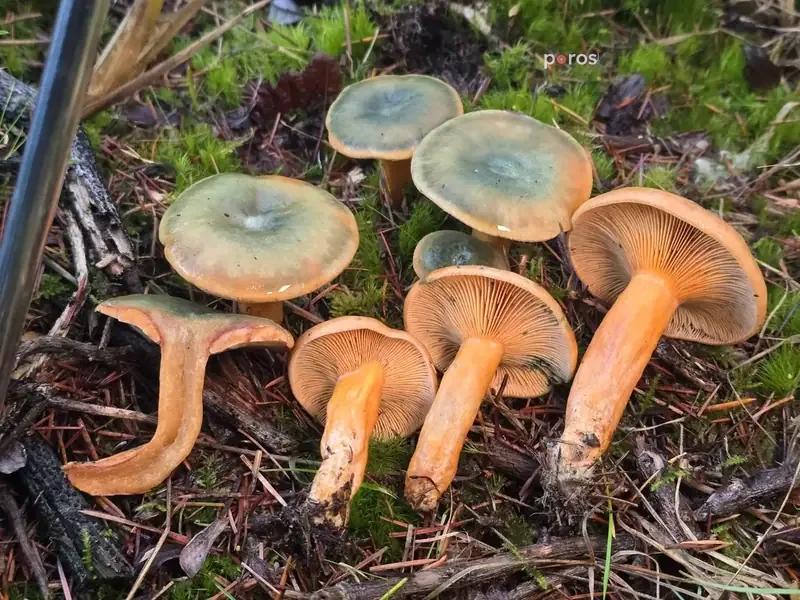 Saffron milk capLactarius deliciosusEdible species
-
 Weeping milk capLactifluus volemusEdible species
-
 False saffron milkcapLactarius deterrimusInedible
-
 Fiery milkcapLactarius pyrogalusInedible
-
 Salmon milkcapLactarius salmonicolorInedible
Sources
- T.C. Tarım ve Orman Bakanlığı, Orman Genel Müdürlüğü: Common Edible Mushrooms from Türkiye and the Mediterranean Basin (Russula delica, R. chloroides) ogm.gov.tr
- Acar, E. (2018), International Journal of Humanities and Education: Kastamonu ve yöresi ağızlarında mantar adları (266 ad, Latince karşılıklarıyla tablo) dergipark.org.tr
- Karakayalı, Z., Enes, K. ve Kanca, B. (2022), ODÜ Sosyal Bilimler Araştırmaları Dergisi: Giresun'da doğal olarak yetişen yenilebilir mantarların gastronomik değeri (yöresel adlar; Türkçe adlar Sesli vd. 2020 Türkiye Mantarları Listesi'nden) dergipark.org.tr
All sources (9)
- Acar, E. (2016), Uluslararası Sosyal Araştırmalar Dergisi 9(43): Sinop ve yöresi ağızlarında mantar adları sosyalarastirmalar.com
- Bulam, S., Pekşen, A. ve Üstün, N. Ş. (2022), Mantar Dergisi 13 (özel sayı): 144–156, Ethnomycological Studies in Anatolia from Past to Present (yöresel adlar derlemesi) dergipark.org.tr
- Wikipedia (EN): Russula delica en.wikipedia.org
- First Nature: Russula delica, Milk White Brittlegill first-nature.com
- GBIF: Türkiye kayıtları gbif.org
- iNaturalist: Türkiye gözlemleri inaturalist.org
Photo credits (5)
- File:Gemeine Weiß-Täubling Russula delica.jpg · Holger Krisp · CC BY 3.0
- File:Russula delica (52409134111).jpg · Claude PAGE · CC BY-SA 4.0
- Russula delica · iNaturalist #316453298 · open_a_ir · CC BY 4.0
- File:Milk-white Russula^ Russula delica - Flickr - gailhampshire.jpg · gailhampshire from Cradley, Malvern, U.K · CC BY 2.0
- Russula delica · iNaturalist #56718889 · Виктория Билоус · CC BY 4.0


