
Silverleaf fungus (silver leaf)
Chondrostereum purpureum · Cyphellaceae

The silverleaf fungus (Chondrostereum purpureum) is a thin fungus that spreads as a crust or small shelves on dead and weakened hardwoods, with a smooth purple underside and a grey-white hairy top. It causes silver leaf disease, which gives the leaves of plum, cherry, apple and apricot trees a silvery sheen. It is not edible.
Also called: silverleaf fungus, silver leaf Turkish: Chondrostereum purpureum Synonyms: Stereum purpureum, Thelephora purpurea
Last updated: Prepared by the Poros Mantar editorial team5 sources checkedReport a correction
Silverleaf fungus photos
-
© Fluff Berger · CC BY-SA 4.0
-

© Alexis Tinker-Tsavalas · CC BY 4.0
-

© Hana Váchová · CC BY 4.0
-

© Dan Vickers · CC BY 4.0
-

© mister_bumble · CC BY 4.0
-

© Guillaume Delaitre · CC BY 4.0
-

© Mark Richman · CC BY 4.0
-

© Jose Gutierrez Higa · CC BY 4.0
-

Smooth underside© Thomas · CC0
-

Cap© Óscar Sampedro · CC BY 4.0
-
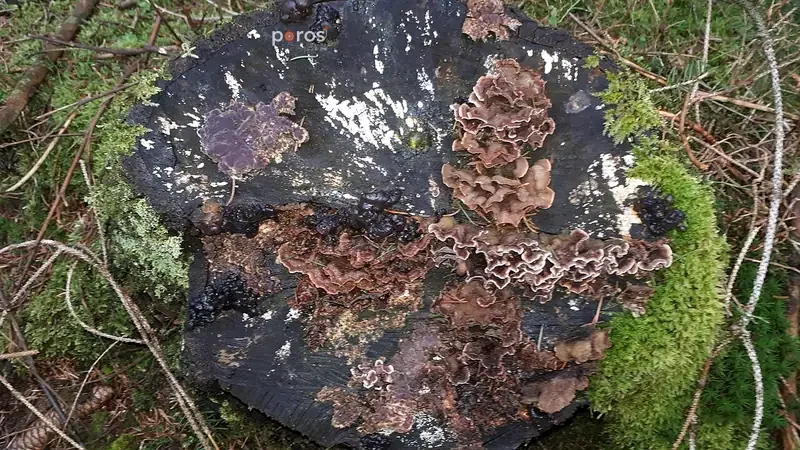
In habitat© Markus Krieger · CC BY 4.0


These are licensed records of this species; photos alone are not enough to identify a mushroom.
Is the silverleaf fungus poisonous?
The silverleaf fungus is not known to be poisonous, but it is thin and leathery and not edible.
Is the silverleaf fungus edible?
No. It is thin and leathery and not edible; it is not known to be poisonous.
How to recognise it
Appearance of silverleaf fungus
No ring or volva Spore print: White Not distinctive.
When and where
When to find silverleaf fungus
Feb–Mar, Oct–Dec
It fruits from autumn to spring in cool, damp weather; our Turkish records fall between October and March.
Where does silverleaf fungus grow?
It grows on dead or wounded hardwoods, on cut surfaces, stumps and log piles, commonly on birch, poplar, willow, beech and fruit trees. It enters trees through pruning wounds.
Where is silverleaf fungus found in Turkey?
Our map data (GBIF and iNaturalist) holds 11 Turkish records: Istanbul (9), Kırklareli (1), Ankara (1). The records are from February, March, October, November, December. GBIF lists 18 Turkish records in total, including literature surveys.
Which months
- Jan0
- Feb1
- Mar6
- Apr0
- May0
- Jun0
- Jul0
- Aug0
- Sep0
- Oct1
- Nov1
- Dec1
3 provinces, 10 observations (GBIF, iNaturalist); months from observation dates. Record density also reflects where observers work.
Latest silverleaf fungus observations
-
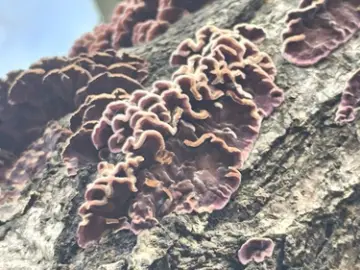 İstanbul14 Feb 2026 · iNaturalist© Umut Nuri Erdoğan · CC BY
-
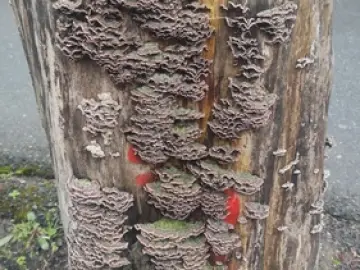 İstanbul13 Mar 2024 · iNaturalist© Umut Nuri Erdoğan · CC BY
-
 Illustrative
Kırklareli17 Oct 2026 · iNaturalist
-
 Illustrative
İstanbul24 Mar 2026 · iNaturalist
-
 Illustrative
İstanbul24 Mar 2026 · iNaturalist
-
 Illustrative
İstanbul12 Mar 2026 · iNaturalist
-
 Illustrative
Ankara7 Mar 2025 · iNaturalist
-
 Illustrative
İstanbul5 Dec 2024 · iNaturalist
- See on the map
On "illustrative" cards the image is a photo of the species; the observation photo cannot be shown here because of its licence, but can be seen at the source.
Look-alikes
What could it be confused with?
Silverleaf fungus can be mistaken for the species below. Each comparison shows Silverleaf fungus on the left, the look-alike on the right, and how to tell them apart.

Hairy curtain crust Stereum hirsutum
How to tell The hairy curtain crust also has a smooth underside, but it is yellow-orange, not purple.

Smoky bracket Bjerkandera adusta
How to tell The smoky bracket has tiny smoky grey to black pores underneath; its underside is not smooth.
Silverleaf fungus and its look-alikes compared
| Species | Status | Underside | Spore print | Season |
|---|---|---|---|---|
| Silverleaf fungusChondrostereum purpureum | Inedible | Smooth, without pores | White | Feb–Mar, Oct–Dec |
| Hairy curtain crustStereum hirsutum | Inedible | The underside is smooth, with no pores or gills | White | Dec–May, Jul–Oct |
| Smoky bracketBjerkandera adusta | Inedible | Smoky grey to blackish, very small pores, separated from the upper layer by a thin dark line | White | Oct–Feb, May, Jul |
The table is compiled from each species page. The status column is a guide only; do not eat a wild mushroom unless an expert has seen it in person. Compare look-alikes side by side
The silverleaf fungus is not known to be poisonous, but it is thin and leathery and not edible. Because it causes silver leaf disease in orchards, pruning tools are kept clean and pruning is done in dry weather. If poisoning is suspected, call poison control.
Frequently asked questions
Is the silverleaf fungus poisonous?
The silverleaf fungus is not known to be poisonous, but it is thin and leathery and not edible.
Is the silverleaf fungus edible?
No. It is thin and leathery and not edible; it is not known to be poisonous.
How do you identify it?
A thin fungus spreading as a crust or small shelves on dead or cut hardwood, grey and hairy on top with a smooth, bright purple underside.
What can it be confused with?
The main look-alikes are: Hairy curtain crust, Smoky bracket. The differences are listed in the look-alikes section; with poisonous look-alikes, always check the cross-section and habitat.
Where does it grow?
It grows on dead or wounded hardwoods, on cut surfaces, stumps and log piles, commonly on birch, poplar, willow, beech and fruit trees. It enters trees through pruning wounds.
When does it appear?
It fruits from autumn to spring in cool, damp weather; our Turkish records fall between October and March.
What is silver leaf disease?
The fungus enters through pruning or break wounds and releases a toxin; leaf tissues separate and the leaves take on a silvery sheen. Plum and cherry are worst affected, and in severe cases branches die back.
Is it used in plant protection?
Yes. In North America and Europe it is registered as a biological agent to stop cut stumps of unwanted trees from resprouting.
Is it found in Turkey?
Our map data (GBIF and iNaturalist) holds 11 Turkish records: Istanbul (9), Kırklareli (1), Ankara (1). The records are from February, March, October, November, December. GBIF lists 18 Turkish records in total, including literature surveys.
When is silverleaf fungus season in Turkey?
In our calendar, silverleaf fungus season runs Feb–Mar, Oct–Dec. It fruits from autumn to spring in cool, damp weather; our Turkish records fall between October and March.
Where does silverleaf fungus grow?
It grows on dead or wounded hardwoods, on cut surfaces, stumps and log piles, commonly on birch, poplar, willow, beech and fruit trees. It enters trees through pruning wounds.
Where is silverleaf fungus found in Turkey?
Our map data (GBIF and iNaturalist) holds 11 Turkish records: Istanbul (9), Kırklareli (1), Ankara (1). The records are from February, March, October, November, December. GBIF lists 18 Turkish records in total, including literature surveys.
What can silverleaf fungus be confused with?
Silverleaf fungus can be confused with hairy curtain crust (Stereum hirsutum, inedible) and smoky bracket (Bjerkandera adusta, inedible). Look-alikes are compared on this page.
What is silverleaf fungus called in Turkish?
In Turkish, silverleaf fungus (Chondrostereum purpureum) is called Chondrostereum purpureum.
Related species
-
 Amethyst deceiverLaccaria amethystinaInedible
-
 Anemone stinkhornAseroe rubraInedible
-
 Artist’s bracketGanoderma applanatumInedible
-
 Barometer earthstarAstraeus hygrometricusInedible
-
 Birch polyporeFomitopsis betulinaInedible
-
 Bitter boleteTylopilus felleusInedible
-
 Bitter oysterPanellus stipticusInedible
-
 Black witches’ butterExidia glandulosaInedible
Sources
- Wikipedia (EN): Chondrostereum purpureum en.wikipedia.org
- iNaturalist: Chondrostereum purpureum (takson, adlar ve fotoğraflar) inaturalist.org
- GBIF: Chondrostereum purpureum gbif.org
All sources (5)
- GBIF: Türkiye kayıtları gbif.org
- iNaturalist: Türkiye gözlemleri (araştırma düzeyi) inaturalist.org
Photo credits (13)
- Chondrostereum purpureum · iNaturalist #18218903 · Fluff Berger · CC BY-SA 4.0
- Chondrostereum purpureum · iNaturalist #36994353 · Alexis Tinker-Tsavalas · CC BY 4.0
- Chondrostereum purpureum · iNaturalist #195945403 · Hana Váchová · CC BY 4.0
- Chondrostereum purpureum · iNaturalist #328073235 · Dan Vickers · CC BY 4.0
- Chondrostereum purpureum · iNaturalist #37002531 · mister_bumble · CC BY 4.0
- Chondrostereum purpureum · iNaturalist #66656579 · Guillaume Delaitre · CC BY 4.0
- Chondrostereum purpureum · iNaturalist #19410754 · Mark Richman · CC BY 4.0
- Chondrostereum purpureum · iNaturalist #339613743 · Jose Gutierrez Higa · CC BY 4.0
- Chondrostereum purpureum · iNaturalist #64532086 · Thomas · CC0
- Chondrostereum purpureum · iNaturalist #143342726 · Óscar Sampedro · CC BY 4.0
- File:Chondrostereum purpureum 62177174.jpg · Markus Krieger · CC BY 4.0
- iNaturalist: İstanbul, 14 Feb 2026 · Umut Nuri Erdoğan · CC BY
- iNaturalist: İstanbul, 13 Mar 2024 · Umut Nuri Erdoğan · CC BY
