Mushrooms don't have seeds the way plants do. They reproduce by microscopic spores, and what growers call “mushroom seed” is spawn: mycelium, the fungus's thread-like body, grown on sterilised grain. The easiest way to start at home is a ready-made block that the mycelium has already colonised.
The short answer: no seeds, just spores and mycelium
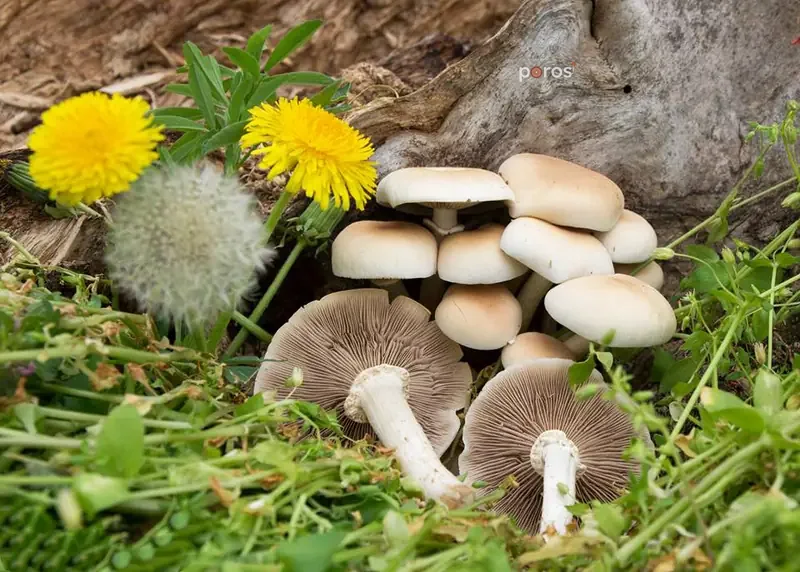
Mushrooms have no seeds; they reproduce by spores released from the gills or pores under the cap. A single spore is invisible to the naked eye. The coloured dust you get by leaving a cap on paper for a few hours (a spore print) is millions of spores seen together; individual spores need a microscope.
When a spore lands somewhere suitable, it germinates and grows fine threads called hyphae. As these branch and tangle, they form a network called mycelium. That is the real organism: it lives inside soil, wood or straw, breaking down food with the enzymes it releases and absorbing the result. The mushroom we see in the woods is only its fruit, much as an apple is the fruit of the tree.
So when people search for “mushroom seeds”, they usually mean either spores or mycelium. What growers actually buy is almost always a material carrying mycelium. Below we separate the three, then explain how to start with each.
This has a practical consequence: “planting” mushrooms isn’t burying seeds in soil like a plant; it’s preparing the food the mycelium likes and bringing the two together cleanly. That’s why growers pasteurise straw, sterilise grain and keep bags in the dark. The sections below go through each link in that chain.
Spores, mycelium and spawn: the differences
All three are stages of the same journey; what matters to a grower is knowing which one is in your hands. In brief:
- Spores: the fungus's reproductive cells. They are tiny and collect as dust. You can start from spores at home, but it is slow and unpredictable: you can't know in advance what the germinating spores will produce, and contamination is common.
- Mycelium: the thread-like body that grows from germinated spores and covers any food source like a white web. Wikipedia describes it as a root-like structure made of branching, thread-like hyphae.
- Spawn: mycelium grown on a sterile carrier, usually grain. According to Penn State Extension, spawn production starts by sterilising a mixture of grain, water and chalk; mycelium is then added and colonises the grain. Commercial button mushroom spawn is made on millet, rye or wheat.
- Grow block (kit): spawn mixed into straw, sawdust or another substrate and fully colonised by mycelium. It is the last stage before fruiting.
In short: the “mushroom seed” on sale is usually spawn, mycelium living on grain. Not spores, and certainly not seeds.
How grain spawn is made, and why it's hard at home
Grain spawn is made from a pure culture under sterile conditions, and that sterility is exactly what makes it hard at home. Cooked grain is as good a food for moulds and bacteria as it is for mushroom mycelium. If the grain isn't sterilised under pressure, or the inoculation isn't done somewhere clean, green mould (usually Trichoderma) takes over instead.
The process runs in order: mycelium is taken from a pure culture, inoculated into sterilised grain, and kept warm and dark until every kernel turns white. Penn State's description of commercial production follows the same sequence: sterilisation, then mycelium, then active growth.
Doing this safely at home needs a pressure cooker, a clean inoculation area and a pure culture. Some people try to grow mycelium from a supermarket mushroom's stem or spores. It can work, but you can't control which strain you end up with or whether it's contaminated. We don't recommend it for a first attempt: it takes time, and failure usually ends in mould.
How to tell healthy mycelium and spawn
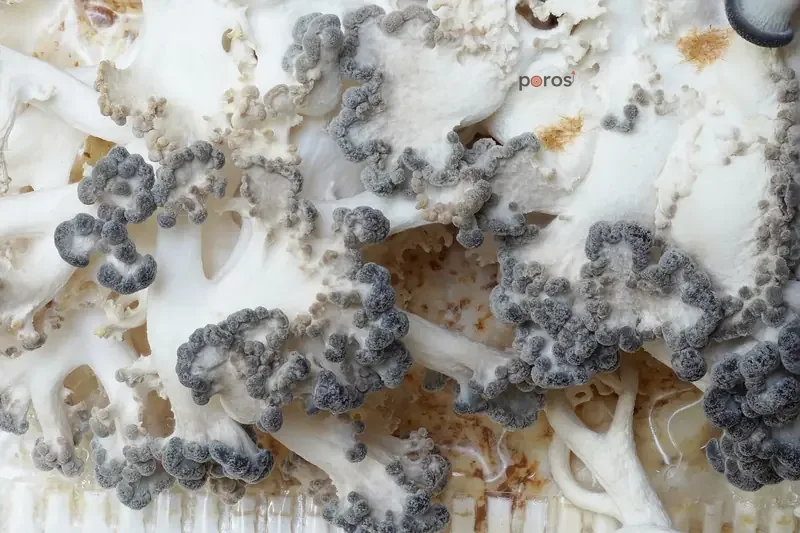
Healthy mycelium looks white, dense and even; coloured patches are almost always a sign of something else growing. Whether you're working with spawn, a bag or a ready-made block, the most useful skill is knowing what to look for. The UF/IFAS guide covers mycelium growth and contamination in oyster mushroom bags in detail; the list below draws on it and on the observations in our kit articles.
As mycelium grows, the bag or grain turns steadily paler until the whole mass knits together like white felt. UF/IFAS says this stage takes 2–3 weeks in the dark for an oyster bag, and fruiting begins once the bag is completely white. Brown bits of straw showing through the white are fine; the mycelium will cover them in time.
- White and dense: healthy mycelium. If the bag or grain has firmed up and the kernels stick together, colonisation is nearly complete.
- Green, blue, black or yellow patches: UF/IFAS lists these as signs of unwanted mould or bacteria. The most common is Trichoderma, a fast-spreading green mould.
- Sour or rotten smell, slimy wetness: usually bacterial contamination, often when grain or straw stayed too wet.
- Light contamination: UF/IFAS says a partly contaminated bag may still give at least one flush; heavily contaminated bags should be thrown away. Never eat mushrooms growing from a mouldy patch.
If you see these signs on a ready-made kit, it usually isn't your fault; report it to the seller with a photo. More in why didn't my mushroom kit fruit.
How to use spawn: straw, sawdust or compost
Spawn isn't buried like a seed; it's mixed into the substrate the species likes. The right substrate depends on the species, and it is the most important decision in growing:
- Straw: the most common substrate for oyster mushrooms. The University of Florida (UF/IFAS) home guide describes cutting wheat straw into 10–12 cm pieces, soaking it overnight and pasteurising it in water at 74 °C (165 °F) for 1–2 hours. Once cool, spawn is mixed in at 5–10% by weight or volume and packed firmly into a bag.
- Sawdust and logs: wood-loving species such as shiitake grow on hardwood sawdust or logs. They take longer and need patience.
- Compost: the button mushroom (Agaricus bisporus) grows on a special compost of straw and manure matured in two phases. Penn State says the whole cycle, from making compost to cleaning up after harvest, takes about 14 weeks.
- Prepare the substrate: cut, soak and pasteurise straw, or moisten sawdust.
- When it's cool enough to handle, mix in the spawn with clean hands or gloves.
- Pack the mix tightly into a bag; UF/IFAS says it should feel like a firm pillow.
- Make small holes in the bag and keep it dark and warm (about 24–25 °C / 75–77 °F) until the mycelium has colonised the whole bag, which takes 2–3 weeks for oyster mushrooms.
- Once the bag is completely white, move it somewhere bright, humid and well ventilated; pins will form at the holes.
Oyster-specific details are in how to grow oyster mushrooms at home. We don't sell spawn, straw or compost; if you want to buy materials locally, choose a well-established producer.
Why morel and truffle “seeds” don't work
Morel and truffle “seeds” won't produce mushrooms at home, because these species live lives too complex to imitate in a bag of straw. They are two of the most searched-for “seeds”, so they deserve a separate word.
People have been trying to cultivate morels (Morchella) for more than a century. According to the sources Wikipedia brings together, large-scale attempts have rarely succeeded, and the commercial morel trade still relies mainly on wild harvests. Indoor cultivation has advanced in recent years, but that came from climate-controlled facilities and long experimentation, not from a jar of spawn on a balcony.
Truffles depend on tree roots. They form a partnership (mycorrhiza) with the roots of trees such as oak and hazel and fruit underground. Truffle growing means planting seedlings whose roots have been inoculated with truffle mycelium in suitable soil; Wikipedia notes that Tasmania's first truffle harvest came after eight years of work with inoculated trees. Growing truffles is a matter of orchards and years, not pots. More in where truffles grow in Turkey.
The easiest way to start: a ready-made block
For a first-time home grower, the easiest route is a ready-made block that the mycelium has already fully colonised. Spawn, pasteurisation, sterile work and the mould risk are all behind you; your job is to give the mushrooms the right conditions to fruit: light, humidity and fresh air.
Oyster mushrooms are the most forgiving species for this. Our oyster mushroom grow kit works on that principle: open the box and mist it a few times a day. Step-by-step instructions are in how to use a mushroom grow kit, and if something goes wrong see why didn't my mushroom kit fruit. For every method in one place, see our growing mushrooms at home guide.
To decide, ask yourself one question: do you want to watch mushrooms grow and cook them, or learn every stage of production? For the first, a ready-made block is enough. For the second, learning the growing conditions with a block first and then moving on to a straw bag leads to far fewer disappointments.
FAQ
Where can I buy mushroom seeds?
What's sold as “mushroom seed” is spawn: mycelium grown on grain. Buy it fresh and labelled from an established producer. For a first try, a ready-made, fully colonised grow block is easier than spawn.
Do morels have seeds?
Morels have no seeds either. Even if morel spawn is on sale, don't expect it to fruit at home; large-scale attempts have rarely succeeded and the morel trade relies mainly on wild harvests.
Can I grow mycelium from supermarket mushrooms?
Cloning tissue from a stem is possible but needs sterile technique; contamination is common and you can't control the strain. We don't recommend it for a first attempt.
How should mushroom spawn be stored?
Spawn is alive and isn't meant to be kept for long. Store it as the producer instructs and use it soon; it weakens and becomes more prone to mould the longer it waits.
What's the difference between spawn and a grow kit?
Spawn is mycelium on grain, waiting to be mixed into a substrate. A kit is a block the mycelium has already colonised, ready to fruit. With a kit, pasteurisation and inoculation are already done.
Can you see mushroom spores?
A single spore is invisible to the naked eye and needs a microscope. A spore print, made by leaving a cap on paper, shows millions of spores together, and its colour helps with identification.
What is oyster mushroom spawn and how do you use it?
Oyster mushroom spawn is sterilised grain colonised by oyster mushroom mycelium. You mix it with a pasteurised substrate such as straw, sawdust or coffee grounds, pack it into a bag with holes and keep it somewhere cool and dark until the mycelium turns the substrate white. Then you open the bag and give it light and humidity.
Can you grow oyster mushroom spawn on coffee grounds?
Yes, oyster mushrooms are one of the few species that grow well on spent coffee grounds. Use fresh, clean grounds before they turn mouldy.
Can you make mushroom spawn at home?
You can, but it needs sterile technique: grain is sterilised in a pressure cooker and inoculated from a clean culture. Mould contamination is common at home, so we suggest starting with bought spawn or a kit.
Sources
- Penn State Extension — Mushrooms: Production and Harvesting (spawn ve üretim adımları) extension.psu.edu
- UF/IFAS EDIS — D.I.Y. FunGuide: Grow Your Own Oyster Mushrooms at Home (SS662) ask.ifas.ufl.edu
- Wikipedia (EN) — Mycelium en.wikipedia.org
All sources (6)
- Wikipedia (EN) — Spore print en.wikipedia.org
- Wikipedia (EN) — Morchella (Cultivation) en.wikipedia.org
- Wikipedia (EN) — Truffle (Cultivation) en.wikipedia.org
Last updated: 2 November 2026