
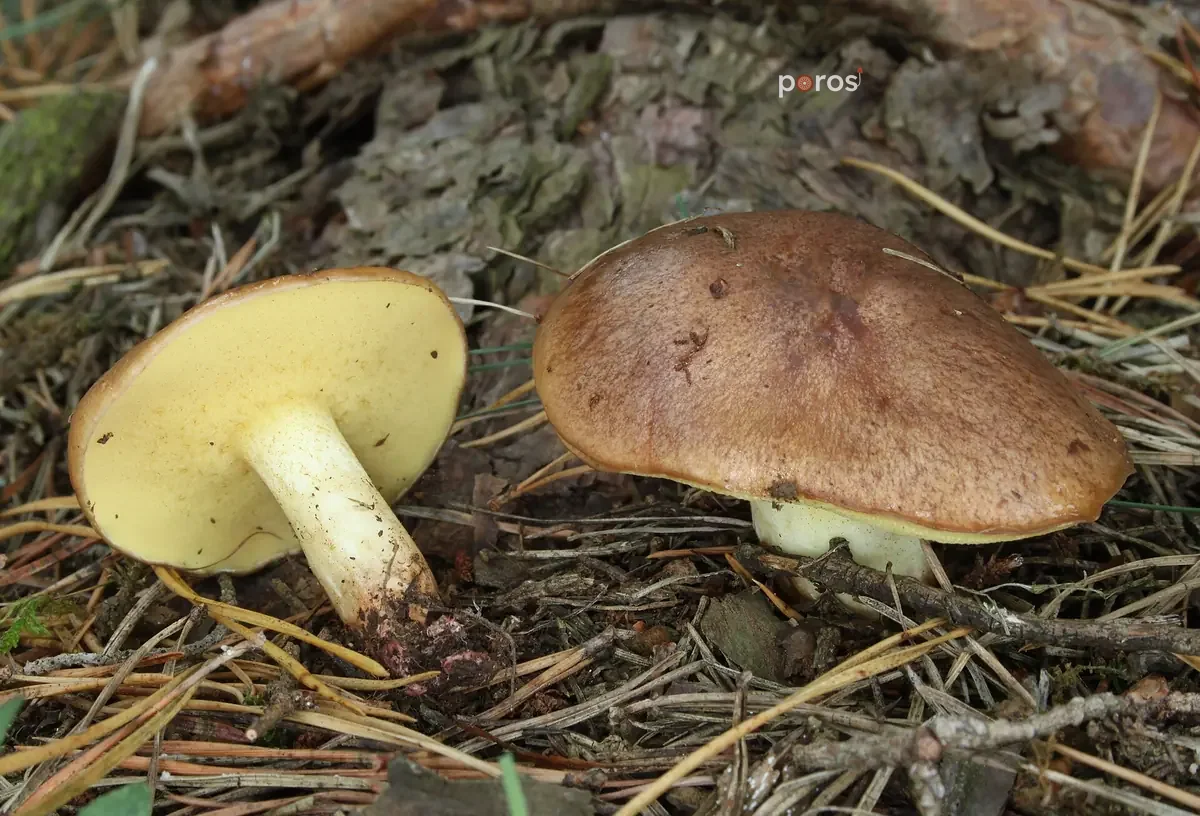


Suillus collinitus
Suillus collinitus · Suillaceae
Suillus collinitus is a pine-associated bolete with a chestnut to reddish-brown cap that is slimy when damp, yellow pores and no ring.
Last updated: Prepared by the Poros Mantar editorial team4 sources checkedReport a correction
Suillus collinitus is a pine-associated bolete with a chestnut to reddish-brown cap that is slimy when damp, yellow pores and no ring. The pink mycelium at the stem base is its clearest mark. Some sources say it is edible when well cooked, but the slimy cap skin can cause diarrhoea and allergic reactions in some people; our advice is not to eat it.
Also called: pink-based slippery jack Turkish: Beneklisünger mantarı Synonyms: Boletus collinitus, Suillus fluryi
How to recognise it
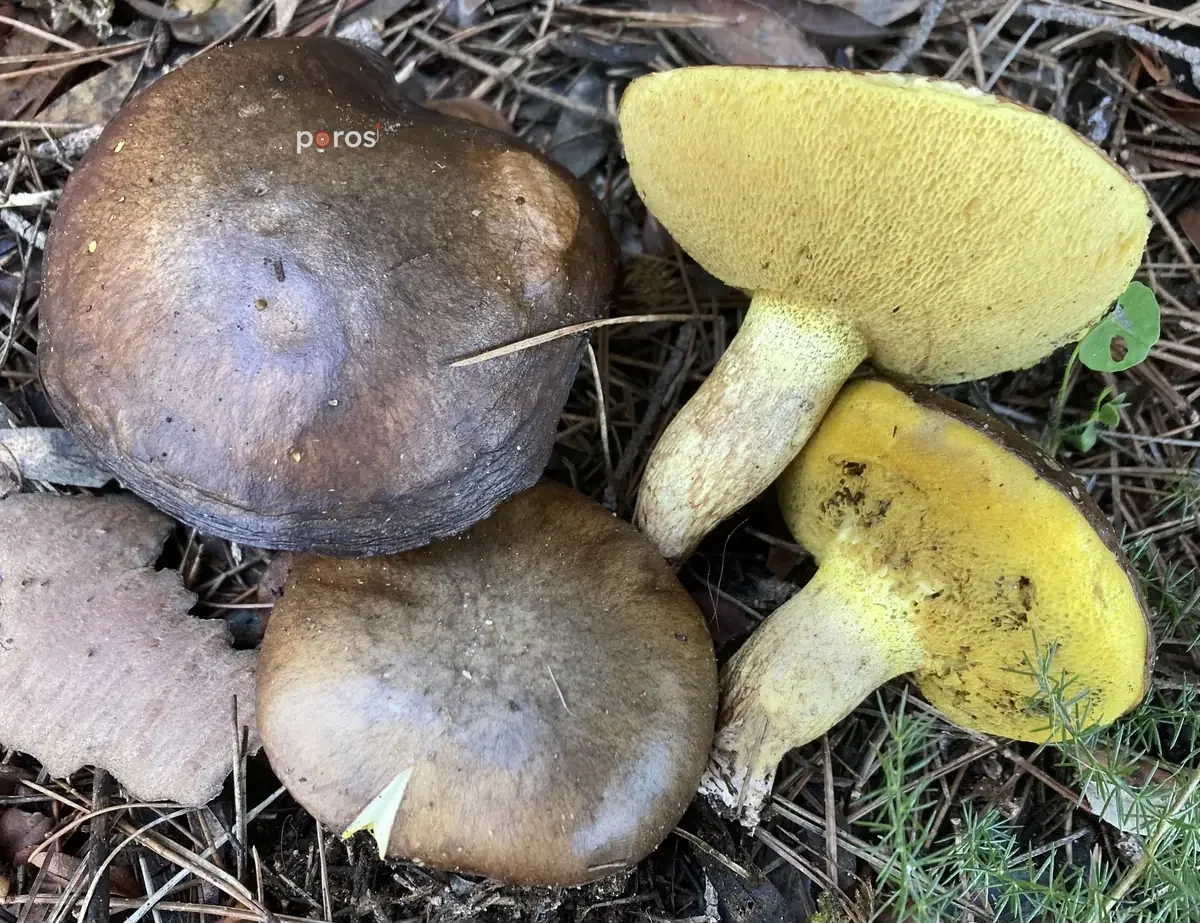
Suillus collinitus, part by part
No ring or volva Spore print: Ochre-brown Mild and not distinctive; yellow flesh that does not change colour when cut.


When and where
May, Aug–Jan
- Janin season
- Feb
- Mar
- Apr
- Mayin season
- Jun
- Jul
- Augin season
- Sepin season
- Octin season
- Novin season
- Decin season
In mild climates it fruits from autumn into midwinter. Our Turkish records fall in January, May and August to December, mostly in October and December.
Type Inedible
Months seen JanuaryMayAugustSeptemberOctoberNovemberDecember
Regions Black Sea RegionCentral Anatolia RegionMediterranean RegionAegean RegionMarmara RegionManisaIspartaSamsunAnkaraSakaryaBoluBursaIstanbul
Where does suillus collinitus grow?
It lives only with pines, such as Turkish red pine, Aleppo pine and black pine, mostly on calcareous soils, and is common in Mediterranean pine forests. It grows from soil singly or in groups.
Where is suillus collinitus found in Turkey?
Our map data (GBIF and iNaturalist) holds 15 Turkish records: 5 from Istanbul, 3 from Ankara, 2 from Manisa and one each from Sakarya, Isparta, Samsun, Bolu and Bursa. A specimen collected on the Bolu–Abant road also appears in a study published on DergiPark (Akkoyunlu et al., 2025, Anatolian Journal of Botany).
Which months
- Jan1
- Feb0
- Mar0
- Apr0
- May3
- Jun0
- Jul0
- Aug1
- Sep1
- Oct4
- Nov1
- Dec4
8 provinces, 15 observations (GBIF, iNaturalist); months from observation dates. Record density also reflects where observers work.
Latest suillus collinitus observations
-
 Manisa21 Dec 2023 · iNaturalist© Umut Nuri Erdoğan · CC BY
-
 Illustrative
Bursa31 Oct 2026 · iNaturalist
-
 Illustrative
Sakarya27 Oct 2025 · iNaturalist
-
 Illustrative
Ankara22 Sep 2025 · iNaturalist
-
 Illustrative
Ankara25 May 2025 · iNaturalist
-
 Illustrative
Ankara8 May 2025 · iNaturalist
-
 Illustrative
İstanbul9 Dec 2024 · GBIF
-
 Illustrative
Isparta26 Aug 2024 · GBIF
- See on the map
On "illustrative" cards the image is a photo of the species; the observation photo cannot be shown here because of its licence, but can be seen at the source.
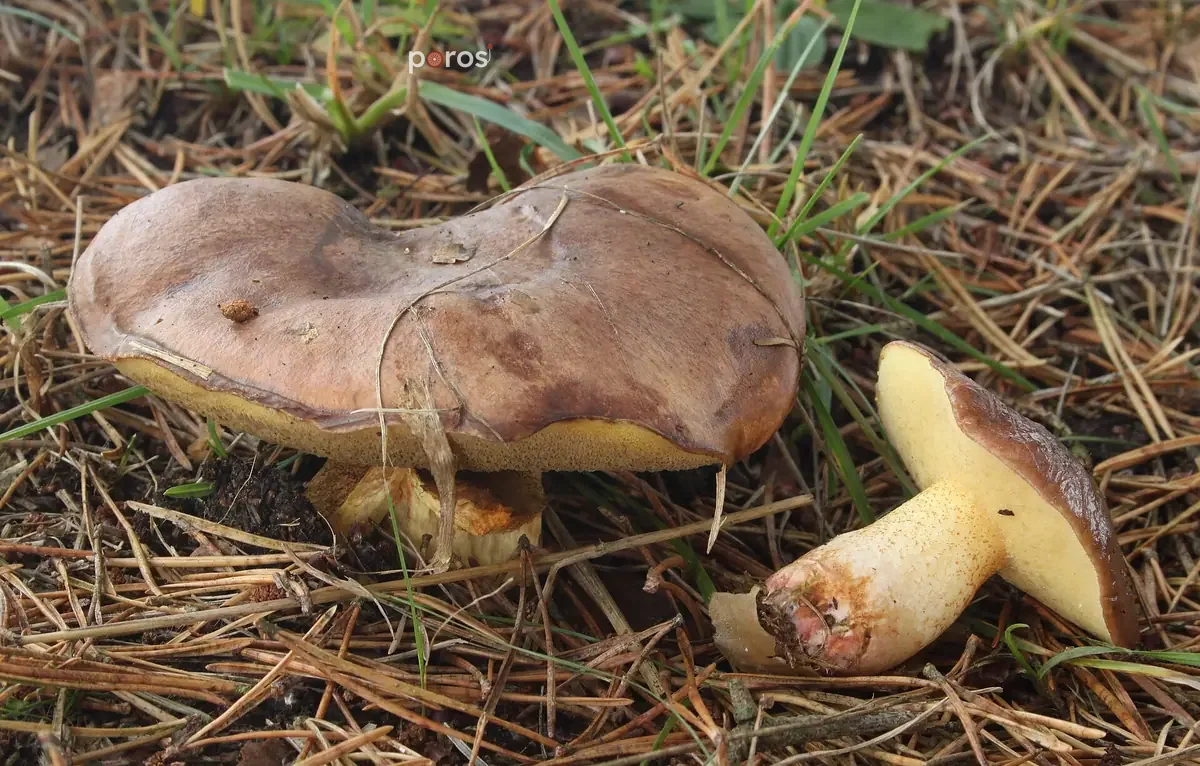
Look-alikes
What could it be confused with?
Suillus collinitus can be mistaken for the species below. Each card shows the look-alike and how it differs from Suillus collinitus.
 Edible species
not Suillus collinitus
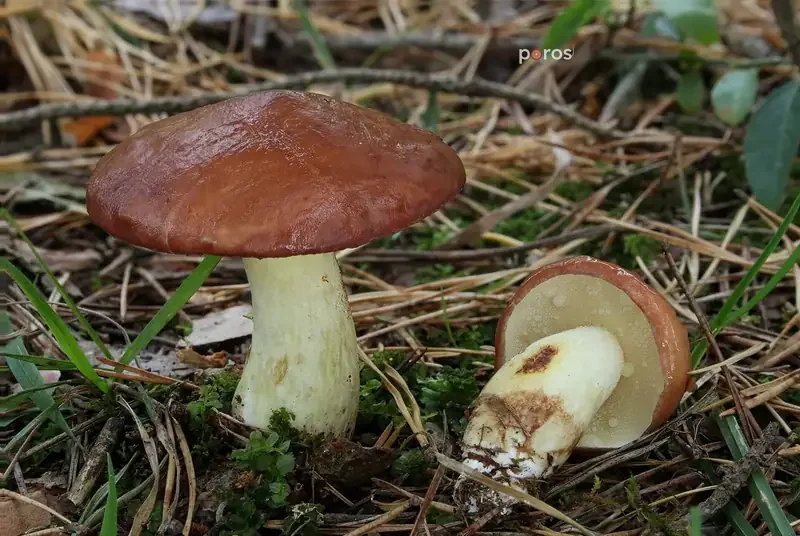
Weeping bolete Suillus granulatus
Its closest look-alike; the cap is paler orange-brown, there is no pink mycelium at the stem base and young pores weep milky droplets.
 Deadly
not Suillus collinitus
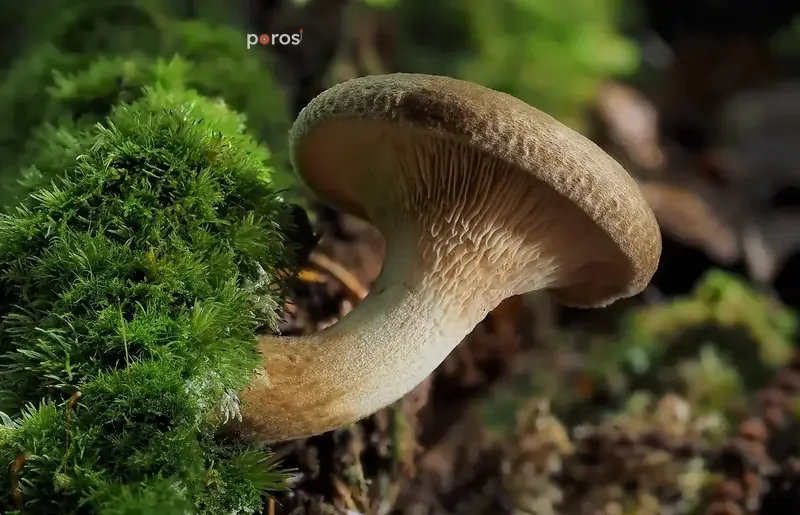
Brown roll-rim Paxillus involutus
Its cap is also brown and sticky when damp, but it has gills running down the stem instead of pores, an inrolled cap margin and bruises brown.
 Edible species
not Suillus collinitus
Slippery jack Suillus luteus
It has a distinct membranous ring on the stem; Suillus collinitus never has one.
What it contains
Its culinary value is moderate to low; the flesh is soft and watery. Extracts of specimens collected in Turkey have been studied in the laboratory for antioxidant, genotoxic and antifungal effects; this does not mean any use in people.
General information, not a health claim.
Some sources say Suillus collinitus is edible when well cooked, but its slimy cap skin can cause diarrhoea and allergic reactions in some people, and boletes can be confused with poisonous species. Our advice is not to eat it. If poisoning is suspected, call poison control and keep any leftover mushroom.
Frequently asked questions
Is Suillus collinitus edible?
Our advice is not to eat it. Some sources say it is edible when well cooked, but the slimy cap skin can cause diarrhoea and allergic reactions in some people.
Is it poisonous?
It is not considered deadly; the main problems are that the slimy cap skin can upset digestion and that it can be confused with poisonous species.
What is the easiest way to recognise it?
Look for the combination of pine trees, a slimy chestnut cap, yellow pores, a ringless stem and pink mycelium at the stem base.
How does it differ from the weeping bolete?
The weeping bolete has a paler cap, its young pores weep milky droplets and it lacks the pink mycelium at the stem base.
Which trees does it grow under?
Only under pines, especially Turkish red pine, Aleppo pine and black pine, often on calcareous soil.
When does it appear?
From autumn into midwinter; most of our Turkish records are from October and December.
Does it change colour when cut?
No, its yellow flesh does not noticeably change colour when cut, unlike many boletes that turn blue.
Where is it found in Turkey?
Our map data holds 15 records from Istanbul, Ankara, Manisa, Sakarya, Isparta, Samsun, Bolu and Bursa.
When is suillus collinitus season in Turkey?
In our calendar, suillus collinitus season runs May, Aug–Jan. In mild climates it fruits from autumn into midwinter. Our Turkish records fall in January, May and August to December, mostly in October and December.
Where does suillus collinitus grow?
It lives only with pines, such as Turkish red pine, Aleppo pine and black pine, mostly on calcareous soils, and is common in Mediterranean pine forests. It grows from soil singly or in groups.
Where is suillus collinitus found in Turkey?
Our map data (GBIF and iNaturalist) holds 15 Turkish records: 5 from Istanbul, 3 from Ankara, 2 from Manisa and one each from Sakarya, Isparta, Samsun, Bolu and Bursa. A specimen collected on the Bolu–Abant road also appears in a study published on DergiPark (Akkoyunlu et al., 2025, Anatolian Journal of Botany).
What can suillus collinitus be confused with?
Suillus collinitus can be confused with weeping bolete (Suillus granulatus, edible species), brown roll-rim (Paxillus involutus, deadly) and slippery jack (Suillus luteus, edible species). Look-alikes are compared on this page.
What is suillus collinitus called in Turkish?
In Turkish, suillus collinitus (Suillus collinitus) is called Beneklisünger mantarı.
Related species
-
Weeping boleteSuillus granulatusEdible species
-
 Amethyst deceiverLaccaria amethystinaInedible
-
 Artist’s bracketGanoderma applanatumInedible
-
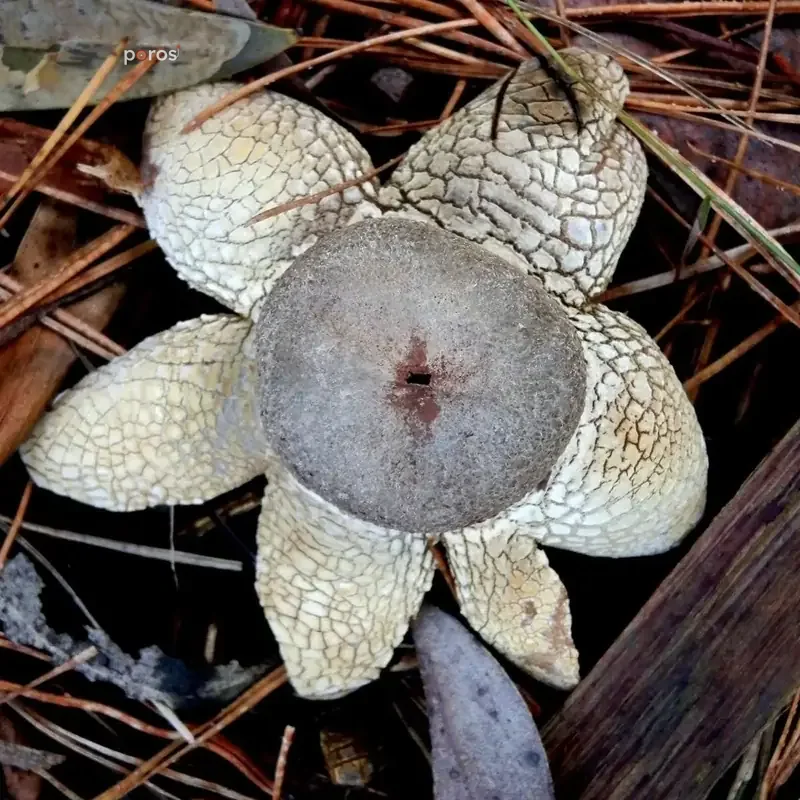 Barometer earthstarAstraeus hygrometricusInedible
-
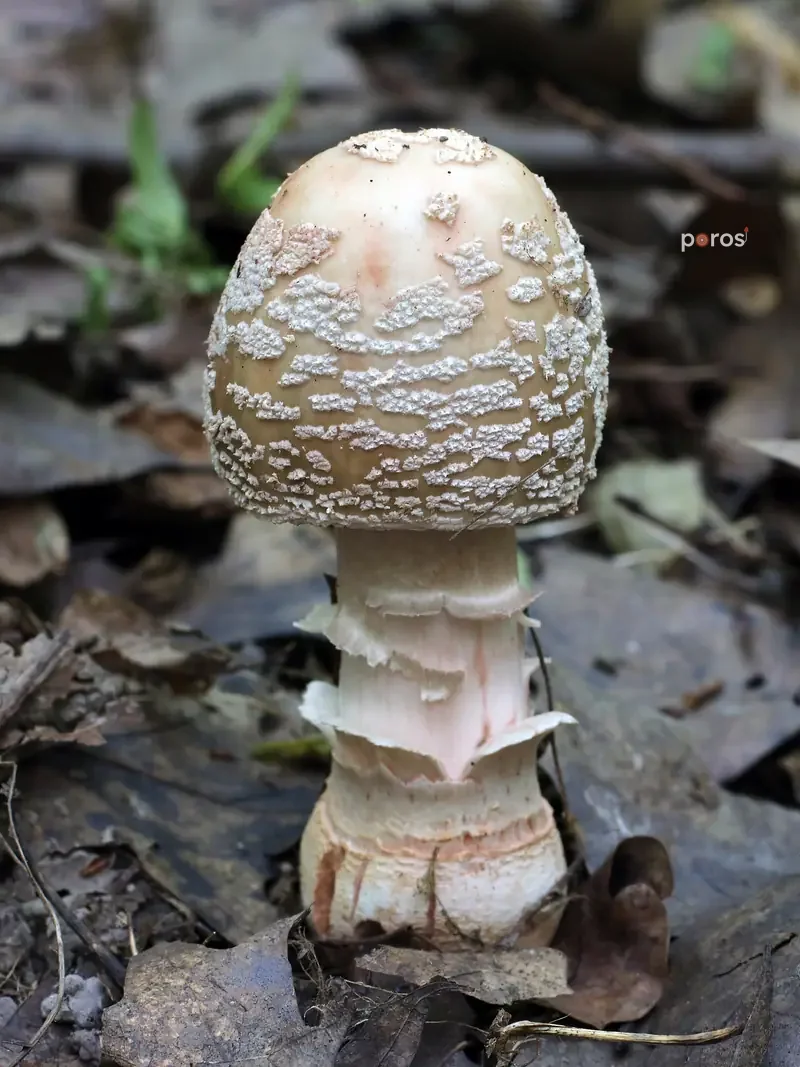 BlusherAmanita rubescensInedible
-
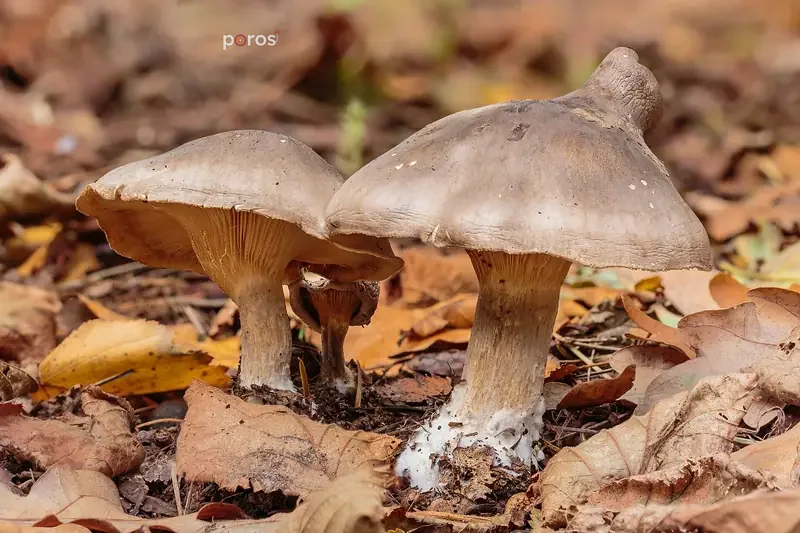 Clouded funnelClitocybe nebularisInedible
-
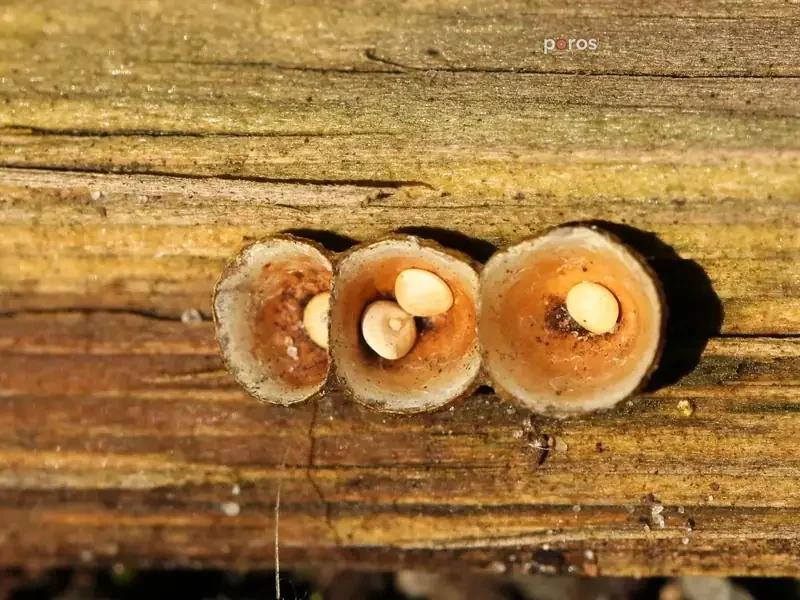 Common bird’s nest fungusCrucibulum laeveInedible
-
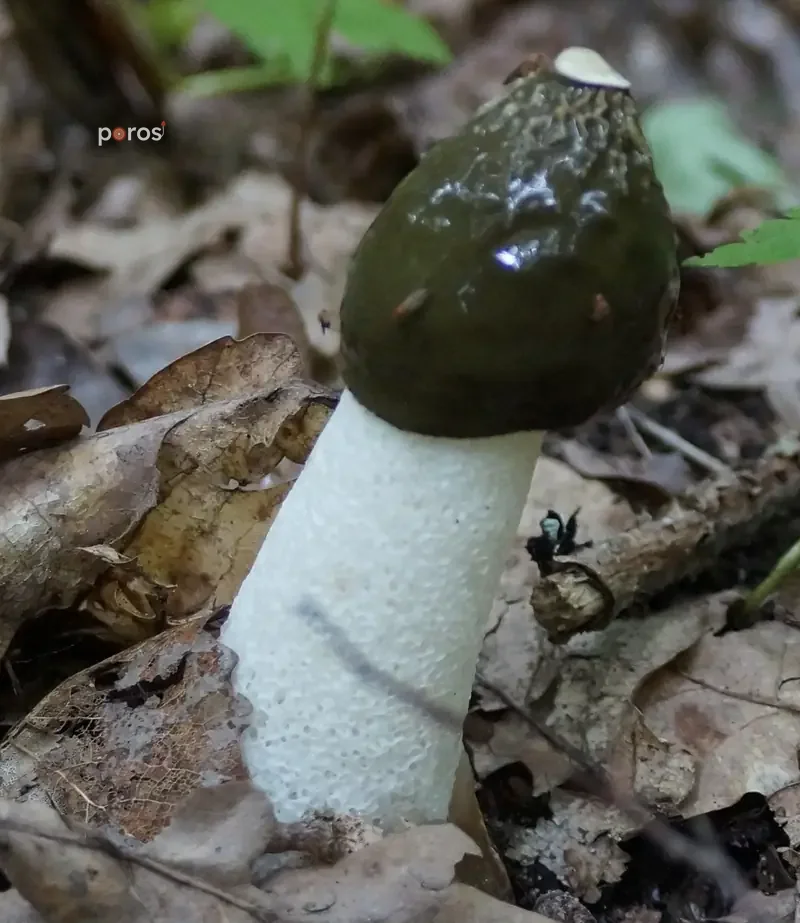 Common stinkhornPhallus impudicusInedible
Sources
- Akkoyunlu, Dülger ve Dülger (2025), Anatolian Journal of Botany 9(1): 11-15: Evaluation of antifungal activities of the ethanolic extract of the macrofungus Suillus collinitus against dermatophytes dergipark.org.tr
- Wikipedia (EN): Suillus collinitus en.wikipedia.org
- iNaturalist: Suillus collinitus (Türkçe ad ve Türkiye gözlemleri) inaturalist.org
All sources (4)
- GBIF: Türkiye kayıtları gbif.org
Photo credits (9)
- File:Ringloser Butterpilz Suillus collinitus.jpg · Holger Krisp · CC BY 3.0
- Suillus collinitus · iNaturalist #329076713 · Lucian Clanet · CC BY 4.0
- Suillus collinitus · iNaturalist #252085778 · Pieter Prins · CC BY-SA 4.0
- Suillus collinitus · iNaturalist #329076713 · Lucian Clanet · CC BY 4.0
- Suillus collinitus · iNaturalist #320381217 · Gergely Nigg · CC BY 4.0
- Suillus collinitus · iNaturalist #327686963 · Daniel Ghyselinck · CC BY 4.0
- Suillus collinitus · iNaturalist #247800309 · Kristian Bosak · CC BY 4.0
- File:Ringlose Butterpilz Suillus collinitus.jpg · Holger Krisp · CC BY 3.0
- iNaturalist: Manisa, 21 Dec 2023 · Umut Nuri Erdoğan · CC BY

