Mushroom poisonings rise in autumn because rain triggers fruiting, people go foraging in those weeks, and the most dangerous species, the death cap, appears at the same time. In a study of 420 patients in Turkey's central Black Sea region, 57.6 percent of emergency visits came in the autumn months. Most fatal mushroom poisonings in Turkey are caused by the death cap, whose symptoms begin hours after the meal.
Why do mushroom poisonings rise in autumn?
Mushroom poisonings rise in autumn because three factors coincide: rain triggers fruiting, people head into the woods to forage in those weeks, and the most dangerous poisonous species appear at the same time. When the soil has been soaked a few times after the summer drought, edible and poisonous species come up together, and an abundance of mushrooms also raises the chance that an inexperienced forager gets it wrong.
The pattern is not unique to Turkey. A report on a death cap poisoning outbreak in California notes that abundant early rain followed by warm weather coincided with an unusually large death cap bloom around San Francisco Bay, and that inexperienced foraging added to the risk. The authors note that weather alone does not prove cause, but that rain and warmth contributed substantially to mushroom growth.
What does the data from Turkey show?
Data from Turkey show that mushroom poisonings cluster in rainy seasons. A medical specialty thesis at Ondokuz Mayıs University examined 420 patients who came to the emergency department of a university hospital in the central Black Sea region with mushroom poisoning over five years: 57.6 percent of visits were in the autumn months, and mushrooms accounted for 13.3 percent of all poisonings.
Autumn is not the only peak. The Turkish Ministry of Health announced that in one spring, mushroom poisoning consultations in April and May rose 34 percent on the same period of the previous year, and linked the rise to increased rainfall. In both seasons, the common factor is rain.
- Central Black Sea, 420 patients: 57.6 percent of visits in autumn; median time to first symptom 2 hours; 2 of the 47 patients with raised liver enzymes died (OMÜ thesis).
- Ministry of Health, spring period: a 34 percent rise in consultations, attributed to rainfall.
- California outbreak: 14 patients, 3 liver transplants; a heavy death cap bloom after rain and warm weather (CDC MMWR).
Which species causes most fatal poisonings?
The great majority of fatal mushroom poisonings in Turkey are caused by the death cap (Amanita phalloides); Turkish Wikipedia puts the figure at around 90 percent. The same source records that serial poisonings caused by this mushroom one November in Istanbul killed more than 20 people.
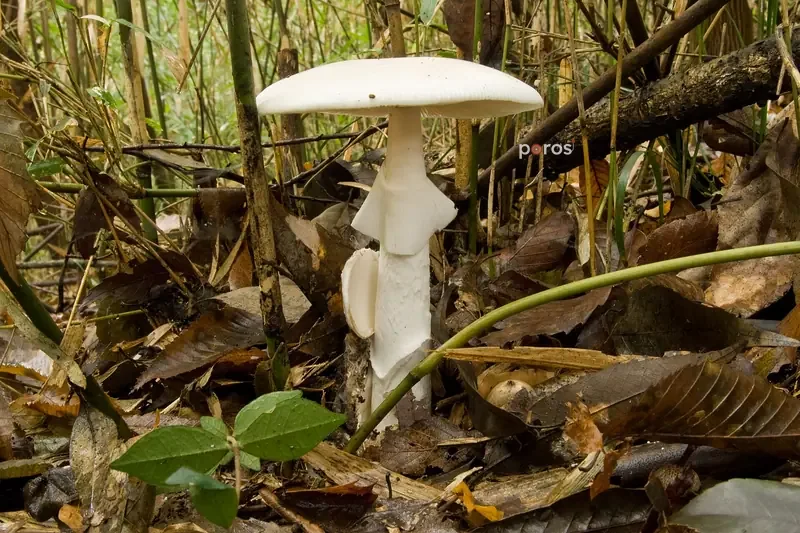
In Europe the death cap fruits from July to November, and Turkish observation records cluster in August and in October–November. So autumn's foraging weeks are also the weeks this species is most often seen. Its white relative, the destroying angel, which carries the same toxins, and the wood-growing funeral bell (Galerina marginata) are autumn species too.
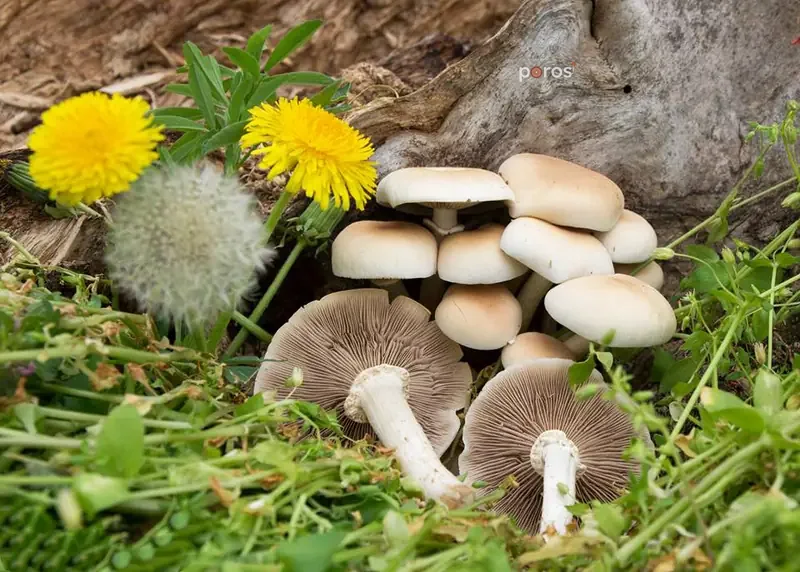
All of these contain amatoxins. The young, unopened death cap can be mistaken for edible mushrooms, and its white relative for button and field mushrooms. We show look-alikes side by side on our poisonous mushrooms page.
Why are delayed symptoms a trap?
Delayed symptoms are a trap because the most dangerous mushrooms cause no complaints in the first hours, so people assume what they ate was harmless. According to Turkish Wikipedia, the first symptoms of death cap poisoning begin 8–12 hours after eating. Wikipedia describes how these first gastrointestinal symptoms are followed by a deceptive recovery lasting up to a few days while liver damage continues. In the California outbreak, symptoms began between 4 and 12 hours after eating, and 3 patients needed a liver transplant.
In milder poisonings, by contrast, symptoms start quickly: in the central Black Sea study the median time to the first symptom was 2 hours. That is why “nothing happened for a few hours, so it must be safe” is wrong. We explain symptom timing and what it means in mushroom poisoning symptoms.
The authors of the California report point out that symptoms resembling viral gastroenteritis can progress to liver toxicity.
Why are village-market, roadside and gifted mushrooms risky?
Wild mushrooms sold at village markets or by the roadside, or given as a gift, are risky because it is unclear who picked them, where, and who confirmed the species. Some patients in the California outbreak had not picked the mushrooms themselves: one woman cooked mushrooms given to her by someone she didn't know, who had reportedly picked them in the mountains, and shared them with her household; two elderly women received wild mushrooms from a friend.
The Turkish Ministry of Health's advice is clear: don't eat wild mushrooms, choose packaged and labelled cultivated mushrooms instead. If you do buy wild mushrooms at market, at least ask for the scientific name and where they were picked, and don't buy from sellers who can't tell you. Even sought-after autumn species such as the saffron milk cap can be mixed with poisonous look-alikes; we explain how to tell them apart in saffron milk cap look-alikes.
- Don't accept wild mushrooms from strangers, and don't cook gifted mushrooms until the species is confirmed.
- Don't buy from a crate where different species are mixed.
- Don't give away mushrooms you picked; the responsibility for identification passes to you.
- If you forage yourself, see our mushroom foraging guide for rules and equipment.
Does cooking destroy mushroom toxins?
No, cooking does not destroy deadly mushroom toxins. According to Tox Info Suisse, the amatoxins in the death cap survive boiling, frying, drying, pickling and freezing. The Turkish Ministry of Health's warnings also advise against eating wild mushrooms; there is no kitchen method that makes a poisonous mushroom safe.
The same misconception shows up in folk tests. A silver spoon, onion or garlic turning black does not reveal a poisonous mushroom; the Catalan health department states plainly that these tests do not work. Nor is it reassuring that a snail or insect has eaten it. The only reliable method is correct identification of the species; we collect general rules in how to tell if a mushroom is poisonous.
How can you reduce the risk in mushroom season?
The way to reduce the risk in mushroom season is to eat wild mushrooms only when they are identified with certainty, and not to leave identification to someone else's word. After the first autumn rains, when the woods fill up, enthusiasm rises too; remembering the rules below in those weeks prevents most of what ends up in the news. Telling children and older relatives not to touch or put in their mouths mushrooms found in gardens or parks is part of the same precaution.
- Don't eat any mushroom you can't identify with certainty; “probably” is not enough.
- When identifying a mushroom, look at cap, gills, stem, stem base, tree and place together, not one feature.
- Keep species separate in the basket; don't put an unknown mushroom next to edible ones.
- Don't test your finds by tasting them or with folk tests.
- Set aside an uncooked specimen of any wild mushroom you eat and keep it in the fridge; if in doubt, take it to the doctor.
If you suspect poisoning: call 112 and 114
If you have doubts after eating wild mushrooms, call 112 without waiting for symptoms and contact the National Poison Information Centre on 114. According to the Turkish Ministry of Health, the 114 line is open around the clock. With species that cause delayed symptoms, early treatment is decisive.
The Catalan health department's advice is practical: go to hospital straight away even if symptoms seem mild; take leftovers, peelings or the rest of the dish with you; and everyone who ate the same meal should seek medical attention, even without symptoms. Don't induce vomiting or try any home remedy.
Prevention is always easier than treatment. See which species appear in autumn in our mushroom calendar, and get a first idea about a find from our identify by photo tool; but a photo is not enough to decide edibility.
FAQ
Can mushroom poisoning kill you?
Yes, some species are deadly. Most fatal mushroom poisonings in Turkey are caused by the death cap, whose toxin damages the liver and whose symptoms start hours later. If in doubt, call 112 without waiting for symptoms and contact 114.
Which poisonous mushrooms appear in autumn?
The most dangerous are the death cap, the destroying angel and the wood-growing funeral bell; all three contain amatoxins. Turkish death cap records cluster in August and October–November.
Are wild mushrooms from a market safe?
Not by default; it is unclear who picked them and who confirmed the species. The Turkish Ministry of Health recommends packaged, labelled cultivated mushrooms instead of wild ones.
Why doesn't everyone at the table get sick at once?
People don't eat the same amount or the same pieces of mushroom, and age and body weight change the effect. That is why everyone who ate the dish should seek medical attention, even without symptoms.
Why take a mushroom sample to hospital?
Identifying the mushroom eaten helps determine the toxin involved and the treatment. Take leftovers, peelings or the rest of the dish with you.
Does cooking destroy mushroom toxins?
No. Death cap amatoxins survive boiling, frying, drying, pickling and freezing. No kitchen method makes a poisonous mushroom safe.
Sources
- Habertürk — Sağlık Bakanlığı'ndan mantar zehirlenmelerine karşı uyarı haberturk.com
- Vo KT ve ark. — Amanita phalloides Mushroom Poisonings, Northern California, December 2016. MMWR 2017;66(21):549–553 (PMC) pmc.ncbi.nlm.nih.gov
- Altuntaş M. — Acil servise mantar intoksikasyonu nedeni ile başvuran hastaların retrospektif olarak değerlendirilmesi (Tıpta uzmanlık tezi, Ondokuz Mayıs Üniversitesi) acikerisim.omu.edu.tr
All sources (7)
- Vikipedi (TR) — Köygöçüren mantarı (Amanita phalloides) tr.wikipedia.org
- Wikipedia (EN) — Amanita phalloides en.wikipedia.org
- Tox Info Suisse — Toxic tales from daily life at the Tox: Mushrooms toxinfo.ch
- Generalitat de Catalunya — Health recommendations (mantar mevsimi) tramits.gencat.cat
Last updated: 2 November 2026