
Mains Eastern European and Turkish home cooking
Honey fungus beef stew
Honey fungus caps parboiled, then simmered with beef for 20 minutes; a hearty, saucy stew finished with celery and bean sprouts.
- Prep
- 20 min
- Cook
- 1 hr 35 min
- Serves
- 4
- Difficulty
- Medium
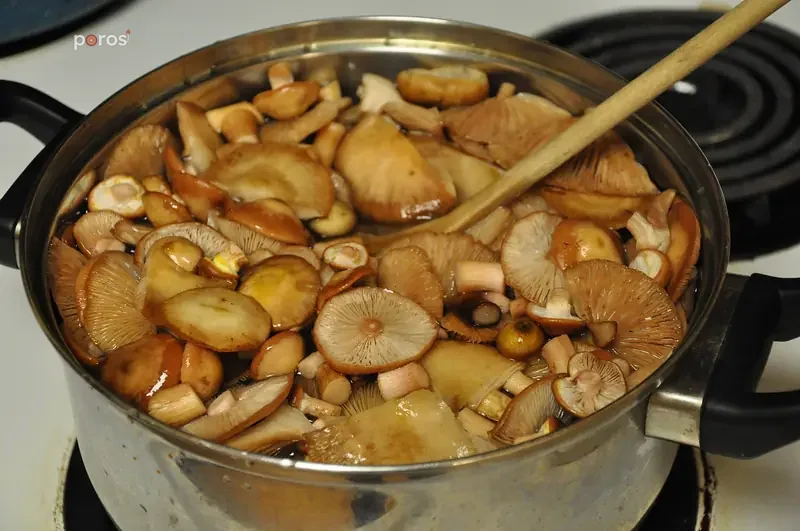
Honey fungus (Armillaria mellea) fruits in clusters at the base of stumps in autumn and is much loved in Eastern Europe. It must never be eaten raw or undercooked: sources advise cooking the caps thoroughly and parboiling them for 5 minutes, discarding the water, if they taste bitter. In this recipe the caps are parboiled and then simmered in the stew for 20 minutes.
Never eat a mushroom you haven't identified with certainty: deadly Galerina can grow mixed into honey fungus clusters. Even well cooked, honey fungus upsets some people's stomachs, so try a small amount the first time.
Ingredients
Tick them off as you go.
For the stew
Method
Tap a step when it's done; in cook mode the next one is highlighted.
-
Check every honey fungus one by one to make sure no other species (above all deadly Galerina) is mixed into the cluster. Remove the stems, parboil the caps in boiling salted water for 5 minutes and discard the water.
~10 min -
Heat the oil in a heavy pot and brown the beef in batches on all sides; set aside.
~12 min -
Return all the beef to the pot with the onions and water. Cover and simmer gently for 60 minutes.
~1 hr -
Add the parboiled caps (and a little more water if needed) and simmer for another 20 minutes. Never cook honey fungus for less than this.
~20 min -
Stir in the celery, soy sauce and flour paste and cook for 2–3 minutes until the celery is tender but still a little crisp.
~3 min -
Add the bean sprouts, cover and take off the heat; they cook in the steam in about 5 minutes. Season with pepper and serve with rice.
~5 min
Enjoy!
The mushroom in this recipe

Mushroom swaps
 Nameko Pholiota microsporaIf you can't find honey fungus, use the same weight of nameko; it needs no parboiling, add it for the last 10 minutes.
Tips
- Use only young, firm caps; the stems are fibrous and tough.
- Throw away the parboiling water; don't add it to the sauce.
- The original recipe uses pork; beef takes longer, so the first simmer is extended to 60 minutes.
Storage
The stew keeps for 2 days in a covered container in the fridge; reheat until boiling. Cook fresh honey fungus the day you pick it.
Frequently asked questions
How long does Honey fungus beef stew take?
It takes 1 hr 55 min in total: 20 minutes of preparation and 95 minutes of cooking.
Which mushroom is used for Honey fungus beef stew?
This recipe uses Honey fungus.
What other mushrooms work for Honey fungus beef stew?
Nameko: If you can't find honey fungus, use the same weight of nameko; it needs no parboiling, add it for the last 10 minutes.
How do you store Honey fungus beef stew?
The stew keeps for 2 days in a covered container in the fridge; reheat until boiling. Cook fresh honey fungus the day you pick it.
What should you watch for when making Honey fungus beef stew?
Use only young, firm caps; the stems are fibrous and tough. Throw away the parboiling water; don't add it to the sauce.
How many does Honey fungus beef stew serve?
The quantities serve 4; change the number of servings on the page and the ingredients adjust.
Adapted from: Mycological Society of San Francisco — Pork Stew with Honey Mushrooms; parboiling and try-a-little advice from the same page
If you liked this
All recipes Mains
Turkish mushroom sauté
A classic Turkish sauté of button mushrooms, peppers, tomatoes and tomato paste – perfect with rice and ready in 35 minutes.
35 min
Button mushroom
 Mains
Mushroom pilaf (mantarlı pilav)
Buttery Turkish rice pilaf with browned mushrooms, cooked so every grain stays separate and fluffy.
1 hr 10 min
Button mushroom
 Soups
Shiitake ramen
Homemade ramen with a deeply savoury broth of dried shiitake and kombu, finished with miso, crisp fresh shiitake and soy-marinated eggs.
1 hr 20 min
Shiitake
Kitchen guides
Before you cook: clean, store, dry
 How to clean mushroomsPractical ways to clean everything from button mushrooms to morels without waterlogging them or ruining their texture.
 How to store mushroomsHow to keep fresh, cooked, frozen and dried mushrooms at their best — and how to tell when they’ve gone bad.
 How to dry mushroomsA step-by-step guide to drying mushrooms at home in the oven, in a dehydrator or on a string — and how to store and rehydrate them.